Proof Techniques - Stanford Computer Science
our proof might rely on special properties of the number 3 that don’t generalize to all odd numbers). ... By de nition, an odd number is an integer that can be written in the form 2k + 1, for some integer k. This means we can write x = 2k + 1, where k is some integer. So x 2= (2k + 1) = 4k2 + 4k + 1 = 2(2k2 + 2k) + 1. Since k is an
Download Proof Techniques - Stanford Computer Science

Information
Domain:
Source:
Link to this page:
Documents from same domain

EPIGENETICS COURSERA CLASS: LECTURE WEEK 1
cs.stanford.eduepigenetics coursera class: lecture week 2 Acetylation or Methylation (among other things) can happen at Nterminal tails of histones. Various molecules can bind to histones, some suggest there is a “histone code”, as these all

KAREL THE ROBOT - Stanford Computer Science
cs.stanford.eduthe word Karel in a Karel program represents the entire class of robots that know how to respond to the move() , turnLeft() , pickBeeper() , and putBeeper() commands. Whenever you have an actual robot in the world, that robot is an object that represents a
Designing Fast Absorbing Markov Chains - Stanford University
cs.stanford.eduMarkov Chains and Absorption Times A discrete Markov chain (Grinstead and Snell 1997) Mis a stochastic process defined on a finite set Xof states.
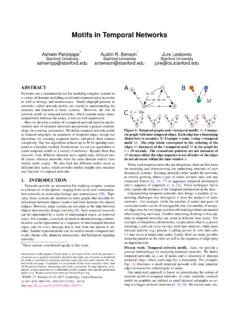
Motifs in Temporal Networks - Stanford University
cs.stanford.edumotifs defined by a constant number of temporal edges between 2 nodes, this general algorithm is optimal up to constant factors—it runs in O(m) time, where mis the number of temporal edges.
Statement of Purpose - Stanford University
cs.stanford.eduStatement of Purpose Jacob Steinhardt December 31, 2011 1 Career Goals The advent of the computer, together with Turing’s theory of universal computation, has revo-

Deep Visual-Semantic Alignments for Generating Image ...
cs.stanford.eduFigure 2. Overview of our approach. A dataset of images and their sentence descriptions is the input to our model (left). Our model first infers the correspondences (middle, Section3.1) and then learns to generate novel descriptions (right, Section3.2).
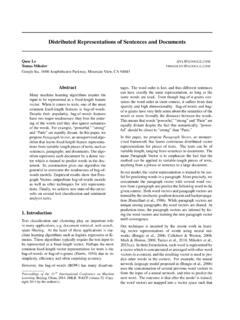
Distributed Representations of Sentences and Documents
cs.stanford.eduunique vector, represented by a column in matrix W. The paragraph vector and word vectors are averaged or concate-nated to predict the next word in a context. In the experi-ments, we use concatenation as the method to combine the vectors. More formally, the only change in this model compared to the word vector framework is in equation 1, where h is
Twitter Sentiment Classification using Distant Supervision
cs.stanford.edu1.2 Characteristics of Tweets Twitter messages have many unique attributes, which dif-ferentiates our research from previous research: Length The maximum length of a Twitter message is 140 characters. From our training set, we calculate that the average length of a tweet is 14 words or 78 characters. This

Guide to the MSCS Program Sheet
cs.stanford.edustatistics can usually be satisfied by any course in probability taught from a rigorous mathematical perspective. Courses in statistics designed for social scientists generally do not have the necessary sophistication. A useful rule of thumb is that courses satisfying this requirement must have a calculus prerequisite. 3.

Algorithms Graph Search
cs.stanford.eduGraphs have nodes and edges. How many nodes are there? How many edges? Graphs . ... Which explored the most area before finding the target? Do A* and BFS always find the same path? Theorem: If the heuristic function is a lower bound for the ... Do Dijkstra and weighted A* ever find paths of different lengths?
Related documents

Thermal properties of phonons - University of Michigan
www-personal.umich.eduTherefore, expHä k a NL = 1, so k a N = 2 pn where n is an integer. So k = (5.18) 2 pn a N = 2 pn L were, a N = L is just the length of the system. Notice here that k and k + 2 p’a gives exactly the same wave, expBä k + (5.19) 2 p a asF = expHäk as + ä2 psL = expHäk asLexpHä2 psL = expHäk asL So we will only need to consider -p’a < k ...
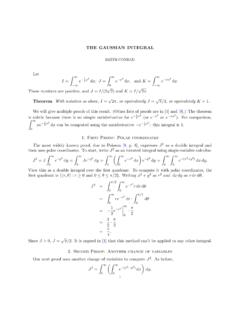
THE GAUSSIAN INTEGRAL - University of Connecticut
kconrad.math.uconn.eduFor any integer n 0, we have n! = Z 1 0 tne tdt. For x>0 we de ne ( x) = Z 1 0 txe t dt t; so ( n) = (n 1)! when n 1. Using integration by parts, ( x+ 1) = x( x). One of the basic properties of the -function [15, pp. 193{194] is (6.1) ( x)( y) ( x+ y) = Z 1 0 tx 1(1 t)y 1 dt:
Sets and set operations - University of Pittsburgh
people.cs.pitt.edu4 CS 441 Discrete mathematics for CS M. Hauskrecht Equality Definition: Two sets are equal if and only if they have the same elements. Example: • {1,2,3} = {3,1,2} = {1,2,1,3,2} Note: Duplicates don't contribute anythi ng new to a set, so remove them. The order of the elements in a set doesn't contribute
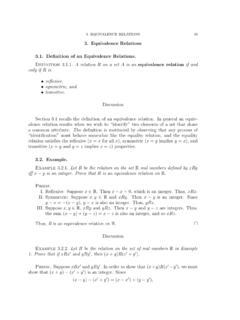
3. Equivalence Relations 3.1. Definition of an Equivalence ...
www.cs.fsu.edutransitive (x = y and y = z implies x = z) properties. 3.2. Example. Example 3.2.1. Let R be the relation on the set R real numbers defined by xRy iff x−y is an integer. Prove that R is an equivalence relation on R. Proof. I. Reflexive: Suppose x ∈ R. Then x−x = 0, which is an integer. Thus, xRx. II. Symmetric: Suppose x,y ∈ R and xRy.