Psychiatric Disorders
The result is… categorically defined disorders Bipolar Disorder A disorder affecting adults characterized by… Depressive episodes: e.g. sadness, anxiety, guilt, hopelessness Manic episodes: e.g. elevated/ irritable mood, racing thoughts, easily distracted
Download Psychiatric Disorders

Information
Domain:
Source:
Link to this page:
Documents from same domain
From Walking to Marathons - Science in the News
sitn.hms.harvard.eduFrom Walking to Marathons: The Role of Nutrition in Exercise. Roadmap Background: •Metabolism and Exercise Vignettes •Endurance Athletes and Carb Loading •Diabetes and Walking. ... Fact and fiction of carbohydrate loading •Carb loading is a …

You Are What Your Mother Ate: The Science of Epigenetics
sitn.hms.harvard.edu• Epigenetics is the study of heritable changes in gene activity that do not involve alterations to the genetic code • Epigenetic marks tell your genes to switch on or off
You Are What Your Mother Ate: The Science of Epigenetics
sitn.hms.harvard.eduSummary • Epigenetics is the study of heritable changes in gene activity that do not involve alterations to the genetic code • Epigenetic marks tell your genes to switch on or off • Two types of marks: chemical (e.g., methylation) or protein (e.g., histones) • Through epigenetic marks, environmental factors like diet, stress and prenatal nutrition can make an imprint on
Related documents

Birleson Self-Rating Scale for Child Depressive Disorder
www.scalesandmeasures.netdepressive diagnosis (Major Depression or Dysthymia). The predictive value of the ... and conduct disorder and emotional disorders including school refusal. Many had isolated depressive symptoms and a depressed appearance at interview. Most had histories of parental loss or rejection, and discordant and conflicted family ...

DSM-5 Depressive Disorders: Diagnostic and Treatment ...
www.lacounseling.org•Depressive Disorders are common and treatable •Be sure your diagnosis is part of an overall case formulation •Remember: To understand the disorder, you need to understand the person (Hippocrates) References American Psychiatric Association. (2013).

Persistent Depressive Disorder (Dysthymia) 300.4 (F34.1)
images.pearsonclinical.comdepressive disorder. If full criteria for a major depressive episode have been met at some point during the current episode of illness, they should be given a diagnosis of major depressive disorder. Otherwise, a diagnosis of other specified depressive disorder or unspecified depressive disorder is warranted.
Persistent Depressive Disorder (Dysthymia) 300.4 (F34.1)
images.pearsonclinical.comdepressive disorder. If full criteria for a major depressive episode have been met at some point during the current episode of illness, they should be given a diagnosis of major depressive disorder. Otherwise, a diagnosis of other specified depressive disorder or unspecified depressive disorder is warranted.

Depression and Other Common Mental Disorders
apps.who.intDepressive disorders include two main sub-categories: major depressive disorder / depressive episode , which involves symptoms such as depressed mood, loss of interest and enjoyment, and decreased energy; depending on the number and severity of symptoms, a depressive episode can be categorized as mild, moderate, or severe; and
CROSSWALK DSM-IV – DSM V – ICD-10 6.29
dhcfp.nv.govDepressive Disorders . F34.8 . Disruptive Mood Dysregulation Disorder . 296.xx ; Major Depressive Disorder __.__ Major Depressive Disorder .2X Single Episode __.__ Single episode F32.0 Mild F32.1 Moderate F32.2 Severe F32.3 With psychotic features F32.4 In partial remission F32.5 In full remission ...
Personality Disorders: Identification, Assessment, and ...
lms.rn.comFeb 03, 2012 · major depressive disorder, or other personality disorders (APA, 2013; Esterberg, Goulding, & Walker, 2010; Hoermann, Zupanick, & Dombeck, 2015a). Schizotypal Personality Disorder . Schizotypal personality disorder is seen as a pervasive pattern of social and interpersonal limitations (APA, 2013).
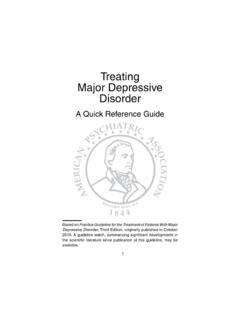
Treating Major Depressive Disorder - Psychiatry
psychiatryonline.orgthree remaining symptoms of the major depressive episode. • When selecting an initial treatment modality, consider the fol-lowing: • Severity of symptoms • Presence of co-occurring disorders or psychosocial stressors • Biological, psychological, and environmental factors con-tributing to the current episode of depression • Patient ...
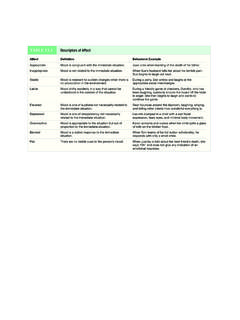
Mental Disorders TABLE 13.1 Descriptors of Affect
wps.prenhall.comthe mood disorders: major depressive symptoms, manic symptoms, or mixed symptoms. Clients often have diffi-culty maintaining job or school functioning, experience problems with self-care, are socially isolated, and often suf-fer from suicidal ideation. The age of onset is typically late adolescence or early adulthood.
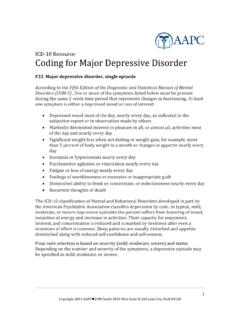
ICD‐10 Resource: Coding for Major Depressive Disorder
www.hamiltonhealth.comF33.1 Major depressive disorder, recurrent, moderate F33.2 Major depressive disorder, recurrent, severe without psychotic features F33.3 Major depressive disorder, recurrent, severe with psychotic features F33.4 Major depressive disorder, recurrent, in remission For a classification of in remission the patient has had two or more depressive