Qualitative data collection techniques
• Describe different types of data collection techniques • Demonstrate dimensions , type of observations and how to prepare and conduct observation • Understand the practical communication skills for interviews to ask good questions , probe and follow up questions • Able to prepare for interview
Download Qualitative data collection techniques

Information
Domain:
Source:
Link to this page:
Documents from same domain

Introduction to operations research - gfmer.ch
www.gfmer.chIntroduction to Operations Research Aminu Magashi Garba, MBBS, MSc.PH, DLSHTM Geneva Workshop 27th-31st August 2012 Training Course in Sexual and Reproductive Health Research

Introduction to Excel, Word and Powerpoint - …
www.gfmer.chIntroduction to Excel, Word and Powerpoint Developing Valuable Technology Skills! Shawn Koppenhoefer Training in Research in Reproductive Health/Sexual Health 2005. Excel spreadsheets ... Microsoft Word • What you should know – Opening a file (an existing file or a new file)

MENOPAUSE, PERIMENOPAUSE, POSTMENOPAUSE. - gfmer.ch
www.gfmer.chMenopause is the end point of a process. – Hormones are stable – Take care of the long term consequences of hypoestrogenisme. ...

ANATOMY OF THE CERVIX, SQUAMOCOLUMNAR JUNCTION ...
www.gfmer.chThe endocervix (endocervical canal) is a luminal cavity within the cervix forming a passageway between the external os and the internal os. The upper limit of the endocervical canal called the internal os or isthmus, marks the transition from the endocervix to …

Data Collection methods (Questionnaire & Interview)
www.gfmer.ch• Interviews consist of collecting data by asking questions. • Data can be collected by listening to individuals, recording, filming their responses, or a combination of methods. • There are four types of interview: 1. Structured interview 2. Semi-structured interview 3. In-depth interview 4. Focused group discussion

Abr é gé d Acupuncture - gfmer.ch
www.gfmer.chSyndromes du Qi, du Sang et des liquides organiques Thérapeutique Annexes Historique Points les plus utilisés Atlas des points d¶acupuncture Les Correspondances des cinq Mouvements Tableau récapitulatif des points Index 9 20 24 26 45 70 73 78 83 85 87 91 95 97 101 105 115 Introduction Yin ± Yang Constitution de l¶ Homme 5 Mouvements Zang ...

Formative research: What, why, and how
www.gfmer.chmanual for conducting formative research. University of Arizona, National Institutes of Health, University of the Philippines, 2005. Web. May 26, 2011. *Note: These two articles came from a special edition of the Journal of Perinatology which focused on Using Research for Improved Delivery of Newborn Health Interventions. Volume 28; December 2008.
Data collection instruments (questionnaire and interview)
www.gfmer.chAdvantages and disadvantages of interview Advantages: •Collect complete information with greater understanding. •It is more personal, as compared to questionnaires, allowing us to have higher response rates. •It allows for more control over the order and flow of questions.
Principles of Population and Demography
www.gfmer.chGlobal Handbook Family planning guidelines and tools The Medical Eligibility Criteria Wheel Reproductive Choices and Family Planning for People with HIV CIRE Guide to family planning for health care providers and New their clients 4th edition just published! 2010

QUALITATIVE SAMPLING TECHNIQUES
www.gfmer.chA flexible research and sampling design is an important feature of qualitative research, particularly when the research being conducted is exploratory in nature. When little is known about a phenomenon or setting, a priori sampling decisions can be difficult. In such circumstances, creating a research design that is flexible enough to foster
Related documents

VMware Infrastructure Architecture Overview
www.vmware.comA Host represents the aggregate computing and memory resources of a physical x86 server. For example, if the physical x86 server has four dual-core CPUs running at 4 GHz each and GB of system memory, then the Host will have GHz of computing power and GBs of memory available for running virtual machines that are assigned to it.

Chapter 9: Critical and Creative Thinking Skills
www.opdt-johnson.com3. Describe each part. 4. Describe the whole in terms each part Supporting a Statement: Use appropriate reasons, detail, or examples to support a statement, idea, or conclusion. Thinking Frame 1. Make a statement or claim. 2. Gather information/data to support the statement. 3. Organize the information. 4. Describe the original statement in ...
Technical Guide for PLC Basic - Omron
www.ia.omron.comCPU Unit Memory Area The PLC Unit utilizes a variety of different data including user programs, I/O Memory data and comments, CPU Unit and Special I/O units Parameters, and Registered I/O Table information etc. All of this data that is used by the …
FDCAN peripheral on STM32 devices - Application note
www.st.com• Give an overview of the controller area network (CAN) with flexible data-rate (CAN-FD) protocol. • Describe the improvements and benefits of CAN-FD over classical CAN (CAN2.0). • Present the CAN-FD implementation in the STM32 microcontrollers and microprocessors listed in …
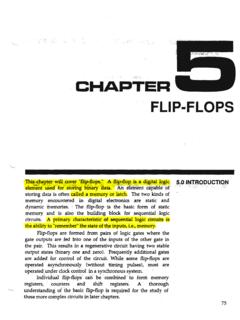
FLIP-FLOPS - California State University, Northridge
www.csun.edustoring data is often called a memory or latch. The two kinds of memory ,encountered in digital .. electr-onics ,are . static and dynamic' memories. ' The flip-flop ,is . the , basic form . ofs~atic . memory 'and is, also the ' building, block for sequential:1qgic circuits. A . ... • Define and describe the action of a flip-flop. ...

29.2 Numeric, Pointer, Bit Field, and String Data Types
cse.unl.eduperformed on numeric data types (signed and unsigned integers and BCD integers). See Figure 29-3. Also, some instructions recognize and operate on additional pointer, bit field, and string data types. The following sections describe these additional data types. 29.2.1 Integers Integers are signed binary numbers held in a byte, word, or doubleword.

NVIDIA A40 GPU Accelerator
www.nvidia.comThe following sub -sections describe the PCIe interface specifications for the NVIDIA A40 PCIe card. PCIe Speed Support The A40 card supports PCIe Gen4 and PCIe Gen link training. For optimal graphics processing unit ( GPU) performance, a Gen4 ×16 connection is recommended, but a Gen 4 ×8 or Gen3 ×16 link connection is supported as well.

Syntax - Stata: Software for Statistics and Data Science
www.stata.comData > Data utilities > Label utilities > Copy value labels label drop Data > Variables Manager label save Data > Data utilities > Label utilities > Save value labels as do-file Description label data attaches a label (up to 80 characters) to the dataset in memory. Dataset labels are displayed when you use the dataset and when you describe it.
describe — Describe data in memory or in file
www.stata.comdescribe— Describe data in memory or in file 7 describe, replace describe with the replace option is rarely used, although you may sometimes find it convenient. Think of describe, replace as separate from but related to describe without the replace option. Rather than producing a written report, describe, replace produces a new dataset that