Qualitative data collection techniques - gfmer.ch
Practical Communication Skills for Interviews •Good communication should lead to a shared understanding •Be aware of nonverbal communication (70%) •Giving constructive feedback 1. Comment on positive things first 2. Be constructive 3. Be …
Download Qualitative data collection techniques - gfmer.ch

Information
Domain:
Source:
Link to this page:
Documents from same domain

Introduction to operations research - gfmer.ch
www.gfmer.chIntroduction to Operations Research Aminu Magashi Garba, MBBS, MSc.PH, DLSHTM Geneva Workshop 27th-31st August 2012 Training Course in Sexual and Reproductive Health Research

Introduction to Excel, Word and Powerpoint - …
www.gfmer.chIntroduction to Excel, Word and Powerpoint Developing Valuable Technology Skills! Shawn Koppenhoefer Training in Research in Reproductive Health/Sexual Health 2005. Excel spreadsheets ... Microsoft Word • What you should know – Opening a file (an existing file or a new file)

MENOPAUSE, PERIMENOPAUSE, POSTMENOPAUSE. - gfmer.ch
www.gfmer.chMenopause is the end point of a process. – Hormones are stable – Take care of the long term consequences of hypoestrogenisme. ...

ANATOMY OF THE CERVIX, SQUAMOCOLUMNAR JUNCTION ...
www.gfmer.chThe endocervix (endocervical canal) is a luminal cavity within the cervix forming a passageway between the external os and the internal os. The upper limit of the endocervical canal called the internal os or isthmus, marks the transition from the endocervix to …
Data Collection methods (Questionnaire & Interview)
www.gfmer.ch• Interviews consist of collecting data by asking questions. • Data can be collected by listening to individuals, recording, filming their responses, or a combination of methods. • There are four types of interview: 1. Structured interview 2. Semi-structured interview 3. In-depth interview 4. Focused group discussion

Abr é gé d Acupuncture - gfmer.ch
www.gfmer.chSyndromes du Qi, du Sang et des liquides organiques Thérapeutique Annexes Historique Points les plus utilisés Atlas des points d¶acupuncture Les Correspondances des cinq Mouvements Tableau récapitulatif des points Index 9 20 24 26 45 70 73 78 83 85 87 91 95 97 101 105 115 Introduction Yin ± Yang Constitution de l¶ Homme 5 Mouvements Zang ...

Formative research: What, why, and how
www.gfmer.chmanual for conducting formative research. University of Arizona, National Institutes of Health, University of the Philippines, 2005. Web. May 26, 2011. *Note: These two articles came from a special edition of the Journal of Perinatology which focused on Using Research for Improved Delivery of Newborn Health Interventions. Volume 28; December 2008.
Data collection instruments (questionnaire and interview)
www.gfmer.chAdvantages and disadvantages of interview Advantages: •Collect complete information with greater understanding. •It is more personal, as compared to questionnaires, allowing us to have higher response rates. •It allows for more control over the order and flow of questions.
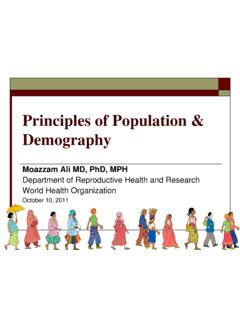
Principles of Population and Demography
www.gfmer.chGlobal Handbook Family planning guidelines and tools The Medical Eligibility Criteria Wheel Reproductive Choices and Family Planning for People with HIV CIRE Guide to family planning for health care providers and New their clients 4th edition just published! 2010

QUALITATIVE SAMPLING TECHNIQUES
www.gfmer.chA flexible research and sampling design is an important feature of qualitative research, particularly when the research being conducted is exploratory in nature. When little is known about a phenomenon or setting, a priori sampling decisions can be difficult. In such circumstances, creating a research design that is flexible enough to foster
Related documents

Designing and Conducting 1 Research With Online Interviews
www.betterevaluation.orgKinesic communication. includes eye contact and gaze, facial expressions, body movements, gestures, and postures. • Proxemic communication. is the use of interpersonal space to com-municate attitudes (Gordon, 1980; Guerrero et al., 1999; Kalman, Ravid, Raban, & Rafaeli, 2006). Nonverbal signals can be noted during an interview, or categorized as

THE NATURE OF COMMUNICATION
prod-cat-files.macmillan.cloudThe idea of communication as a symbolic process leads into another characteristic of communication, that communication is the construction of meaning. We use symbols through verbal and nonverbal messages to construct meaning. This char-acteristic emphasizes how meaning is constructed through the sending and receiv-

What Is (Mediated) Communication? - Higher Education
he.kendallhunt.comseries of verbal and nonverbal assurances that you were enjoying yourself. Second, the goal of communication is to get some meaning across to another person or persons. This also suggests that effective communication is best thought of as an audience-centered process; that is, one needs to think about what will most
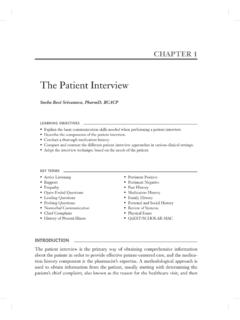
The Patient Interview - Jones & Bartlett Learning
samples.jbpub.com• Nonverbal communication cues active Listening The first communication skill to be mastered is listening, specifically active listen-ing. Listening is defined as hearing what is being said, whereas active listeningis a dynamic process that includes …