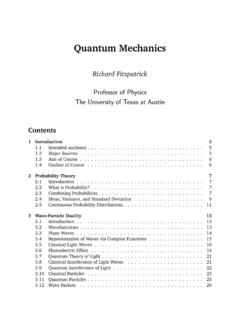
Quantum Mechanics
Probability Theory 7 2 Probability Theory 2.1 Introduction This section is devoted to a brief, and fairly low level, introduction to a branch of mathe-matics known as probability theory. 2.2 What is Probability? What isthe scientific definitionofprobability? Well, let usconsideranobservationmadeon a …
Download Quantum Mechanics

Information
Domain:
Source:
Link to this page:
Documents from same domain
Euclid's Elements of Geometry - Home Page for …
farside.ph.utexas.eduIntroduction 4 Book 1 5 Book 2 49 Book 3 69 Book 4 109 Book 5 129 Book 6 155 Book 7 193 ... Euclid’s Elements is by far the most famous mathematical work of ...
Classical Electromagnetism - University of Texas at Austin
farside.ph.utexas.edu8 CLASSICAL ELECTROMAGNETISM In integral form, making use of the divergence theorem, this equation becomes d dt V ρdV + S j·dS =0, (1.8) where V is a fixed volume bounded by a surface S.The volume integral represents the net electric
Classical Mechanics - Home Page for Richard Fitzpatrick
farside.ph.utexas.eduClassical Mechanics An introductory course Richard Fitzpatrick Associate Professor of Physics The University of Texas at Austin
Classical Electromagnetism
farside.ph.utexas.edu8 CLASSICAL ELECTROMAGNETISM In integral form, making use of the divergence theorem, this equation becomes d dt V ρdV + S j·dS =0, (1.8) where V is a fixed volume bounded by a surface S.The volume integral represents the net electric
Quantum Mechanics - University of Texas at Austin
farside.ph.utexas.eduIntroduction 5 1 Introduction 1.1 Intended audience These lecture notes outline a single semester course on non-relativistic quantum mechanics which is primarily intended for upper-division undergraduate physics majors.The course
Thermodynamics and Statistical Mechanics
farside.ph.utexas.eduthat governed the system under investigation. For instance, Newton’s equations of motion, or Maxwell’s equations for electromagnetic fields. We can then analyze the system by solving these equations, either exactly or approximately. In thermodynamics,we have no problem formulatingthe governingequations. The motionsof
Classical Mechanics
farside.ph.utexas.eduPhysics for scientists and engineers: R.A. Serway, and R.J. Beichner, Fifth edition, Vol. 1 (Saunders College Publishing, Orlando FL, 2000). 1.2 What is classical mechanics? Classical mechanics is the study of the motion of bodies (including the special case in which bodies remain at rest) in accordance with the general principles
Euclid's Elements of Geometry - University of Texas at Austin
farside.ph.utexas.eduκβʹ. Τὼν δὲ τετραπλεύρων σχημάτων τετράγωνον μέν 21. And furtherof thetrilateral figures: a right-angled ἐστιν, ὃ ἰσόπλευρόν τέ ἐστι καὶ ὀρθογώνιον, ἑτερόμηκες triangle is that having a right-angle, an obtuse-angled

Thermodynamics & Statistical Mechanics
farside.ph.utexas.edumolecules are completely negligible. This means that the forces between atoms and molecules are predominantly electromagnetic in origin, and are, therefore, very well understood. So, in principle, we could write down the exact laws of motion for a thermodynamical system, including all of the inter-atomic forces.
Related documents
Classical Electrodynamics - Duke University
webhome.phy.duke.eduelectromagnetic wave stands to this day as one of the greatest moments in the history of science. These four equations even contain within them the seeds of their own destruction as a classical theory. Once Maxwell’s equations were known, the inconsistency of the classical physics one could then easily derive from
Electromagnetism: the simplest gauge theory
www.physics.usu.eduClassical Field Theory Electromagnetism: the simplest gauge theory Electromagnetism: the simplest gauge theory Electromagnetism Let us now study some of the salient eld theoretic properties of \electromagnetic theory". This is historically the rst and also the simplest example of a \gauge theory".

24 ELECTROMAGNETIC WAVES - Wright State University
www.wright.eduMaxwell’s complete and symmetric theory showed that electric and magnetic forces are not separate, but different manifestations of the same thing—the electromagnetic force. This classical unification of forces is one motivation for current attempts to unify the four basic forces in
An Introduction to String Theory - UCB Mathematics
math.berkeley.eduAn Introduction to String Theory ... 2.1 Classical Action for Point Particles 11 ... is the inertial mass should include the electromagnetic self-energy. Thus what really happens is that the physical mass mis given by the sum of the bare mass ˆmand the electrons field energy. This means that the “bare” mass is “infinite” in the limit ...
Electromagnetic Field Theory - A Problem-Solving Approach ...
ocw.mit.eduElectromagnetic field theory is often the least popular course in the electrical engineering curriculum. Heavy reli ance on vector and integral calculus can obscure physical phenomena so that the student becomes bogged down in the mathematics and loses sight of …

Quantum Field Theory I - ETH Z
people.phys.ethz.ch[3]Quantum Field Theory in a nutshell, A. Zee, Princeton University Press. [4]Quantum Field Theory, Mark Srednicki, Cambridge University Press. [5]An introduction to Quantum Field Theory, George Sterman, Cambridge University Press. [6]Classical Mechanics, Goldstein, Poole and Safko, Addison-Wesley

QUANTUM YANG–MILLS THEORY The Physics of Gauge Theory
www.claymath.orgThe idea of a gauge theory evolved from the work of Hermann Weyl. One can find in [34] an interesting discussion of the history of gauge symmetry and the discovery of Yang–Mills theory [50], also known as “non-abelian gauge theory.” At the classical level one replaces the gauge group U(1) of electromagnetism by a compact gauge group G.

Quantization of the Free Electromagnetic Field: Photons ...
www.phys.ksu.edubasis for consideration of interactions of particles with EM fields (light). Quantum theory for light is especially important at low light levels, where the number of light quanta (or photons) is small, and the fields cannot be considered to be continuous (opposite of the classical limit, of course!).