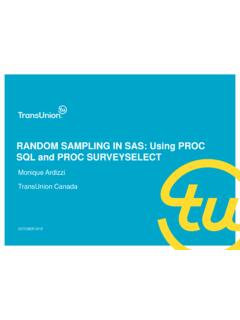
RANDOM SAMPLING IN SAS: Using PROC SQL and PROC …
Simple Random Sampling a % of the Population: PROC SQL Each time a record is considered for selection a random number between 0 and 1 is generated and if it falls in the range (0,0.1) the record is selected.
Download RANDOM SAMPLING IN SAS: Using PROC SQL and PROC …

Information
Domain:
Source:
Link to this page:
Documents from same domain
SAS Functi ons by Example
www.sas.comSAS ® Functi ons by Example ... Program 4.1: Creating a SAS date value from separate variables ... Examples . For these examples, H = 1, ...
Learning SAS by Example
www.sas.comLearning SAS ® by Example A Programmer’s Guide SAS ... Part 1 Getting Started 1 Chapter 1 What Is SAS? 3 1.1 Introduction 3 1.2 ... From Learning SAS ...

Retail Customer Segmentation - SAS
www.sas.comRetail Customer Segmentation using SAS April 2014 Calgary SAS Users Group meeting Jenny Chen Data Science, LoyaltyOne

Catalyzing Positive Change in Education: The Four …
www.sas.com2 Catalyzing Positive Change in eduCation: the Four Pillars Catalyze Conversations nothing kills our energized embrace of education reform like top-down, do-it-or-we-
Best Practices in Credit Risk Management - SAS
www.sas.comWHITE PAPER Best Practices in Credit Risk Management Challenges to and Opportunities for Rebuilding Trust

Developing Credit Risk Models Using SAS® …
www.sas.com2 Developing Credit Risk Models Using SAS Enterprise Miner and SAS/STAT The remaining chapters are structured as follows: Chapter 2 covers the area of sampling and data pre-processing. This chapter defines and contextualizes issues such as variable selection, missing values, and outlier detection within the area of credit risk modeling…
A Non-Geek’s A-to-Z Guide to the Internet of Things
www.sas.comA Non-Geek’s A-to-Z Guide to the Internet of Things 2 Internet of Things ... A good case in point is big data. ... helping you pick out groceries, ...
PREDICTIVE BUSINESS ANALYTICS
www.sas.comCHAPTER 9 Integration of Business Intelligence, Business Analytics, and Enterprise Performance ... Predictive business analytics leverages data within

e s s I n telli B I A I 2016 d A R C - SAS
www.sas.comAs expected, Advanced Analytics lags behind Business Intelligence in terms of usage across an entire organization. This lag is re"ected in
Conditional Processing in EG - SAS
www.sas.comCopyright © 2013, SAS Institute Inc. All rights reserved. sas.com THANK YOU! Title: Conditional Processing in EG Author: Matt Malczewski Created Date: 4/29/2014 11 ...
Related documents
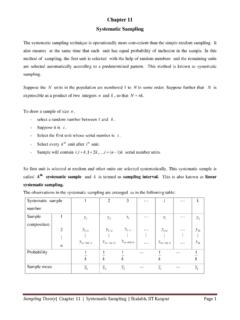
Chapter 11 Systematic Sampling - IIT Kanpur
home.iitk.ac.inThe systematic sampling technique is operationally more convenient than simple random sampling. It also ensures, at the same time that each unit has an equal probability of inclusion in the sample. In this method of sampling, the first unit is selected with the help of random numbers, and the remaining units

Chapter -2 Simple Random Sampling - IIT Kanpur
home.iitk.ac.inSimple random sampling (SRS) is a method of selection of a sample comprising of n a number of sampling units out of the population having N number of sampling units such that every sampling unit has an equal chance of being chosen. The …
Chapter 4 - Stratified Random Sampling - University of Arizona
cals.arizona.edueach stratum. With only one stratum, stratified random sampling reduces to simple random sampling. The population mean (μ) is estimated with: ()∑ = = + + + = L i N N NL L N Ni i N 1 1 1 2 2 1 1 μˆ μˆ μˆ L μˆ μˆ where N i is the total number of sample units in strata i, L is the number of strata, and N is the total

Session 8 SAMPLING THEORY - Atlantic International University
courses.aiu.eduSimple Random Sampling The simplest form of random sampling is called simple random sampling. Pretty tricky, huh? Here's the quick description of simple random sampling: Objective: To select n units out of N such that each N C n has an equal chance of being selected. Procedure: Use a table of random numbers, a computer random number generator, or a
Sampling Designs in Qualitative Research: Making the ...
files.eric.ed.govschemes, random sampling offers the best chance for a researcher to obtain a representative sample. Thus, if external statistical generalization is the goal, which typically is not the case, then qualitative researchers should consider selecting one of the five random sampling schemes (i.e., simple random sampling, stratified random
Chapter 8: Quantitative Sampling
www.csun.eduiv. Types of Probability Sampling Techniques 1. Simple Random a. In simple random sampling, a researcher develops an accurate sampling frame, selects elements from the sampling frame according to a mathematically random procedure, and then locates the exact element that was selected for inclusion in the sample. 2. Systematic Sampling a.

“Sampling Strategies” - NATCO
www.natco1.orgselected. Four main methods include: 1) simple random, 2) stratified random, 3) cluster, and 4) systematic. Non-probability sampling – the elements that make up the sample, are selected by nonrandom methods. This type of sampling is less likely than probability sampling to produce representative samples.