
Random Walk: A Modern Introduction
Random walk – the stochastic process formed by successive summation of independent, identically distributed random variables – is one of the most basic and well-studied topics in probability theory. For random walks on the integer lattice Zd, the main reference is the classic book by Spitzer [16].
Download Random Walk: A Modern Introduction

Information
Domain:
Source:
Link to this page:
Documents from same domain
More is Better
www.math.uchicago.eduMore is Better an investigation of monotonicity assumption in economics Joohyun Shon August 2008 Abstract Monotonicity of preference is assumed in the conventional economic
Stochastic Calculus: An Introduction with Applications
www.math.uchicago.eduIntroductory comments This is an introduction to stochastic calculus. I will assume that the reader has had a post-calculus course in probability or statistics.
Introduction de la spculation Preliminaries
www.math.uchicago.eduAN INTRODUCTION TO THE STOCHASTIC INTEGRAL MATT OLSON Abstract. This paper gives an elementary introduction to the development of the stochastic integral. I aim to provide some of the foundations for some-one who wants to begin the study of stochastic calculus, which is of great

Overview - Department of Mathematics
www.math.uchicago.eduOverview This is an introduction to the mathematical foundations of probability theory. It is intended as a supplement or follow-up to a graduate course in real analysis. The rst two sections assume the knowledge of measure spaces, measurable functions, Lebesgue integral, and notions of convergence of functions; the third assumes ...
A CATEGORICAL INTRODUCTION TO SHEAVES
www.math.uchicago.eduA CATEGORICAL INTRODUCTION TO SHEAVES DAPING WENG Abstract. Sheaf is a very useful notion when de ning and computing many di erent cohomology theories over topological spaces.
Completed cohomology – a survey
www.math.uchicago.eduCompleted cohomology – a survey 3 compactly supported) of X r that we have written down are finitely gen- erated over the indicated ring of coefficients, and that they are related by appropriate forms of duality.1 We also suppose from now on that G

Markov Chains and Applications - University of Chicago
www.math.uchicago.eduMarkov Chains and Applications Alexander olfoVvsky August 17, 2007 Abstract In this paper I provide a quick overview of Stochastic processes and then quickly delve into a discussion of Markov Chains.
Random Walk: A Modern Introduction - University of Chicago
www.math.uchicago.eduContents Preface page 6 1 Introduction 9 1.1 Basic definitions 9 1.2 Continuous-time random walk 12 1.3 Other lattices 14 1.4 Other walks 16 1.5 Generator 17
Stochastic Calculus: An Introduction with Applications
www.math.uchicago.eduThis is an introduction to stochastic calculus. I will assume that the reader has had a post-calculus course in probability or statistics. For much of these notes this is all that is needed, but to have a deep understanding of the subject, one needs to know measure theory and probability from that per-spective.
A Concise Course in Algebraic Topology J. P. May
www.math.uchicago.eduneeds of algebraic topologists would include spectral sequences and an array of calculations with them. In the end, the overriding pedagogical goal has been the introduction of basic ideas and methods of thought. Our understanding of the foundations of algebraic topology has undergone sub-tle but serious changes since I began teaching this course.
Related documents
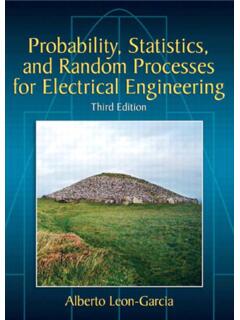
Probability, Statistics, and Random Processes for ...
www.sze.huThis book provides a carefully motivated, accessible, and interesting introduction to probability, statistics, and random processes for electrical and computer engineers.The complexity of the systems encountered in engineering practice calls for an understand-ing of probability concepts and a facility in the use of probability tools.The goal of the
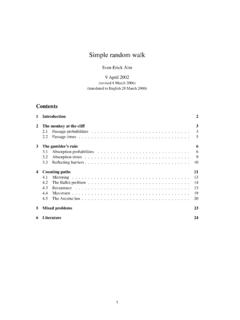
Simple random walk - Uppsala University
www2.math.uu.se1 Introduction A random walk is a stochastic sequence {S n}, with S 0 = 0, defined by S n = Xn k=1 X k, where {X k} are independent and identically distributed random variables (i.i.d.). TherandomwalkissimpleifX k = ±1,withP(X k = 1) = pandP(X k = −1) = 1−p = q. Imagine a particle performing a random walk on the integer points of the real line, where it
Introduction to Partial Differential Equations with ...
iitg.ac.inworks, and biology (birth and death processes and control of disease). The method of probability generating functions in the study of stochastic processes is discussed and illustrated by many examples. In recent books the topic of first order equations is either omitted or treated inadequately.

Discrete Stochastic Processes, Chapter 4: Renewal Processes
ocw.mit.edu158 CHAPTER 4. RENEWAL PROCESSES In most situations, we use the words arrivals and renewals interchangably, but for this type of example, the word arrival is used for the counting process {N(t); t > 0} and the word renewal is used for {Nr(t); t > 0}.The reason for being interested in {Nr(t); t > 0} is that it allows us to analyze very complicated queues such as this in two stages.
Applied Stochastic Differential Equations
users.aalto.fi3 Pragmatic Introduction to Stochastic Differential Equations 23 3.1 Stochastic Processes in Physics, Engineering, and Other Fields 23 3.2 Differential Equations with Driving White Noise 33 3.3 Heuristic Solutions of Linear SDEs 36 3.4 Heuristic Solutions of Nonlinear SDEs 39 3.5 The Problem of Solution Existence and Uniqueness 40 3.6 Exercises 40
Independent Component Analysis
www.cs.helsinki.fi2.8 Stochastic processes * 43 2.8.1 Introduction and definition 43 2.8.2 Stationarity, mean, and autocorrelation 45 2.8.3 Wide-sense stationary processes 46 2.8.4 Time averages and ergodicity 48 2.8.5 Power spectrum 49 2.8.6 Stochastic signal models 50 2.9 Concluding remarks and references 51 Problems 52 3 Gradients and Optimization Methods 57
High-Dimensional Probability
www.math.uci.edumetrization tricks, chaining and comparison techniques for stochastic processes, combinatorial reasoning based on the VC dimension, and a lot more. High-dimensional probability provides vital theoretical tools for applications in data science. This book integrates theory with applications for covariance