
Recursive Deep Models for Semantic Compositionality Over a ...
Richard Socher, Alex Perelygin, Jean Y. Wu, Jason Chuang, Christopher D. Manning, Andrew Y. Ng and Christopher Potts Stanford University, Stanford, CA 94305, USA richard@socher.org,faperelyg,jcchuang,angg@cs.stanford.edu fjeaneis,manning,cgpottsg@stanford.edu Abstract Semantic word spaces have been very use …
Download Recursive Deep Models for Semantic Compositionality Over a ...

Information
Domain:
Source:
Link to this page:
Documents from same domain
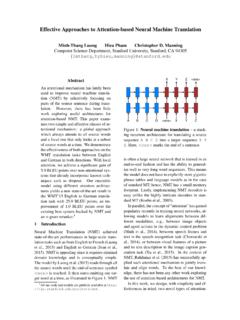
Effective Approaches to Attention-based Neural Machine ...
nlp.stanford.eduEffective Approaches to Attention-based Neural Machine Translation ... ines two simple and effective classes of at-tentional mechanism: a global approach which always attends to all source words and a local one that only looks at a subset of source words at atime. Wedemonstrate

Statistical Machine Translation of French and German into ...
nlp.stanford.eduFrench sentence pairs based on the likelihood that one is a trans- lation of the other, and a decoder attempts to find the English sentence for which the product of the language and translation
A Fast and Accurate Dependency Parser using Neural Networks
nlp.stanford.eduing algorithm but in the feature extraction step (He et al., 2013). For instance, Bohnet (2010) reports that his baseline parser spends 99% of its time do-ing feature extraction, despite that being done in standard efficient ways. In this work, we address all of these problems by using dense features in place of the sparse indi-cator features.
Introduction to Information Retrieval
nlp.stanford.eduApr 01, 2009 · CLASSIFICATION ing queries belong, we now introduce the general notion of a classification problem. Given a set of classes, we seek to determine which class(es) a given ... Books in a library are assigned Library of Congress categories by a librarian. But manual classification is
Generalized Linear Mixed Models (illustrated with R on ...
nlp.stanford.eduGeneralized Linear Mixed Models (illustrated with R on Bresnan et al.’s datives data) Christopher Manning 23 November 2007 In this handout, I present the logistic model with fixed and random effects, a form of Generalized Linear Mixed Model (GLMM). I illustrate this with an analysis of Bresnan et al. (2005)’s dative data (the version

BERT: Pre-training of Deep Bidirectional Transformers for ...
nlp.stanford.eduImagine it’s 2013: Well-tuned 2-layer, 512-dim LSTM sentiment analysis gets 80% accuracy, training for 8 hours. Pre-train LM on same architecture for a week, get 80.5%.
Collocations - Stanford University
nlp.stanford.eduThe twenty highest ranking phrases containing strong and powerful all have the form A N (where A is either strong or powerful). We have listed them in Table 5.4. Again, given the simplicity of the method, these results are surprisingly accurate. For example, they give evidence that strong challenge and powerful
GloVe: Global Vectors for Word Representation
nlp.stanford.eduCollobert, 2014) has been suggested as an effec-tive way of learning word representations. Shallow Window-Based Methods. Another approach is to learn word representations that aid in making predictions within local context win-dows. For example, Bengio et al. (2003) intro-duced a model that learns word vector representa-
Get To The Point: Summarization with Pointer-Generator ...
nlp.stanford.eduGermany beat Argentina 2-0 the model may attend to the words victorious and win in the source text. et al.,2014), in which recurrent neural networks (RNNs) both read and freely generate text, has made abstractive summarization viable (Chopra et al.,2016;Nallapati et al.,2016;Rush et al., 2015;Zeng et al.,2016). Though these systems

LDAvis: A method for visualizing and interpreting topics
nlp.stanford.eduics. This two-stage process yields good results on experimental data, although the resulting output is still simply a ranked list containing a mixture of terms and n-grams, and the usefulness of the method for topic interpretation was not tested in a user study. Newman et al. (2010) describe a method for ranking terms within topics to aid ...
Related documents

Olives: Safe Methods for Home Pickling
anrcatalog.ucanr.eduOlives: Safe Methods for Home Pickling Revised by SYLVIA YADA, Scientist, and LINDA J. HARRIS, Extension Specialist in Microbial Food Safety, Department of Food Science and Technology, UC Davis, working from the original publication by GEORGE YORK, Professor Emeritus, and REESE VAUGHN (deceased), Department of Food Science and Technology, …
Worksheet: Logarithmic Function
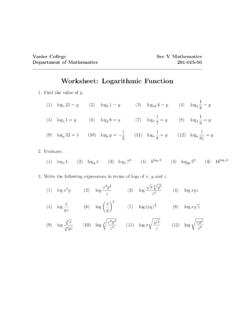
math.colorado.eduVanier College Sec V Mathematics Department of Mathematics 201-015-50 Worksheet: Logarithmic Function 1. Find the value of y. (1) log 5 25 = …
The US Natural Gas Compression Infrastructure ...
netl.doe.govUS Natural Gas Pipelines and Compression Stations - 2.3 million miles of pipelines - 850-900 mainline compressor stations, 800-900 booster stations (+ 15,000 gas gathering machines) - Average age of pipeline compressors: 25-30 years - Consume/lose about 2.5-3.5% of US NG = 0.7 tcf/y = 3-4 billion US Dollars per year

Convención sobre la protección del patrimonio mundial ...
whc.unesco.orgpatrimonio mundial, cultural y natural La Conferencia General de la Organización de las Naciones Unidas para la Educación, la Ciencia y la Cultura, en su 17a, reunión celebrada en París del 17 de octubre al 21 de noviembre de 1972.

At Risk: natural hazards, people’s vulnerability and disasters
www.preventionweb.netnot only natural events that cause them. They are also the product of social, political and economic environments (as distinct from the natural environ-ment), because of the way these structure the lives of different groups of people (see Box 1.1).4 There is a danger in treating disasters as something