
Relation Classification via Convolutional Deep Neural Network
In this paper, we propose a convolutional DNN to extract lexical and sentence level features for relation classication; our method effectively alleviates the shortcomings of traditional features. 3 Methodology 3.1 The Neural Network Architecture network takes an input sentence and discovers multiple levels of feature extraction, where higher levels
Download Relation Classification via Convolutional Deep Neural Network

Information
Domain:
Source:
Link to this page:
Documents from same domain
Transformer-XL: Attentive Language Models beyond a Fixed ...
aclanthology.org⌧+1= Transformer-Layer(q n,kn ⌧+1,v n). where the function SG(·) stands for stop-gradient, the notation [hu hv] indicates the concatenation of two hidden sequences along the length dimen-sion, and W· denotes model parameters. Com-pared to the standard Transformer, the critical dif-ference lies in that the key kn ⌧+1 and value v n ⌧+1
Improving Multimodal Named Entity Recognition via Entity ...
aclanthology.orgwith cross-modal attention mechanism to produce an image-aware word representation and a word-aware visual representation for each input word, respectively. Finally, to largely eliminate the bias of the visual context, we propose to leverage text-based entity span detection as an auxiliary task, and design a unified neural architecture based on
Entity, Relation, and Event Extraction with Contextualized ...
aclanthology.orgSpan enumeration Event propagation Coreference Auxiliary Sentence Sentence É É Sentence Figure 1: Overview of our framework: DYGIE++. Shared span representations are constructed by refin-ing contextualized word embeddings via span graph updates, then passed to scoring functions for three IE tasks. Mitchell,2016;Li and Ji,2014) and neural scor-
CH-SIMS: A Chinese Multimodal Sentiment Analysis Dataset ...
aclanthology.orgSentiment analysis is an important research area in Natural Language Processing (NLP). It has wide applications for other NLP tasks, such as opinion mining, dialogue generation, and user behavior analysis. Previous study (Pang et al.,2008;Liu and Zhang,2012) mainly focused on text sentiment analysis and achieved impressive results. However,
Recurrent Attention Network on Memory for Aspect …
aclanthology.orgtic analysis (Socher et al.,2010) and sentence sen-timent analysis (Socher et al.,2013). (Dong et al., 2014;Nguyen and Shirai,2015) adopted Rec-NN for aspect sentiment classication, by converting the opinion target as the tree root and propagating the sentiment of targets depending on the context and syntactic relationships between them. How-
A Joint Neural Model for Information Extraction with ...
aclanthology.orgEntity Extraction aims to identify entity men-tions in text and classify them into pre-defined en-tity types. A mention can be a name, nominal, or pronoun. For example, “Kashmir region” should be recognized as a location (LOC) named entity mention in Figure2. Relation Extraction is the task of assigning a
Exploring Pre-trained Language Models for Event Extraction ...
aclanthology.org3 Extraction Model This section describes our approach to extract events that occur in plain text. We consider event extraction as a two-stage task, which includes trig-ger extraction and argument extraction, and pro-pose a Pre-trained Language Model based Event Extractor (PLMEE). Figure3illustrates the archi-tecture of PLMEE.
BLEU: a Method for Automatic Evaluation of Machine …
aclanthology.orgtor and a standard (poor) machine translation system using 4 reference translations for each of 127 source sentences. The average precision results are shown in Figure 1. Figure 1: Distinguishing Human from Machine ˘ ˇ ˆ The strong signal differentiating human (high pre-cision) from machine (low precision) is striking.
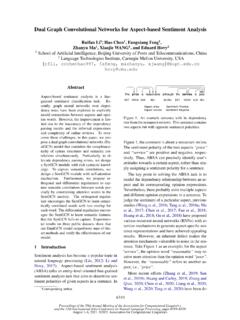
Dual Graph Convolutional Networks for Aspect-based ...
aclanthology.orgAspect-based sentiment analysis is a fine-grained sentiment classification task. Re-cently, graph neural networks over depen-dency trees have been explored to explicitly model connections between aspects and opin-ion words. However, the improvement is lim-ited due to the inaccuracy of the dependency parsing results and the informal expressions
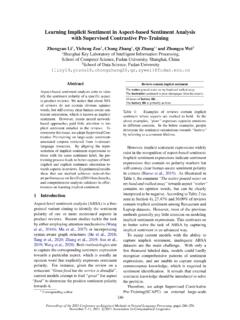
Learning Implicit Sentiment in Aspect-based Sentiment ...
aclanthology.orgAspect-based sentiment analysis aims to iden-tify the sentiment polarity of a specific aspect in product reviews. We notice that about 30% of reviews do not contain obvious opinion words, but still convey clear human-aware sen-timent orientation, which is known as implicit sentiment. However, recent neural network-
Related documents
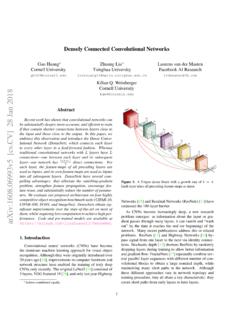
Densely Connected Convolutional Networks - arXiv
arxiv.orglutional Network (DenseNet), which connects each layer to every other layer in a feed-forward fashion. Whereas traditional convolutional networks with Llayers have L connections—one between each layer and its subsequent layer—our network has L(L+1) 2 direct connections. For each layer, the feature-maps of all preceding layers are
![Abstract arXiv:1411.4038v2 [cs.CV] 8 Mar 2015](/cache/preview/e/8/a/1/0/5/9/a/thumb-e8a1059a2748cde7ba3d756f44e4ca34.jpg)
Abstract arXiv:1411.4038v2 [cs.CV] 8 Mar 2015
arxiv.orgWe show that a fully convolutional network (FCN), trained end-to-end, pixels-to-pixels on semantic segmen-tation exceeds the state-of-the-art without further machin-ery. To our knowledge, this is the first work to train FCNs end-to-end (1) for pixelwise prediction and (2) from super-vised pre-training. Fully convolutional versions of existing

Lecture 10: Recurrent Neural Networks
cs231n.stanford.edu(Vanilla) Recurrent Neural Network x RNN y The state consists of a single “hidden” vector h: Fei-Fei Li & Justin Johnson & Serena Yeung Lecture 10 - 23 May 4, 2017 h 0 f W h 1 x 1 RNN: Computational Graph. Fei-Fei Li & Justin Johnson & Serena Yeung Lecture 10 - 24 May 4, 2017 h 0 f W h 1 f W h 2 x 2 x 1

Eyeriss: A Spatial Architecture for Energy-Efficient Dataflow …
people.csail.mit.eduA convolutional neural network (CNN) is constructed by stacking multiple computation layers as a directed acyclic graph [36]. Through the computation of each layer, a higher-level abstraction of the input data, called a feature map (fmap), is extracted to preserve essential yet unique information. Modern CNNs are able to achieve superior ...

Classification of Image using Convolutional Neural Network …
globaljournals.orgConvolutional Neural Network extracts the feature maps from the 2D images by using filters. The Convolutional neural network considers the mapping ofimage pixels with the neighborhood space rather than having a fully connected layer of neurons. The Convolutional neural network has been proved to bea very dominant and

Sparse Convolutional Neural Networks
www.cv-foundation.orgconvolutional kernel parameters of the network in [14] with relatively small number of bases while keeping the drop of accuracy to less than 1%. In our Sparse Convolutional Neural Networks (SCNN) model, each sparse convolutional layer can be performed with a few convolution kernels followed by a sparse ma-trix multiplication.