Rotational Motion - Physics
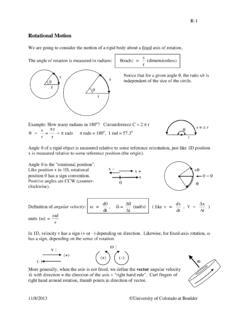
Rotational Motion We are going to consider the motion of a rigid body about a fixed axis of rotation. ... is due to change in magnitude of velocity, speed v a tan and a r are the tangential and radial components of the acceleration vector a. a 22 ... If several torques are applied, the net torque causes angular acceleration: ...
Download Rotational Motion - Physics

Information
Domain:
Source:
Link to this page:
Documents from same domain
Operational Amplifiers and Negative Feedback
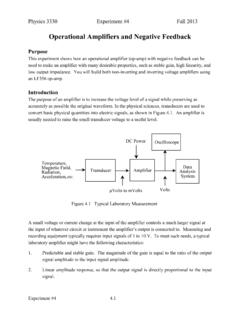
physicscourses.colorado.eduOperational Amplifiers and Negative Feedback Purpose This experiment shows how an operational amplifier (op-amp) with negative feedback can be used to make an amplifier with many desirable properties, such as stable gain, high linearity, and low output impedance. You will build both non-inverting and inverting voltage amplifiers using an LF356 ...
DIGITAL ELECTRONICS: LOGIC AND CLOCKS
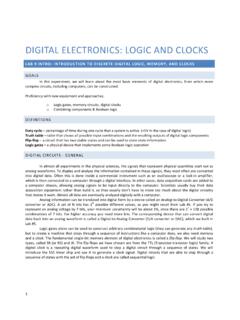
physicscourses.colorado.eduDIGITAL LOGIC GATES The flow of digital signals is controlled by transistors in various configurations depending on the logic family (see H&H 8.09 for details). For most purposes, we can imagine that the logic gates are composed of several ideal switches with just two states: OPEN and CLOSED. The state of a switch is controlled by a digital signal.
Static Equilibrium - Physics
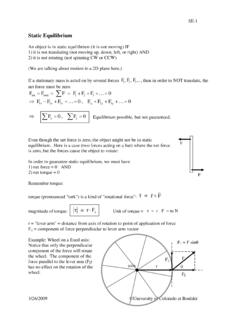
physicscourses.colorado.eduEquilibrium possible, but not guaranteed. Even though the net force is zero, the object might not be in static equilibrium. Here is a case (two forces acting on a bar) where the net force is zero, but the forces cause the object to rotate: In order to guarantee static equilibrium, we must have 1) net force = 0 AND 2) net torque = 0
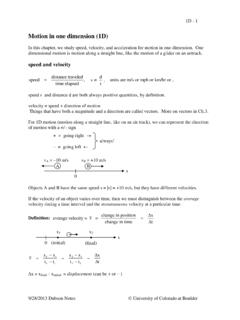
Motion in 1D - Physics
physicscourses.colorado.eduExample: Projectile Motion: A projectile is fired straight up from the ground with an initial speed of |v o | = 10 m/s. Describe the velocity vs. time. (Assume negligible air resistance.) Choose upward as the (+) direction and set the ground at y = 0. y o = …
Related documents
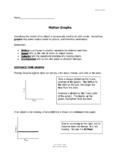
motion graphs - Homestead
camillasenior.homestead.comDescribing the motion of an object is occasionally hard to do with words. Sometimes graphs help make motion easier to picture, and therefore understand. Remember: • Motion is a change in position measured by distance and time. • Speed tells us the rate at which an object moves. • Velocity tells the speed and direction of a moving object.
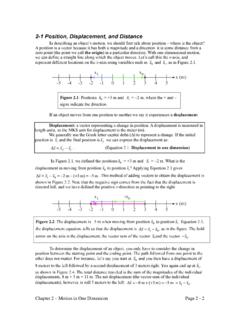
2-1 Position, Displacement, and Distance
physics.bu.edufind the net displacement by adding, as vectors, the displacement of +80 meters, in the first 40 seconds, to the displacement of –40 meters, which occurs in the last 10 seconds. (b) Applying Equation 2.3 to find the average speed, . The average speed and average velocity differ because the motion involves a change of direction.
Chapter 5. Force and Motion - Physics & Astronomy
physics.gsu.edu- Kinetic friction – opposes the motion direction – opposite the velocity vector - static friction – prevent the motion of the object ... • 2nd Law: change in motion ... constant velocity, if and only if the net force acting on the object is zero. a ==== 0 rrr F ==== 0 rrrr
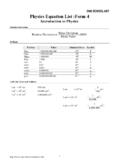
ONE-SCHOOL.NET Physics Equation List :Form 4
www.one-school.netv = final velocity (ms-1) u = initial velocity (ms-1) t = time for the velocity change (s) Graph of Motion Gradient of a Graph The gradient 'm' of a line segment between two points and is defined as follows: Change in y coordinate, Gradient, Change in x coordinate, y m x or y m x Δ = Δ Δ = Δ

Newton’s First Law Worksheet SOLUTIONS
pa01000188.schoolwires.netobject remain in motion or will its motion change? If the motion changes, what kind of change occurs? Since the forces are balanced, the object will continue moving in its current motion, at a constant velocity of 4 m/s [NE]. Newton’s 1st Law confirms this. 7. An object is at rest on a perfectly frictionless surface. Instantly, a 10 N [W ...
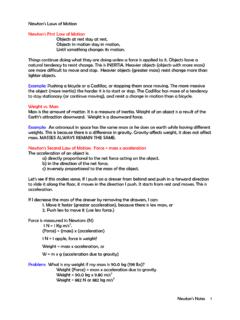
Newton's Laws of Motion Newton's First Law of Motion ...
w3.ric.eduNewton's Laws of Motion Newton's First Law of Motion Objects at rest stay at rest, Objects in motion stay in motion, Until something changes its motion. Things continue doing what they are doing unless a force is applied to it. Objects have a natural tendency to resist change. This is INERTIA. Heavier objects (objects with more mass)
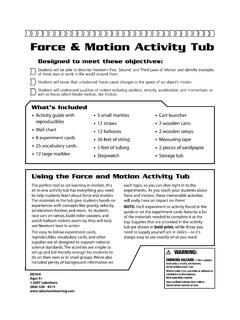
Force & Motion Activity Tub - Lakeshore Learning
www.lakeshorelearning.comOnce an object is set into motion, we can measure how fast it travels and calculate its speed.We can also calculate the velocity, which describes the speed and direction of a moving object.If the moving object travels at the same, unchanging velocity, it has a constant speed.A change in velocity (speeding up) causes acceleration. 4

Physics Intro & Kinematics
www.phys.ufl.eduup, slow down, or change direction; the rate at which velocity changes Speed vs. Velocity • Speed is a scalar (how fast something is moving regardless of its direction). Ex: v = 20 mph • Speed is the magnitude of velocity. • Velocity is a combination of speed and direction. Ex: v = 20 mph at 15° south of west • The symbol for speed is v.

NEWTON’S LAWS OF MOTION
www.sas.upenn.edu3. An object’s resistance to change in motion is dependent solely on what quantity? 4. Inertia is the resistance to change in motion so inertia depends solely on what? 5. What is required to cause acceleration? 6. What is the net force if you push a cart to the right with 5Nof force and a friend pushes the cart to the left with 5Nof force? 7.
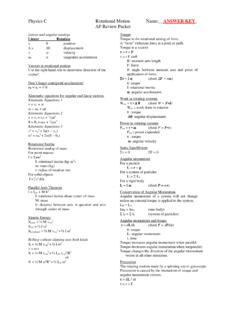
Physics C Rotational Motion Name: ANSWER KEY AP Review …
www.smcisd.netPhysics C Rotational Motion Name:__ANSWER KEY_ AP Review Packet Linear and angular analogs Linear Rotation x A “twist” (whereas force is a push or pull). position x displacement v velocity a T tangential acceleration Vectors in rotational motion Use the right hand rule to determine direction of the