Safe Operating Procedure
Training . Forklift/Powered Industrial Truck (PIT) operators must be trained before independently operating a PIT, and complete refresher training every three years, or sooner if warranted. Initial PIT training consists of three parts: ... General PIT Operational Safety Precautions
Download Safe Operating Procedure

Information
Domain:
Source:
Link to this page:
Documents from same domain
AERIAL LIFT SAFETY - Environmental Health & Safety
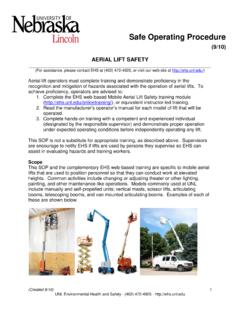
ehs.unl.edu1. Complete the EHS web-based Mobile Aerial Lift Safety training module ... painting, and other maintenance- like operations. Models commonly used at UNL
(Revised 9/16) FIRST AID KITS - University of …
ehs.unl.edu(Revised 9/16) FIRST AID KITS _____ While UNL facilities are not required by law to be equipped with ...
Safe Operating Procedure - University of …
ehs.unl.eduSafe Operating Procedure ... First aid kits are encouraged in all work ... injury/illness should seek medical treatment at the University Health Center or their ...
GASES UNDER PRESSURE HAZARDS & RISK MINIMIZATION
ehs.unl.eduGases in high-pressure cylinders contain an extraordinary amount of stored energy. If a cylinder valve is breached (i.e., breaks off when the cylinder falls and strikes a hard surface, etc.), the
PERSONAL PROTECTIVE EQUIPMENT (PPE) – BODY …
ehs.unl.edu(Created 7/12; Revised 11/15) UNL Environmental Health and Safety · (402) 472-4925 · http://ehs.unl.edu. unnecessarily burdened • Protective clothing should be ...
Chemical Safety
ehs.unl.eduExposure Limits Permissible Exposure Limits - (PEL's) Recommended Exposure Limits – (REL’s) ... flashpoint > 73 F, < 100 F, no bp limits Amyl Acetate, Xylene. 35 Chemical Safety 3 Combustible Liquids Solvents! ... Acetonitrile, Adriamycin, Heavy Metals, Cannabis, Dimethyl sulfoxide, Ethylene oxide, Formaldehyde, Ketamine, d-Limonene ...
Compressed Gas Safety.ppt
ehs.unl.edu−20 feet from oxygen & combustible material. −Never place anything on top of cylinder. Oxygen −20 feet from flammable or combustible material. Separation can be 1 hour fire wall. Cylinders in use or connected can be stored together.
1. Why Report Near Misses?
ehs.unl.eduJun 20, 2014 · Identifying and investigating near-misses is a key element to finding and controlling risks before workers are injured. The information gathered through near-miss reporting is evaluated to determine root causes and hazard mitigation strategies. “Lessons learned” are shared in a general way (you are not identified) so all
(Revised 8/15) GENERAL MACHINE SAFETY
ehs.unl.eduGENERAL MACHINE SAFETY _____ This SOP is intended to provide general safety guidance for power-driven (including ... Hazard Overview . Potential hazards of operating machines and equipment are numerous. Some of the ... preventative maintenance. Do not use compressed air for cleaning of debris.
BASIC ELECTRICITY 101 - Environmental Health & Safety
ehs.unl.eduBASIC ELECTRICITY 101 Kevin Booker, Executive Director State Electrical Division of Nebraska. OBJECTIVES Review some typical hazards associated with electricity and learn how to mitigate the hazards. In the United States, electrical hazards are ... Product Safety Commission) went to the electrical manufacturers of GFCI’s and
Related documents
Forklift Safety Guide - University of Washington
depts.washington.eduApr 01, 2007 · This book has general information about: • the kinds of forklifts commonly available • the principles of physics that allow a forklift to lift and move heavy loads safely • forklift operator training requirements • some basic operator safety rules • hazardous locations where carbon monoxide is a problem or a special forklift is needed

Quick Reference to OSHA Regulations for Manufacturing
allrisktraining.comEmployers must not only provide the safety equipment required they must also provide the correct training and keep records of training and accidents. An OSHA inspector is allowed to inspect a facility without advanced warning. Willful violations can result in fines up to $500,000 and could include a jail term. Citations may be issued for
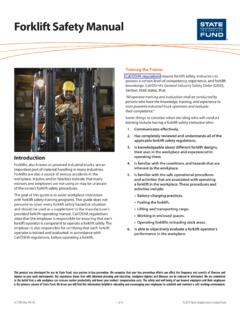
Forklift Safety Manual
content.statefundca.comCal/OSHA regulations, before operating a forklift. Training the Trainer. Cal/OSHA regulations require forklift safety instructors to possess a certain level of competency, experience, and forklift knowledge. Cal/OSHA’s General Industry Safety Order (GISO), Section 3668 states, that: “All operator training and evaluation shall be conducted by
CHILD LABOR LAWS
www.dir.ca.govTraining for Prohibited and Restricted Occupations 33 . 9. ENTERTAINMENT INDUSTRY 36 . Defined36 . Permits to Work and Permits to Employ 36 . Procedure for Obtaining an Entertainment Work Permit 36 . School Age Children37 . Excused School Absences 39 . Hours of Work and Concurrent Requirements40 . Wages42 . Out-of-State Locations42 . Studio ...
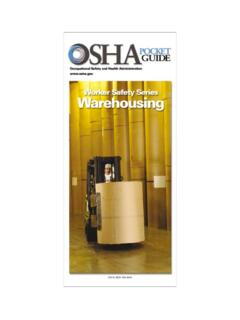
OSHA 3220-10N 2004
www.osha.gov• Provide general ergonomics training and task-specific training; • Minimize the need for lifting by using good design and engineering techniques; • Lift properly and get a coworker to help if a product is too heavy. Hazard Communication Hazard: Chemical burns are possible if spills of hazardous materials occur. Solutions:
Your Company Name General Construction Safety
www.syrabex.com10. Forklift Safety Policy 11. General Construction Safety 12. Hazard Communications + GHS 13. Ladder Safety Policy 14. Lockout Tagout Policy 15. Noise In Construction Policy 16. Personal Protective Equipment 17. Respiratory Policy 18. Scaffold Policy 19. Silica in Construction Policy 20. Spill Prevention Policy 21. Tool Safety Policy 22.