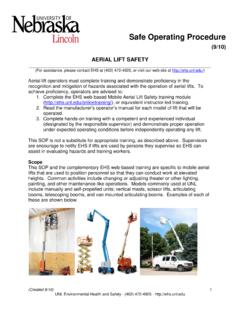
Safe Operating Procedure
• 29 CFR 1926.453 (Aerial Lifts) • 29 CFR 1926.451 & .452 (Scaffolds) • 29 CFR 1926.20 (General Safety and Health Provisions) • 29 CFR 1926.21 (Safety Training and Education) • Section 5 of the OSHA Act, commonly referred to as the “General Duty Clause.” • American National Standards Institute (ANSI), A92.3, Manually Propelled ...
Download Safe Operating Procedure

Information
Domain:
Source:
Link to this page:
Documents from same domain
(Revised 9/16) FIRST AID KITS - University of …
ehs.unl.edu(Revised 9/16) FIRST AID KITS _____ While UNL facilities are not required by law to be equipped with ...
Safe Operating Procedure - University of …
ehs.unl.eduSafe Operating Procedure ... First aid kits are encouraged in all work ... injury/illness should seek medical treatment at the University Health Center or their ...
GASES UNDER PRESSURE HAZARDS & RISK MINIMIZATION
ehs.unl.eduGases in high-pressure cylinders contain an extraordinary amount of stored energy. If a cylinder valve is breached (i.e., breaks off when the cylinder falls and strikes a hard surface, etc.), the
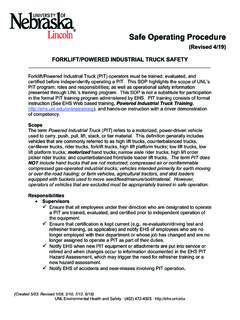
FORKLIFT/POWERED INDUSTRIAL TRUCK SAFETY
ehs.unl.edu• PITs should be driven on the right side of the road or aisle-way, and operated at a safe speed with due regard for traffic and conditions (slippery surfaces,
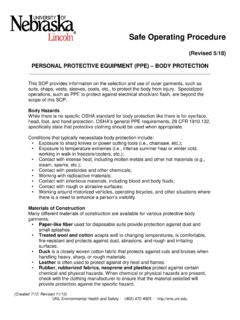
PERSONAL PROTECTIVE EQUIPMENT (PPE) – BODY …
ehs.unl.edu(Created 7/12; Revised 11/15) UNL Environmental Health and Safety · (402) 472-4925 · http://ehs.unl.edu. unnecessarily burdened • Protective clothing should be ...
Chemical Safety
ehs.unl.eduExposure Limits Permissible Exposure Limits - (PEL's) Recommended Exposure Limits – (REL’s) ... flashpoint > 73 F, < 100 F, no bp limits Amyl Acetate, Xylene. 35 Chemical Safety 3 Combustible Liquids Solvents! ... Acetonitrile, Adriamycin, Heavy Metals, Cannabis, Dimethyl sulfoxide, Ethylene oxide, Formaldehyde, Ketamine, d-Limonene ...
Compressed Gas Safety.ppt
ehs.unl.edu−20 feet from oxygen & combustible material. −Never place anything on top of cylinder. Oxygen −20 feet from flammable or combustible material. Separation can be 1 hour fire wall. Cylinders in use or connected can be stored together.
1. Why Report Near Misses?
ehs.unl.eduJun 20, 2014 · Identifying and investigating near-misses is a key element to finding and controlling risks before workers are injured. The information gathered through near-miss reporting is evaluated to determine root causes and hazard mitigation strategies. “Lessons learned” are shared in a general way (you are not identified) so all
(Revised 8/15) GENERAL MACHINE SAFETY
ehs.unl.eduGENERAL MACHINE SAFETY _____ This SOP is intended to provide general safety guidance for power-driven (including ... Hazard Overview . Potential hazards of operating machines and equipment are numerous. Some of the ... preventative maintenance. Do not use compressed air for cleaning of debris.
BASIC ELECTRICITY 101 - Environmental Health & Safety
ehs.unl.eduBASIC ELECTRICITY 101 Kevin Booker, Executive Director State Electrical Division of Nebraska. OBJECTIVES Review some typical hazards associated with electricity and learn how to mitigate the hazards. In the United States, electrical hazards are ... Product Safety Commission) went to the electrical manufacturers of GFCI’s and
Related documents

Fixed and Portable Ladders- A Guide to OSHA Rules
precast.orginjuries and fatalities among construction workers for example, and many of the injuries are serious enough to require time off the job. OSHA rules apply to all stairways and ladders used in construction, alteration, repair, painting, decorating and demolition of worksites covered by OSHA’s construction safety and health standards.

OSHA CHECKLIST FOR THE CONSTRUCTION INDUSTRY
www.scosha.llronline.comfor the Construction Industry, as adopted from 29 CFR (Code of Federal Regulations) Part 1926, under authority of the South Carolina Code of Laws (1976) as amended, Section 41-15-210, and other selected General Industry Safety and Health Standards (Article VI, Part 1910) having applicability to construction work.

PERSONAL FALL PROTECTION EQUIPMENT
safetyequipment.orgThe Occupational Safety and Health Act (OSHA) under Title 29 of the Code of Federal Regulations (29 CFR) assures and enforces safe and healthful working conditions for gen-eral industry, construction and the maritime trades. Under the Act, employers have the duty of providing their workers with a place of employment free from recognized safety and
Jobsite Safety Inspection Checklist - Builders' Show
www.buildersshow.comHard hats are worn in the construction areas where there is a risk of injury ... the guidelines outlined in OSHA Standards. Footing and anchors are sound, rigid, and capable of carrying 4 times the ... All job-built ladders are constructed in accordance with 29 CFR 1926.25 regulations.

Welding, Cutting, and Brazing Checklist
www.tdi.texas.govIt is based on 29 Code of Federal Regulations (CFR) Part 1910, Subpart Q, and 29 CFR Part 1926, Subpart J, OSHA Standards for the General and Construction Industry. These standards can be found on OSHA’s web site at www.osha.gov. Employers in the construction industry should review the section dealing with general industry, because some of the
Underground Construction (Tunneling)
www.osha.govsummarizes OSHA’s regulations related to underground construc-tion. As such, it should be used as a guide but not as a substitute for the complete text of 29 CFR 1926.800. Construction operations covered by the OSHA standard The OSHA underground construction regulation (29 CFR 1926.800) applies to the construction of underground tunnels ...

Reducing Falls in Construction: Safe Use of Stepladders
www.osha.govOSHA standard: 29 CFR 1926 Subpart X— Stairways and Ladders American National Standards Institute standard: ANSI A14.1, A14.2, A14.5—Ladder Safety Requirements (Not an OSHA standard, included to be used as guidance to meet OSHA’s requirements) Employers using stepladders must follow the ladder requirements set forth in 29 CFR 1926 Subpart X.