Safe Operating Procedure
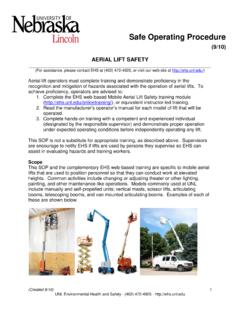
operating conditions before independently operating any lift. The form at the end of this document can be used to document operator hands-on training but are not mandatory. An equivalent form of the department’s choosing can be used. The Nebraska Safety Council offers the following training: “Aerial Lift Safety: Train-the-Trainer”.
Download Safe Operating Procedure

Information
Domain:
Source:
Link to this page:
Documents from same domain
(Revised 9/16) FIRST AID KITS - University of …
ehs.unl.edu(Revised 9/16) FIRST AID KITS _____ While UNL facilities are not required by law to be equipped with ...
Safe Operating Procedure - University of …
ehs.unl.eduSafe Operating Procedure ... First aid kits are encouraged in all work ... injury/illness should seek medical treatment at the University Health Center or their ...
GASES UNDER PRESSURE HAZARDS & RISK MINIMIZATION
ehs.unl.eduGases in high-pressure cylinders contain an extraordinary amount of stored energy. If a cylinder valve is breached (i.e., breaks off when the cylinder falls and strikes a hard surface, etc.), the
FORKLIFT/POWERED INDUSTRIAL TRUCK SAFETY
ehs.unl.edu• PITs should be driven on the right side of the road or aisle-way, and operated at a safe speed with due regard for traffic and conditions (slippery surfaces,
PERSONAL PROTECTIVE EQUIPMENT (PPE) – BODY …
ehs.unl.edu(Created 7/12; Revised 11/15) UNL Environmental Health and Safety · (402) 472-4925 · http://ehs.unl.edu. unnecessarily burdened • Protective clothing should be ...
Chemical Safety
ehs.unl.eduExposure Limits Permissible Exposure Limits - (PEL's) Recommended Exposure Limits – (REL’s) ... flashpoint > 73 F, < 100 F, no bp limits Amyl Acetate, Xylene. 35 Chemical Safety 3 Combustible Liquids Solvents! ... Acetonitrile, Adriamycin, Heavy Metals, Cannabis, Dimethyl sulfoxide, Ethylene oxide, Formaldehyde, Ketamine, d-Limonene ...
Compressed Gas Safety.ppt
ehs.unl.edu−20 feet from oxygen & combustible material. −Never place anything on top of cylinder. Oxygen −20 feet from flammable or combustible material. Separation can be 1 hour fire wall. Cylinders in use or connected can be stored together.
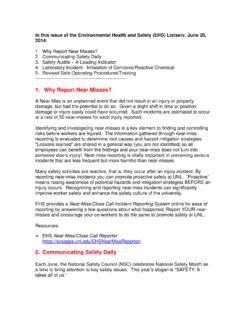
1. Why Report Near Misses?
ehs.unl.eduJun 20, 2014 · Identifying and investigating near-misses is a key element to finding and controlling risks before workers are injured. The information gathered through near-miss reporting is evaluated to determine root causes and hazard mitigation strategies. “Lessons learned” are shared in a general way (you are not identified) so all
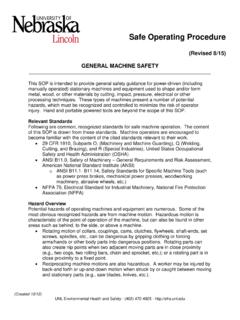
(Revised 8/15) GENERAL MACHINE SAFETY
ehs.unl.eduGENERAL MACHINE SAFETY _____ This SOP is intended to provide general safety guidance for power-driven (including ... Hazard Overview . Potential hazards of operating machines and equipment are numerous. Some of the ... preventative maintenance. Do not use compressed air for cleaning of debris.
BASIC ELECTRICITY 101 - Environmental Health & Safety
ehs.unl.eduBASIC ELECTRICITY 101 Kevin Booker, Executive Director State Electrical Division of Nebraska. OBJECTIVES Review some typical hazards associated with electricity and learn how to mitigate the hazards. In the United States, electrical hazards are ... Product Safety Commission) went to the electrical manufacturers of GFCI’s and
Related documents
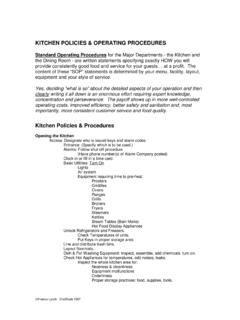
KITCHEN POLICIES & OPERATING PROCEDURES
www.menucha.orgGeneral Safety Rules &Procedures: Keep food temperatures below 40 (5C) and above 140 (60C). Understand and apply the principles of safe, sanitary food handling. (Key personnel should take the SERVE-SAFE course!) Do not work when you have a cold. Keep your hands CLEAN at all times. In emergencies, quick-thaw frozen food under cool (70°F ...

Safe operating procedures and equipment maintenance ...
education.qld.gov.auSafe operating procedures and equipment maintenance records for schools officers This fact sheet highlights the importance for safe operating procedures (SOPs) and equipment maintenance records (EMRs) for staff working within the role of schools officer (grounds and facilities) or other areas within the school where equipment is used.

Safe Operating Procedures Guide - maqohsc.sa.gov.au
www.maqohsc.sa.gov.auSafe operating procedures should be reviewed on a periodic basis, e.g. every 2 years, depending upon the level of risk, to ensure that the procedure remains current and appropriate. Reviews of safe operating procedures will be required sooner than two years in the event:

Safe Operating Procedures SOP 14 Fuelling Vehicles
www.une.edu.auSafe Operating Procedures This SOP should be used in conjunction with relevant machinery manuals and manufacturer recommendations. Procedure Reference Version Effective Date Review Date Page Number Date Printed WHS SOP 14 1.0 28/03/2018 28/03/2021 2 24/04/2018 allow for expansion of the tank. 3.

Safe Operating Procedures SOP 15 Oxy Acetylene Cutting ...
www.une.edu.auSafe Operating Procedures This SOP should be used in conjunction with relevant machinery manuals and manufacturer recommendations. Procedure Reference Version Effective Date Review Date Page Number Date Printed WHS SOP 15 1.0 28/03/2018 28/03/2021 2 24/04/2018 POTENTIAL HAZARDS 1. Explosion 2. Burns 3. Eye Injury 4. Fire and Explosion

Standard Operating Procedures Waste Handling & Disposal
www3.nd.eduStandard Operating Procedures Waste Handling & Disposal Handling and disposal of waste generated during laboratory experiments must be conducted in accordance with University policies. For a full description of waste handling and disposal procedures, see the University Chemical Hygiene Plan on the Risk Management website.