
Sample Space, Events and Probability
For any event E, we refer to P(E) as the probability of E. Here are some examples. Example 8 Tossing a fair coin. In this case, the probability measure is given by P(H) = P(T) = 1 2. If the coin is not fair, the probability measure will be di erent. Example 9 Tossing a fair die. In this case, the probability measure is given by P(1) = P(2 ...
Download Sample Space, Events and Probability

Information
Domain:
Source:
Link to this page:
Documents from same domain

Mathematical Logic (Math 570) Lecture Notes
faculty.math.illinois.edu2 CHAPTER 1. PRELIMINARIES all of mathematics. This era did not produce theorems in mathematical logic of any real depth, 1 but it did bring crucial progress of a conceptual nature, and the recognition that logic as used in mathematics obeys mathematical rules

Math 408, Spring 2008 Midterm Exam 2 Solutions
faculty.math.illinois.eduMath 408 Midterm Exam 2 Spring 2008 (b) Find the probability that the amount of the second claim is at least twice that of the first claim. Solution. Let X 1 and X 2 denote, respectively, the first and second claims. Then we need to compute P(X 2 …

Math 370/408, Spring 2008 Prof. A.J. Hildebrand Actuarial ...
faculty.math.illinois.eduMath 370/408 Spring 2008 Actuarial Exam Practice Problem Set 2 Solutions 1. [2-1] An insurance policy pays an individual 100 per day for up to 3 days of hospitalization and 25 per day for each day of hospitalization thereafter. The number of days of hospitalization, X, is a discrete random variable with probability function P(X = k) = (6−k

Even/odd proofs: Practice problems Solutions
faculty.math.illinois.eduSince the sum of two odd numbers is even (by Problem 1), s+t = p2 is even. Hence p, must be even as well (by Problem 2). Therefore p = 2h for some h 2Z, by the de nition of an even integer. 2. Math 347 Worksheet on \Even/odd" Proofs Solutions A.J. Hildebrand
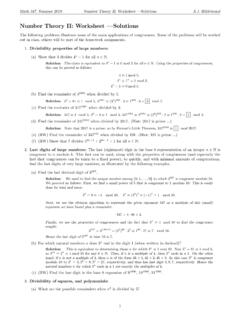
Number Theory II: Worksheet |Solutions
faculty.math.illinois.eduNext, we use the division algorithm to represent the given exponent 347 as a multiple of this (small) exponent we have found plus a remainder: 347 = 4 86 + 3: Finally, we use the properties of congruences and the fact that 34 1 mod 10 to nd the congruence sought: 3347 = 34 86+3 = (34)86 33 186 27 7 mod 10: Hence the last digit of 3347 in base ...
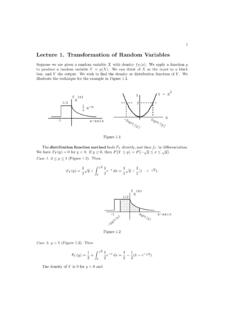
Lecture1.TransformationofRandomVariables
faculty.math.illinois.edu7 2.3ATypicalApplication Let Xand Ybe independent,positive random variables with densitiesf X and f Y,and let Z= XY.We find the density of Zby introducing a new random variable W,as follows: Z= XY, W= Y (W= Xwould be equally good).The transformation is one-to-one because we can solve for X,Yin terms of Z,Wby X= Z/W,Y= W.In a problem of this type,we must always

Math 220 Groupwok 10/12/17 Related Rates Word Problems
faculty.math.illinois.eduRelated Rates Word Problems SOLUTIONS (1)One car leaves a given point and travels north at 30 mph. Another car leaves 1 HOUR LATER, and travels west at 40 mph. At what rate is the distance between the cars changing at the instant the second car has been traveling for 1 hour? z x y Set up the problem by extracting information in terms of the ...
An Introduction to Complex Analysis and Geometry
faculty.math.illinois.eduOrthogonal trajectories and harmonic functions 97 5. A glimpse at harmonic functions 98 ... We de ne the exponential function by its power series and the cosine and sine functions by way of the exponential function. We can and therefore ... We also include sections on the Fourier transform on the Gamma function.
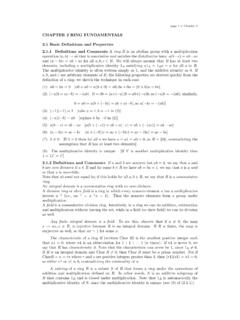
CHAPTER 2 RING FUNDAMENTALS 2.1 Basic Definitions and ...
faculty.math.illinois.edupage 1 of Chapter 2 CHAPTER 2 RING FUNDAMENTALS 2.1 Basic Definitions and Properties 2.1.1 Definitions and Comments A ringRis an abelian group with a multiplication operation (a,b) → abthat is associative and satisfies the distributive laws: a(b+c)=ab+acand (a+ b)c= ab+ acfor all a,b,c∈ R.We will always assume that Rhas at least two elements,including a multiplicative …
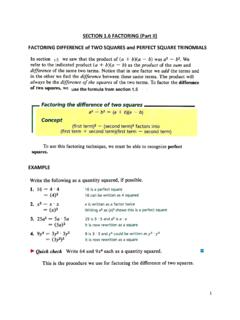
SECTION 1.6 FACTORING (Part II) FACTORING DIFFERENCE of ...
faculty.math.illinois.edu16 is a perfect square 16 can be written as 4 squared x is written as a factor twice Writing x2 as (x)2 shows this is a perfect square 25 is 5. 5 and a2 is a. a It is now rewritten as a square 9 is 3 3 and y4 could be written as It is now rewritten as a square > Quick check Write 64 and 9x4 each as a quantity squared.
Related documents
Notes on Probability
www.maths.qmul.ac.ukSet books The notes cover only material in the Probability I course. The text-books listed below will be useful for other courses on probability and statistics. You need at most one of the three textbooks listed below, but you will need the statistical tables. • Probability and Statistics for Engineering and the Sciences by Jay L. De-
Microeconomic Theory - OAL
people.tamu.eduMicroeconomic Theory Guoqiang TIAN Department of Economics Texas A&M University College Station, Texas 77843 (gtian@tamu.edu) August, 2002/Revised: February 2013 1This lecture notes are only for the purpose of my teaching and convenience of …

Introduction to Probability and Statistics Using R
ipsur.r-forge.r-project.orgSeasoned readers will be able to detect my origins: Probability and Statistical Inference by Hogg and Tanis [44], Statistical Inference by Casella and Berger [13], and Theory of Point Estimation/Testing Statistical Hypotheses by Lehmann [59, 58]. I highly recommend each of vii

Carlos Fernandez-Granda
cims.nyu.eduii. Contents 1 Basic Probability Theory1 ... In this chapter we introduce the mathematical framework of probability theory, which makes it possible to reason about uncertainty in a principled way using set theory. AppendixAcontains a review of basic set-theory concepts.
Statistical Decision Theory: Concepts, Methods and ...
probability.caPart I: Decision Theory – Concepts and Methods 5 dependent on θ, as stated above, is denoted as )Pθ(E or )Pθ(X ∈E where E is an event. It should also be noted that the random variable X can be assumed to be either continuous or discrete. Although, both cases are described here, the majority of this report focuses

PROBABILITY THEORY THE LOGIC OF SCIENCE
www.med.mcgill.cabook on probability theory. I struggled with this for some time, because there is no doubt in my mind that Jaynes wanted this book finished. Unfortunately, most of the later chapters, Jaynes’ intended volume 2 on applications, were either missing or incomplete, and some of …
Probability, Random Processes, and Ergodic Properties
ee.stanford.eduprobability theory point of view and postpone the topological metric space considerations until later. Nonstationary and nonergodic processes We develop the theory of asymptotically mean sta-tionary processes and the ergodic decomposition in order to model many physical processes better than can traditional stationary and ergodic processes.
Hand-book on STATISTICAL DISTRIBUTIONS for …
www.stat.rice.eduInternal Report SUF–PFY/96–01 Stockholm, 11 December 1996 1st revision, 31 October 1998 last modification 10 September 2007 Hand-book on STATISTICAL

Probability Theory and Statistics
web.math.ku.dkii the math boxes, but the interested and capable reader may find them illuminating. The formal mathematical prerequisites for reading the notes is a standard calculus course in addition to a few useful mathematical facts collected in an appendix. The ... 2 Probability Theory 13
Probability Theory: The Logic of Science
bayes.wustl.eduii PROBABILITY THEORY { THE LOGIC OF SCIENCE VOLUME I { PRINCIPLES AND ELEMENTARY APPLICATIONS Chapter 1 Plausible Reasoning 1 Deductive and Plausible Reasoning 1 Analogies with Physical Theories 3 The Thinking Computer 4 Introducing the Robot 5 Boolean Algebra 6 …