
Sample Space, Events and Probability
Probability theory is concerned with such random phenomena or random experiments. Consider a random experiment. The set of all the possible outcomes is called the sample space of the experiment and is usually denoted by S. Any subset E of the sample space S is called an event. Here are some examples.
Download Sample Space, Events and Probability

Information
Domain:
Source:
Link to this page:
Documents from same domain

Mathematical Logic (Math 570) Lecture Notes
faculty.math.illinois.edu2 CHAPTER 1. PRELIMINARIES all of mathematics. This era did not produce theorems in mathematical logic of any real depth, 1 but it did bring crucial progress of a conceptual nature, and the recognition that logic as used in mathematics obeys mathematical rules

Math 408, Spring 2008 Midterm Exam 2 Solutions
faculty.math.illinois.eduMath 408 Midterm Exam 2 Spring 2008 (b) Find the probability that the amount of the second claim is at least twice that of the first claim. Solution. Let X 1 and X 2 denote, respectively, the first and second claims. Then we need to compute P(X 2 …

Math 370/408, Spring 2008 Prof. A.J. Hildebrand Actuarial ...
faculty.math.illinois.eduMath 370/408 Spring 2008 Actuarial Exam Practice Problem Set 2 Solutions 1. [2-1] An insurance policy pays an individual 100 per day for up to 3 days of hospitalization and 25 per day for each day of hospitalization thereafter. The number of days of hospitalization, X, is a discrete random variable with probability function P(X = k) = (6−k

Even/odd proofs: Practice problems Solutions
faculty.math.illinois.eduSince the sum of two odd numbers is even (by Problem 1), s+t = p2 is even. Hence p, must be even as well (by Problem 2). Therefore p = 2h for some h 2Z, by the de nition of an even integer. 2. Math 347 Worksheet on \Even/odd" Proofs Solutions A.J. Hildebrand
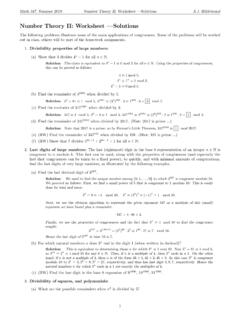
Number Theory II: Worksheet |Solutions
faculty.math.illinois.eduNext, we use the division algorithm to represent the given exponent 347 as a multiple of this (small) exponent we have found plus a remainder: 347 = 4 86 + 3: Finally, we use the properties of congruences and the fact that 34 1 mod 10 to nd the congruence sought: 3347 = 34 86+3 = (34)86 33 186 27 7 mod 10: Hence the last digit of 3347 in base ...
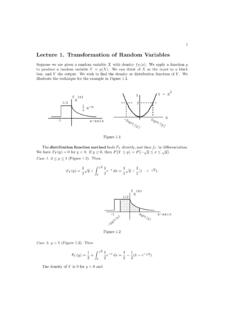
Lecture1.TransformationofRandomVariables
faculty.math.illinois.edu7 2.3ATypicalApplication Let Xand Ybe independent,positive random variables with densitiesf X and f Y,and let Z= XY.We find the density of Zby introducing a new random variable W,as follows: Z= XY, W= Y (W= Xwould be equally good).The transformation is one-to-one because we can solve for X,Yin terms of Z,Wby X= Z/W,Y= W.In a problem of this type,we must always

Math 220 Groupwok 10/12/17 Related Rates Word Problems
faculty.math.illinois.eduRelated Rates Word Problems SOLUTIONS (1)One car leaves a given point and travels north at 30 mph. Another car leaves 1 HOUR LATER, and travels west at 40 mph. At what rate is the distance between the cars changing at the instant the second car has been traveling for 1 hour? z x y Set up the problem by extracting information in terms of the ...
An Introduction to Complex Analysis and Geometry
faculty.math.illinois.eduOrthogonal trajectories and harmonic functions 97 5. A glimpse at harmonic functions 98 ... We de ne the exponential function by its power series and the cosine and sine functions by way of the exponential function. We can and therefore ... We also include sections on the Fourier transform on the Gamma function.
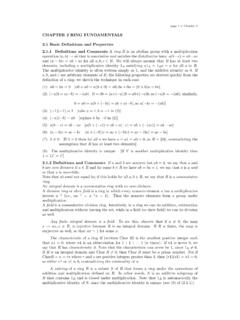
CHAPTER 2 RING FUNDAMENTALS 2.1 Basic Definitions and ...
faculty.math.illinois.edupage 1 of Chapter 2 CHAPTER 2 RING FUNDAMENTALS 2.1 Basic Definitions and Properties 2.1.1 Definitions and Comments A ringRis an abelian group with a multiplication operation (a,b) → abthat is associative and satisfies the distributive laws: a(b+c)=ab+acand (a+ b)c= ab+ acfor all a,b,c∈ R.We will always assume that Rhas at least two elements,including a multiplicative …
SECTION 1.6 FACTORING (Part II) FACTORING DIFFERENCE of ...
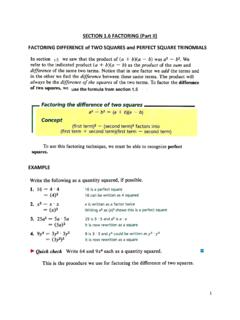
faculty.math.illinois.edu16 is a perfect square 16 can be written as 4 squared x is written as a factor twice Writing x2 as (x)2 shows this is a perfect square 25 is 5. 5 and a2 is a. a It is now rewritten as a square 9 is 3 3 and y4 could be written as It is now rewritten as a square > Quick check Write 64 and 9x4 each as a quantity squared.
Related documents
Review of Probability Theory - Stanford University
cs229.stanford.eduProbability theory is the study of uncertainty. Through this class, we will be relying on concepts from probability theory for deriving machine learning algorithms. These notes attempt to cover the basics of probability theory at a level appropriate for CS 229. The mathematical theory of probability

PROBABILITY THEORY THE LOGIC OF SCIENCE
www.med.mcgill.cainterest in probability theory was stimulated first by reading the work of Harold Jeffreys (1939) and realizing that his viewpoint makes all the problems of theoretical physics appear in a very different light. But then, in quick succession, discovery of the work of R. T. Cox

Probability Theory and Statistics
web.math.ku.dkity theory as the foundation for doing statistics. The probability theory will provide a framework, where it becomes possible to clearly formulate our statistical questions and to clearly express the assumptions upon which the answers rest.
Probability, Statistics, and Random Processes for ...
www.sze.huProbability theory is an inherently mathematical subject so concepts must be presented carefully,simply,and gradually.The axioms of probability and their corollaries are devel-oped in a clear and deliberate manner.The model-building aspect is introduced through
7 Probability Theory and Statistics - Harvard University
ads.harvard.edu7.1 Basic Aspects of Probability Theory We can find the conceptual origins of statistics in probability theory. While it is possible to place probability theory on a secure mathematical axiomatic basis, we shall rely on the commonplace notion of probability. Everyone has heard the phrase "the probability of snow for tomorrow 50%". While this sounds
Grinstead and Snell’s Introduction to Probability
math.dartmouth.edulishing a mathematical theory of probability. Today, probability theory is a well-established branch of mathematics that nds applications in every area of scholarly activity from music to physics, and in daily experience from weather prediction to …
A Short Introduction to Probability - University of Queensland
people.smp.uq.edu.auover, if the probability of failure within some time period is known for each of the engines, what is the probability of failure for the entire system? Again this can be viewed as a random experiment. Below are two more pictures of randomness. The rst is a computer-generated \plant", which looks remarkably like a real plant. The second is real data

Probability Theory: STAT310/MATH230;August 27, 2013
web.stanford.eduProbability, measure and integration This chapter is devoted to the mathematical foundations of probability theory. Section 1.1 introduces the basic measure theory framework, namely, the probability space and the σ-algebras of events in it. The next building blocks are random
Axioms of Probability - Purdue University
www.math.purdue.eduAxiomsofProbability SamyTindel Purdue University Probability-MA416 MostlytakenfromAfirstcourseinprobability byS.Ross Samy T. Axioms Probability Theory 1 / 69

QUEUING THEORY - Whitman College
www.whitman.eduity theory. In particular, we will review the exponential and Poisson probability distributions. 2.1. Exponential and Poisson Probability Distributions. The exponential distribution with parameter λ is given by λe−λt for t ≥ 0. If T is a random variable that represents interarrival times with the exponential distribution, then