
Schemas: Learning through play
Schemas: Learning through play For Scotland’s children, with Scotland’s parents Schematic Play Schematic play happens when babies, toddlers and young children are involved in repeated actions or certain behaviours as they explore the world around them and try to find out how things work. We call these specific actions or behaviours ...
Download Schemas: Learning through play

Information
Domain:
Source:
Link to this page:
Documents from same domain
Gaelic Education: Building on the successes, …
education.gov.scotGaelic Education: Building on the successes, addressing the barriers 1 Foreword The inspectorate has a strong and well-established commitment to promoting Gaelic
English for Speakers of Other Languages (ESOL)
education.gov.scotBackground . In 2015 – 16, £1,455,000 was allocated to Community Planning Partnerships to support the delivery of English for Speakers of Other Languages (ESOL) Programmes.
Learner Participation in Educational Settings (3-18)
education.gov.scotDefining Learner Participation Principles for Learner Participation: • equal opportunities for inclusive, voluntary participation • respect for children and young people’s …
How good is our school? (4th edition) - Education …
education.gov.scotHow good is our school? How good is our school? 4 5 Introduction This edition of How good is our school? aims to support the growth of a culture of self-improvement across Scottish education. It builds on previous editions
Rainbow Fish assembly resource - Education Scotland
education.gov.scotRainbow Fish assembly resource Stage Early stage (pre-school years and P1) Rationale Sometimes young children find sharing difficult. Using this story will help them see the benefits of doing this.
How good is OUR school? Part 1 - education.gov.scot
education.gov.scotHow good is OUR school? A toolkit to support learner participation in self-evaluation and school improvement. Part One 1 Contents Chief Executive Officer’s Foreword 2
Health and wellbeing - Education Scotland
education.gov.scotHealth and wellbeing: experiences and outcomes 2 Mental, emotional, social and physical wellbeing The mental, emotional, social and physical wellbeing of everyone within a learning community should be positively developed by fostering a safe, caring, supportive,
A professional development framework for Scotland's adult ...
education.gov.scot7 The Scottish Government, as part of the implementation of its ten-year strategy for raising the literacies levels of Scotland’s adults, has identified the need for a professional development
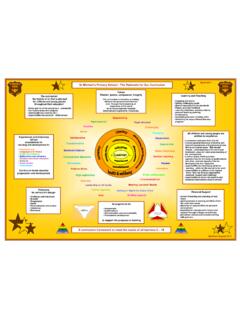
Evaluating and Improving our Curriculum – Primary ...
education.gov.scotEarly learning and Evaluating and Improving our Curriculum – Primary childcare The curriculum What is Curriculum for Excellence? What can learners expect? How is the curriculum organised? How is progress assessed? Building your curriculum Curriculum planning What is Building your Curriculum? Involving the school
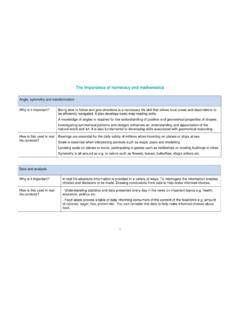
The importance of numeracy and mathematics
education.gov.scotThe importance of numeracy and mathematics 3 In order to make effects and digital images look so real in computer games, mathematicians and software developers make and use complicated equations of how human motion works.
Related documents
Learning To Play The Guitar – An Absolute Beginner’s Guide ...
www.learningtoplaytheguitar.netThis book is written for absolute beginners wanting to learn the basics of playing the guitar. By the end of the book you should be able to play many songs using a range of skills required to play the guitar. If you’ve always wanted to learn to play the guitar but didn’t know where to start this is the book for you.

Playing with Mathematics: Play in Early Childhood as a ...
files.eric.ed.govPlay has long been regarded as a critical element of early childhood curriculum and pedagogy. In addition to being recognised as a vehicle for learning, play is described as a context in which children can demonstrate their own learning and help scaffold the …

Learning and developing through play - Aistear Siolta
www.aistearsiolta.ieAistear: the Early Childhood Curriculum Framework Learning and developing through play Sometimes individual children like to play alone and sometimes they enjoy playing with others: Solitary play – The child plays alone. Spectator play – …

Learning to Play and Playing to Learn: Getting Ready for ...
www.beststart.org8 Learning to Play and Playing to Learn: Getting Ready for SchoolLearning to Play and Playing to Learn: Getting Ready for School Why is play important for learning? Play is the true work of a child. Children are busy when they are playing, and they are learning when they play. For example, when children are lifting, dropping, looking, pouring ...
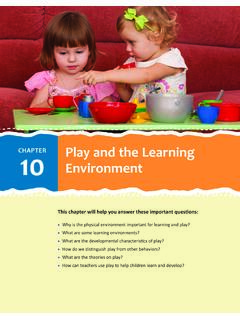
Play and the Learning Environment
www.sagepub.comIMPORTANT FOR LEARNING AND PLAY? A well-arranged environment should enhance children’s development through learning and play. It facilitates classroom management and supports the implementation of curricular goals and objectives (Catron & Allen, 2007). The way the physical environment is designed and configured

Learning through play - UNICEF
www.unicef.org6 Strengthening learning through play in early childhood education programmes Learning through play Scientific research over the past 30 years has taught us that the most important period of human development is from birth to eight years old.4 During these years, the development of cognitive skills, emotional well-being,