Second Order Linear Differential Equations
Any second order differential equation can be written as F(x,y,y0,y00)=0 This chapter is concerned with special yet very important second order equations, namely linear equations. Recall that a first order linear differential equation is an equation which can be written in the form y0 + p(x)y= q(x) where p and q are continuous functions on ...
Download Second Order Linear Differential Equations

Information
Domain:
Source:
Link to this page:
Documents from same domain

Lecture notes Math 4377/6308 { Advanced Linear …
www.math.uh.eduLecture notes Math 4377/6308 { Advanced Linear Algebra I Vaughn Climenhaga October 7, 2013

Lecture notes Math 4377/6308 { Advanced Linear …
www.math.uh.eduLecture notes Math 4377/6308 { Advanced Linear Algebra I Vaughn Climenhaga December 3, 2013

Section 3.2 Solving Systems of Linear Equations Using Matrices
www.math.uh.eduSection 3.2 – Solving Systems of Linear Equations Using Matrices 1. Section 3.2 Solving Systems of Linear Equations Using Matrices . In Section 1.3 we solved 2X2 systems of linear equations using either the substitution or

Test 2 Review - UH
www.math.uh.eduJiwen He, University of Houston Math 1431 – Section 24076, Test 2 Review October 28, 2008 32 / 69 Section 4.7 Vertical Aymptotes: Rational Function The line x = 4 is a vertical asymptote for

1 Definition and Properties of the Exp Function - UH
www.math.uh.edu1 Definition and Properties of the Exp Function 1.1 Definition of the Exp Function Number e Definition 1. The number e is defined by ... ∀x > 0, E L = elnx = x. • ∀x > 0, y = lnx ⇔ ey = x. • graph(ex) is the reflection of graph(lnx) by line y = x. ... eudu = eu +C = eg(x) +C.

Jiwen He 1.1 Geometric Series and Variations
www.math.uh.eduVariations on the Geometric Series (II) Closed forms for many power series can be found by relating the series to the geometric series Examples 2.
Chapter 3 Second Order Linear Differential Equations
www.math.uh.edusecond order linear differential equation: a second or- der, linear differential equation is an equation which can be written in the form y 00 + p ( x ) y 0 + q ( x ) y = f ( x ) (1)

Introduction to Real Analysis Fall 2014 Lecture Notes
www.math.uh.eduChapter 1 Metric Spaces These notes accompany the Fall 2011 Introduction to Real Analysis course 1.1 De nition and Examples De nition 1.1. Given a set X a metric on X is a function d: X X!R

Introduction to Real Analysis Spring 2014 Lecture Notes
www.math.uh.eduChapter 1 Sequences and Series of Functions In this chapter we introduce di erent notions of convergence for sequence and series of functions and then examine how integrals and derivatives be-

Math 1313 Section 3.4 Section 3.4: Matrix Multiplication 1 ...
www.math.uh.eduMath 1313 Section 3.4 . Section 3.4: Matrix Multiplication . If A is a matrix of size m x n and B is a matrix of size n x p then the product AB is defined and is a matrix of size m x p. So, two matrices can be multiplied if and only if the number of columns in the first matrix is equal
Related documents
ELEMENTARY DIFFERENTIAL EQUATIONS
ramanujan.math.trinity.eduThe second order Euler equationis discussed in Section 7.4, where it sets the stage for the method of Frobenius. As noted at the beginning of Section 7.4, if you want to include Euler equations in
Second Order Differential Equations
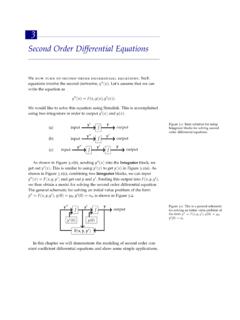
people.uncw.edusecond order differential equations 45 x 0 0.5 1 1.5 2 2.5 3 3.5 4 4.5 5 y 0 0.05 0.1 0.15 y(x) vs x Figure 3.4: Solution plot for the initial value problem y00+ 5y0+ 6y = 0, y(0) = 0, y0(0) = 1 using Simulink. Recall the solution of this problem is found by first seeking the
Second Order Linear Differential Equations
www.math.utah.eduSecond Order Linear Differential Equations 12.1. Homogeneous Equations A differential equation is a relation involvingvariables x y y y . A solution is a function f x such that the substitution y f x y f x y f x gives an identity. The differential equation is said to be linear if it is linear in the variables y y y .
First-Order Differential Equations and Their Applications
assets.press.princeton.eduThe order of a differential equation is the order of the highest derivative of the unknown function (dependent variable) that appears in the equation. The differential equations in (1) are of first, second, and fourth order, respectively. Most of the equations we shall deal with will be of first or second order.
Second Order Linear Differential Equations
www.personal.psu.educharacteristic equation; solutions of homogeneous linear equations; reduction of order; Euler equations In this chapter we will study ordinary differential equations of the standard form below, known as the second order linear equations: y″ + p(t) y′ + q(t) y = g(t). Homogeneous Equations: If g(t) = 0, then the equation above becomes y ...
Second Order Linear Partial Differential Equations Part I
www.personal.psu.eduinto a simultaneous system of 2 ordinary differential equations. They are a second order homogeneous linear equation in terms of x, and a first order linear equation (it is also a separable equation) in terms of t. Both of them can be solved easily using what we …

First Order Partial Differential Equations
people.uncw.edu2 partial differential equations Second order partial derivatives could be written in the forms ¶2u ¶x2,uxx,¶xxu, D2xu. ¶2u ¶x¶y ¶2u ¶y¶x,uxy,¶xyu, DyDxu. Note, we are assuming that u(x,y,. . .) has continuous partial derivatives.
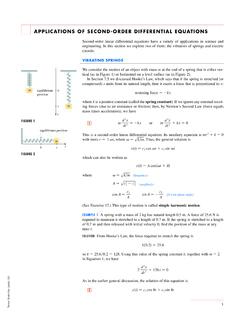
APPLICATIONS OF SECOND-ORDER DIFFERENTIAL …
www.math.pitt.edu4 APPLICATIONS OF SECOND-ORDER DIFFERENTIAL EQUATIONS FORCED VIBRATIONS Suppose that, in addition to the restoring force and the damping force, the motion of the spring is affected by an external force . Then Newton’s Second Law gives Thus, instead of the homogeneous equation (3), the motion of the spring is now governed
Second Order Differential Equation Non Homogeneous
bionics.seas.ucla.eduSecond Order Linear Differential Equations – Homogeneous & Non Homogenous v • p, q, g are given, continuous functions on the open interval I ¯ ® c ( ) 0 ( ) ( ) g t y p t y q t y Homogeneous Non-homogeneous

Second Order Systems
www.et.byu.eduSecond Order Systems Second Order Equations 2 2 +2 +1 = s s K G s τ ζτ Standard Form τ2 d 2 y dt2 +2ζτ dy dt +y =Kf(t) Corresponding Differential Equation K = Gain τ= Natural Period of Oscillation ζ= Damping Factor (zeta) Note: this has to be 1.0!!!