Second Order Linear Differential Equations
12.1 Homogeneous Equations 177 Now unfortunately a quadratic equation does not necessarily always have two real roots, so we have to examine the cases separately. Case of two real roots. If the discriminant a2 4b 0, then there are two real roots, and it is straight-forward to find the solution of the corresponding initial value problem.
Download Second Order Linear Differential Equations

Information
Domain:
Source:
Link to this page:
Documents from same domain
Systems of Differential Equations - Math
www.math.utah.edu522 Systems of Differential Equations Let x1(t), x2(t), x3(t) denote the amount of salt at time t in each tank. We suppose added to tank A water containing no salt. Therefore, the salt in all the tanks is eventually lost from the drains.
Laplace Transform - Home - Math
www.math.utah.eduLaplace Transform The Laplace transform can be used to solve di erential equations. Be-sides being a di erent and e cient alternative to variation of parame-ters and undetermined coe cients, the Laplace method is particularly advantageous for input terms that are piecewise-de ned, periodic or im-
Vector Calculus - Math
www.math.utah.eduCHAPTER 18 Vector Calculus In this chapter we develop the fundamental theorem of the Calculus in two and three dimensions. This begins with a slight reinterpretation of that theorem.
Second Order Linear Differential Equations
www.math.utah.edu12.2 Behavior of the Solutions 179 Example 12.6 Find the solution y y x of y 2y 5y 0, with the initial values y 0 2 y 0 1. The auxiliary equation r2 2r 5 0 has the solutions r

Quadratic Equations By Factoring - Math
www.math.utah.eduSolving Quadratic Equations By Factoring Date_____ Period____ Solve each equation by factoring. 1) (3 n − 2)(4n ... If a quadratic equation cannot be factored then it will have at least one imaginary solution. False (Example, x2 = 10 )-2-Title: Quadratic Equations By Factoring

Magic Squares and Modular Arithmetic - Math
www.math.utah.eduIntroductory problems 1. Find a magic square of order three whose first row is 0 8 4 2. Find a magic square of order three whose first row is 1 8 3

Multivariable Mathematics with Maple
www.math.utah.eduMultivariable Mathematics with Maple Linear Algebra, Vector Calculus and Difierential Equations by James A. Carlson and Jennifer M. Johnson °c 1996 Prentice-Hall

LECTURE NOTES ON DONSKER’S THEOREM - Math
www.math.utah.eduLECTURE NOTES ON DONSKER’S THEOREM DAVARKHOSHNEVISAN ABSTRACT.Some course notes on Donsker’s theorem. These are for Math7880-1(“TopicsinProbability”),taughtattheDeparmentofMath-

9.3 Geometric Sequences and Series - math.utah.edu
www.math.utah.edu9.3 Geometric Sequences and Series In sections 9.3 you will learn to: • Recognize, write and find the nth terms of geometric sequences. ... • Use geometric sequences to model and solve real-life problems. A sequence a 1, a 2, a 3, ... ,a n is said to be geometric is the ratio between consecutive terms remains constant.

Sequences and Series Review - Math
www.math.utah.edu2 A sequence {a n} is a function such that the domain is the set of positive integers and the range is a set of real numbers. Write five terms for each of these sequences: A series is the sum of a sequence. A partial sum is the sum of the first n terms. An infinite sum …
Related documents
Two-Step Equations Date Period - cdn.kutasoftware.com
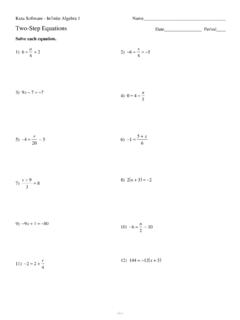
cdn.kutasoftware.comTwo-Step Equations Date_____ Period____ Solve each equation. 1) 6 = a 4 + 2 2) −6 + x 4 = −5 3) 9x − 7 = −7 4) 0 = 4 + n 5 5) −4 = r 20 − 5 6) −1 = 5 + x 6 7) v + 9 3 = 8 8) 2(n + 5) = −2 9) −9x + 1 = −80 10) −6 = n 2 − 10 11) −2 = 2 + v 4 12 ...
Two-Step Equations Date Period - cdn.kutasoftware.com
cdn.kutasoftware.comTwo-Step Equations Date_____ Period____ Solve each equation. 1) 6 = a 4 + 2 2) −6 + x 4 = −5 3) 9x − 7 = −7 4) 0 = 4 + n 5 5) −4 = r 20 − 5 6) −1 = 5 + x 6 7) v + 9 3 = 8 8) 2(n + 5) = −2 9) −9x + 1 = −80 10) −6 = n 2 − 10 11) −2 = 2 + v 4 12 ...
Second Order Linear Partial Differential Equations Part I
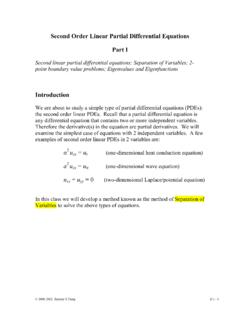
www.personal.psu.eduequations, together with a set of two boundary conditions that go with the equation of the spatial variable x: X ″ + λX = 0, X(0) = 0 and X(L) = 0, T ′ + α 2 λ T = 0. The general solution (that satisfies the boundary conditions) shall be solved from this system of simultaneous differential equations. Then the initial condition u(x, 0) = f

8.7 Solve Two-Step Equations with Fraction Coefficients
www.millikanmiddleschool.orgAug 14, 2015 · 8.7 Solve Two-Step Equations with Fraction Coefficients Common Core Standards 8. EE.7. Solve linear equations in one variable. a. Give examples of linear equations in one variable with one solution, infinitely many solutions, or no solutions. Show which of these possibilities is the case by successively transforming the given

Solving Multi-Step Equations - cdn.kutasoftware.com
cdn.kutasoftware.com21) Explain two ways you could solve 20 = 5(−3 + x) -2- ©D 72 g061 U1Y 5K Uu Ptxat nSTozfHtKw4aDr Fe y yLzLpCJ. j j uA xl Fl H frzi Ngvh ntwsf 9r Desje Lrmv3eGdj. g b gM da gdke N Lw6ixtWhX CIenWf4i on Pijt1e L TAHlWgfe rb UrTa0 m2O.b Worksheet by Kuta Software LLC
Solving Two-Step Equations - Weebly
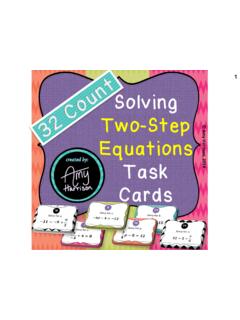
msrobinsondoesmath.weebly.comSolving Two- Step Equations Task Cards 17 -32 . 32. Solving Two- Step Equations Task Cards 1 -8 . Solving Two- Step Equations Task Cards 9 -16 = = =: ...

Second Order Linear Partial Differential Equations Part IV
www.personal.psu.eduThe second type of second order linear partial differential equations in 2 independent variables is the one-dimensional wave equation. Together with the heat conduction equation, they are sometimes referred to as the “evolution equations” because their solutions “evolve”, or change, with passing time.

SOLVING ONE AND TWO STEP EQUATIONS MAZES
learnbps.bismarckschools.org3x%–7%=17% x%=C8% C3x%–5%=10% % x%=6% % 6%=4x%C%10% x%=6% x%=18% % x%=C5% % x%%=1% % 6x%–1%=5% x%=0% 5%C%2x%=12% % 8%–3x%=%8% % Cx%+5%=10% 2x%+3%=11% x%=4% ...
To Solve a Two-Step Equation - Loudoun County Public …
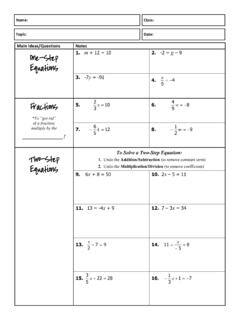
www.lcps.orgEquations To Solve a Two-Step Equation: 1.Undo the Addition/Subtraction (to remove constant term) 2.Undo the Multiplication/Division (to remove coefficient) 9. 6x + 8 = 50 10.2x – 5 = 11 11. 13 = -4x + 9 12.7 – 3x = 34 13. 7 9 2 − = x 14. 8 5

Two-Step Equations: Decimals Sheet 1 - Worksheets for Kids
www.mathworksheets4kids.comTwo-Step Equations: Decimals Name : Printable Worksheets @ www.mathworksheets4kids.com. 1) 0.4x + 2.9 = 1.5 x = ±3.5 2) 3) 5) 14.2 = 2(±5.8 + t) t = 12.9 6) 8) ±1.3g + 1.9 = ±11.1 g = 10 9) ±5.1 ± z = 6.5 z = ±11.6 10) ±14.3 = ±1.4 ± 3d d = 4.3 Solve each equation. Sheet 1 Answer Key a = 30.2 7 = a ± 9.2 3 k = 2.1