Second Order Linear Differential Equations
Second Order Linear Differential Equations 12.1. Homogeneous Equations A differential equation is a relation involvingvariables x y y y . A solution is a function f x such that the substitution y f x y f x y f x gives an identity. The differential equation is said to be linear if it is linear in the variables y y y .
Download Second Order Linear Differential Equations

Information
Domain:
Source:
Link to this page:
Documents from same domain
Systems of Differential Equations - Math
www.math.utah.edu522 Systems of Differential Equations Let x1(t), x2(t), x3(t) denote the amount of salt at time t in each tank. We suppose added to tank A water containing no salt. Therefore, the salt in all the tanks is eventually lost from the drains.
Laplace Transform - Home - Math
www.math.utah.eduLaplace Transform The Laplace transform can be used to solve di erential equations. Be-sides being a di erent and e cient alternative to variation of parame-ters and undetermined coe cients, the Laplace method is particularly advantageous for input terms that are piecewise-de ned, periodic or im-
Vector Calculus - Math
www.math.utah.eduCHAPTER 18 Vector Calculus In this chapter we develop the fundamental theorem of the Calculus in two and three dimensions. This begins with a slight reinterpretation of that theorem.
Second Order Linear Differential Equations
www.math.utah.edu12.2 Behavior of the Solutions 179 Example 12.6 Find the solution y y x of y 2y 5y 0, with the initial values y 0 2 y 0 1. The auxiliary equation r2 2r 5 0 has the solutions r

Quadratic Equations By Factoring - Math
www.math.utah.eduSolving Quadratic Equations By Factoring Date_____ Period____ Solve each equation by factoring. 1) (3 n − 2)(4n ... If a quadratic equation cannot be factored then it will have at least one imaginary solution. False (Example, x2 = 10 )-2-Title: Quadratic Equations By Factoring

Magic Squares and Modular Arithmetic - Math
www.math.utah.eduIntroductory problems 1. Find a magic square of order three whose first row is 0 8 4 2. Find a magic square of order three whose first row is 1 8 3

Multivariable Mathematics with Maple
www.math.utah.eduMultivariable Mathematics with Maple Linear Algebra, Vector Calculus and Difierential Equations by James A. Carlson and Jennifer M. Johnson °c 1996 Prentice-Hall

LECTURE NOTES ON DONSKER’S THEOREM - Math
www.math.utah.eduLECTURE NOTES ON DONSKER’S THEOREM DAVARKHOSHNEVISAN ABSTRACT.Some course notes on Donsker’s theorem. These are for Math7880-1(“TopicsinProbability”),taughtattheDeparmentofMath-

9.3 Geometric Sequences and Series - math.utah.edu
www.math.utah.edu9.3 Geometric Sequences and Series In sections 9.3 you will learn to: • Recognize, write and find the nth terms of geometric sequences. ... • Use geometric sequences to model and solve real-life problems. A sequence a 1, a 2, a 3, ... ,a n is said to be geometric is the ratio between consecutive terms remains constant.

Sequences and Series Review - Math
www.math.utah.edu2 A sequence {a n} is a function such that the domain is the set of positive integers and the range is a set of real numbers. Write five terms for each of these sequences: A series is the sum of a sequence. A partial sum is the sum of the first n terms. An infinite sum …
Related documents
ELEMENTARY DIFFERENTIAL EQUATIONS
ramanujan.math.trinity.eduThe second order Euler equationis discussed in Section 7.4, where it sets the stage for the method of Frobenius. As noted at the beginning of Section 7.4, if you want to include Euler equations in
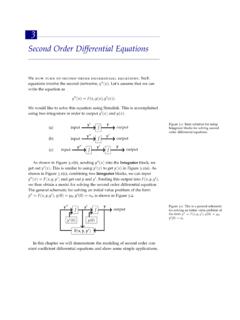
Second Order Differential Equations
people.uncw.edusecond order differential equations 45 x 0 0.5 1 1.5 2 2.5 3 3.5 4 4.5 5 y 0 0.05 0.1 0.15 y(x) vs x Figure 3.4: Solution plot for the initial value problem y00+ 5y0+ 6y = 0, y(0) = 0, y0(0) = 1 using Simulink. Recall the solution of this problem is found by first seeking the
Second Order Linear Differential Equations
www.math.uh.eduAny second order differential equation can be written as F(x,y,y0,y00)=0 This chapter is concerned with special yet very important second order equations, namely linear equations. Recall that a first order linear differential equation is an equation which can be written in the form y0 + p(x)y= q(x) where p and q are continuous functions on ...
First-Order Differential Equations and Their Applications
assets.press.princeton.eduThe order of a differential equation is the order of the highest derivative of the unknown function (dependent variable) that appears in the equation. The differential equations in (1) are of first, second, and fourth order, respectively. Most of the equations we shall deal with will be of first or second order.
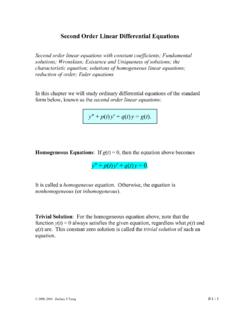
Second Order Linear Differential Equations
www.personal.psu.educharacteristic equation; solutions of homogeneous linear equations; reduction of order; Euler equations In this chapter we will study ordinary differential equations of the standard form below, known as the second order linear equations: y″ + p(t) y′ + q(t) y = g(t). Homogeneous Equations: If g(t) = 0, then the equation above becomes y ...
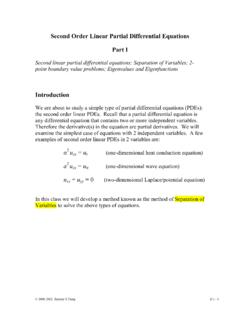
Second Order Linear Partial Differential Equations Part I
www.personal.psu.eduinto a simultaneous system of 2 ordinary differential equations. They are a second order homogeneous linear equation in terms of x, and a first order linear equation (it is also a separable equation) in terms of t. Both of them can be solved easily using what we …

First Order Partial Differential Equations
people.uncw.edu2 partial differential equations Second order partial derivatives could be written in the forms ¶2u ¶x2,uxx,¶xxu, D2xu. ¶2u ¶x¶y ¶2u ¶y¶x,uxy,¶xyu, DyDxu. Note, we are assuming that u(x,y,. . .) has continuous partial derivatives.
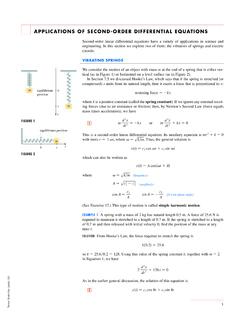
APPLICATIONS OF SECOND-ORDER DIFFERENTIAL …
www.math.pitt.edu4 APPLICATIONS OF SECOND-ORDER DIFFERENTIAL EQUATIONS FORCED VIBRATIONS Suppose that, in addition to the restoring force and the damping force, the motion of the spring is affected by an external force . Then Newton’s Second Law gives Thus, instead of the homogeneous equation (3), the motion of the spring is now governed
Second Order Differential Equation Non Homogeneous
bionics.seas.ucla.eduSecond Order Linear Differential Equations – Homogeneous & Non Homogenous v • p, q, g are given, continuous functions on the open interval I ¯ ® c ( ) 0 ( ) ( ) g t y p t y q t y Homogeneous Non-homogeneous

Second Order Systems
www.et.byu.eduSecond Order Systems Second Order Equations 2 2 +2 +1 = s s K G s τ ζτ Standard Form τ2 d 2 y dt2 +2ζτ dy dt +y =Kf(t) Corresponding Differential Equation K = Gain τ= Natural Period of Oscillation ζ= Damping Factor (zeta) Note: this has to be 1.0!!!