
Second Order Systems
Response of 2nd Order Systems to Step Input ( 0 < ζ< 1) 1. Rise Time: tr is the time the process output takes to first reach the new steady-state value. 2. Time to First Peak: tp is the time required for the output to reach its first maximum value. 3. Settling Time: …
Download Second Order Systems

Information
Domain:
Source:
Link to this page:
Documents from same domain

table of laplace transforms - Educating Global Leaders
www.et.byu.edutable of laplace transforms 1 f(t) f(s) tn n = 1,2,... s > 0 † n! † sn+1 1 s2 † t † ta † a>-1 † G(a+1) sa+1 s > 0 † eat † teat † tneat † 1 s-a † 1 (s-a)2 † n! ... Laplace transform is calculated with the command laplace (f(t),t,s): f(t) denotes the function to be transformed,

Chapter 5 Special Functions
www.et.byu.eduChapter 5 SPECIAL FUNCTIONS Chapter 5 SPECIAL FUNCTIONS Introduction In this chapter we summarize information about several functions which are widely used for mathematical modeling in engineering. Some of them play a supplemental role, while the others, such as the Bessel and Legendre functions, are of primary importance. ...

CHAPTER 3 PRESSURE AND FLUID STATICS
www.et.byu.edu(a) The fluid level in the arm attached to the tank is higher (vacuum): PP P . . .abs atm vac 12 7 1 26 11 44 psia 11.4 psia (b) The fluid level in the arm attached to the tank is lower: PP P . . .abs gage atm 12 7 1 26 13 96 psia 14.0 psia Discussion The final results are reported to three significant digits. Note

Chapter 2 Ordinary Differential Equations
www.et.byu.eduChapter 2 Ordinary Differential Equations (PDE). In Example 1, equations a),b) and d) are ODE’s, and equation c) is a PDE; equation e) can be considered an ordinary differential equation with the parameter t. Differential operator D It is often convenient to use a special notation when dealing with differential equations.
CHAPTER 6 MOMENTUM ANALYSIS OF FLOW SYSTEMS
www.et.byu.edutorque, the angular momentum remains constant, but the angular velocity changes in accordance with I = constant where I is the moment of inertia of the body. Discussion Angular momentum is analogous to linear momentum in this way: Linear momentum does not change unless a force acts on it. Angular momentum does not change unless a torque acts on it.

CHAPTER 5 BERNOULLI AND ENERGY EQUATIONS
www.et.byu.edu5-1 Solutions Manual for Fluid Mechanics: Fundamentals and Applications Third Edition Yunus A. Çengel & John M. Cimbala McGraw-Hill, 2013 CHAPTER 5 BERNOULLI AND ENERGY EQUATIONS PROPRIETARY AND CONFIDENTIAL This Manual is the proprietary property of The McGraw-Hill Companies, Inc.

1 HOMOGENEOUS TRANSFORMATIONS - Ira A. Fulton …
www.et.byu.edusimple 4 x 4 transformation is used in the geometry engines of CAD systems and in the kinematics model in robot controllers. It is very useful for examining rigid-body position and orientation (pose) of a sequence of robotic links and joint frames. Script Notation: Pre super- and pre sub-scripts are often used to denote frames of reference B
Related documents
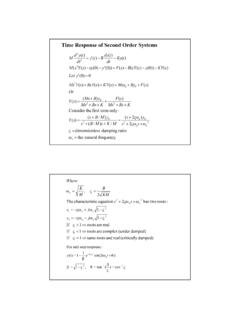
Time Response of Second Order Systems - Mercer University
faculty.mercer.eduFor second order system, we seek for which the response remains within 2% of the final value. This occurs approximately when: Hence the settling time is defined as 4 time constants. T s δ T s n s n s T T T e n s ζω τ ζω ζω 4 4 Therefore: or: 4 0.02 ≅ = ≅ − < Explicit relations for and:

Playing by the Rules - HUD
www.hud.govmanagement, administrative systems, documentation, and record keeping. Many of these problems are attributed to: • Limited experience in dealing with Federally-funded programs. • Lack of adequate staffing or financial resources available on a consistent basis. • Limited understanding about how to meet the complex administrative requirements

Systems of First Order Linear Differential Equations
www.personal.psu.eduSystems of First Order Linear Differential Equations We will now turn our attention to solving systems of simultaneous homogeneous first order linear differential equations. The solutions of such systems require much linear algebra (Math 220). But since it is not a prerequisite for this course, we have to limit ourselves to the simplest
Intoduction to Filing Systems - esc1.net
www.esc1.netAlthough numeric systems are indirect systems (an index is required), they frequently are the fastest to use and produce fewer errors. Numbers are less likely to be misfiled than letters and misfiles are easier to detect. Once developed, this is the easiest type of filing system to use and lends itself very well to color-coding.