SECURITY REQUIREMENTS FOR CRYPTOGRAPHIC MODULES
This standard specifies the security requirements that will be satisfied by a cryptographic module utilized within a security system protecting sensitive but unclassified information (hereafter referred to as sensitive information). The standard provides four increasing, qualitative levels of security: Level 1, Level 2, Level 3, and Level 4.
Download SECURITY REQUIREMENTS FOR CRYPTOGRAPHIC MODULES

Information
Domain:
Source:
Link to this page:
Documents from same domain
ITL Bulletin Guidelines for Securing Wireless Local …
csrc.nist.govWireless networks, like other communications networks, ... NIST SP 800-153, Guidelines for Securing Wireless Local Area Networks (WLANs), was
Windows 7 BitLocker FIPS Security Policy - NIST
csrc.nist.govWindows 7 BitLocker™ Drive Encryption is a data protection feature available in Windows® 7 Enterprise and Ultimate for client computers and in Windows Server 2008 R2. BitLocker is Microsoft’s response to one of our
An information exchange For Information Security and ...
csrc.nist.govIdentity, Credential, and Access Management ICAM ICAM represents the intersection of digital identities, credentials, and access control into one comprehensive approach.
A Random Zoo: Sloth, Unicorn and trx - NIST
csrc.nist.govsloth, described in Section 3 (and pronounced “slow th”), a new approach to public randomness selection, unicorn, is proposed in Section 4: unicorn results in a
Port Authority Series PA111-SA CDI 01-03-0912B
csrc.nist.govThe Port Authority is designed primarily to protect firewall/router console port access. The device was designed to overcome the weaknesses of RADIUS and TACACS+ for remote access authentication. The problem of the firewall/router not being able to contact
HikSSL Cryptographic Module version 1.0.0 FIPS 140-2 Non ...
csrc.nist.govHangzhou Hikvision Digital Technology Co., Ltd. affirms that the module runs correctly on the following network camera and NVR models: • Network Cameras: model names starting with DS-2CD2.
A Method for Quantitative Risk Analysis - NIST
csrc.nist.govIt does, however, present its results in a management-friendly form of monetary values, percentages, and probabilities. Since the Office of Management and ... A Method for Quantitative Risk Analysis James W. Meritt. There are two primary methods of risk analysis: Analysis.
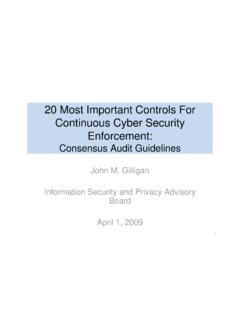
20 Most Important Controls For Continuous Cyber Security ...
csrc.nist.govTopics • Background • Philosophy and Approach for the “20 Most Important Security Controls” • Control Examples and List of Controls
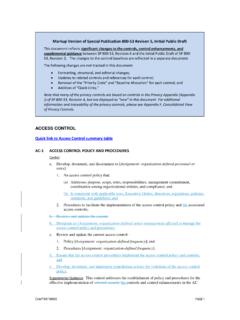
J) of SP 800 - NIST Computer Security Resource Center
csrc.nist.govbetween SP 800-53, Revision 4 and the Initial Public Draft of SP 800- 53, Revision 5. The changes to the control baselines are reflected in a separate document.
Publication Number: NIST Special Publication (SP) 800-53 ...
csrc.nist.govThe Special Publication 800-series reports on ITL’s research, guidelines, and outreach efforts in information system security, and its collaborative activities …
Related documents

Data Encryption Standard (DES) - Cleveland State University
academic.csuohio.edu144 Cryptography and Network Security symmetric-key block cipher since its publication. NIST later issued a new standard (FIPS 46-3) that recommends the use of triple DES (repeated DES cipher three times) for future applications. As we will see in Chapter 7, AES, the recent standard, is supposed to replace DES in the long run. 6.1.2 Overview

Lecture 3: Block Ciphers and the Data Encryption Standard ...
engineering.purdue.eduComputer and Network Security by Avi Kak Lecture3 BacktoTOC 3.2 THE FEISTEL STRUCTURE FOR BLOCK CIPHERS The DES (Data Encryption Standard) algorithm for encryption and decryption, which is the main theme of this lecture, is based on what is known as the Feistel Structure. This section and the next two subsections introduce this structure:

Application Security Verification Standard 3 - OWASP
owasp.orgThe Application Security Verification Standard is a list of application security requirements or tests that can be used by architects, developers, testers, security professionals, and even consumers to define what a secure

HIPAA Security Series #5 - Organizational, Policies and ...
www.hhs.govApr 20, 2005 · end of the Security Rule, but must- not be overlooked by covered entities. These requirements must be implemented to achieve compliance. The objectives of this paper are to: Review each Organizational Requirements- and Policies and Procedures and Documentation Requirements standard and implementation specification listed in the Security Rule. -

Standard Form 86 QUESTIONNAIRE FOR OMB No. 3206 …
www.opm.govNATIONAL SECURITY POSITIONS. Standard Form 86 Revised December 2010 U.S. Office of Personnel Management 5 CFR Parts 731, 732, and 736 Form approved: OMB No. 3206 0005 . 6. Place of birth requires Country entry, even if in the U.S.
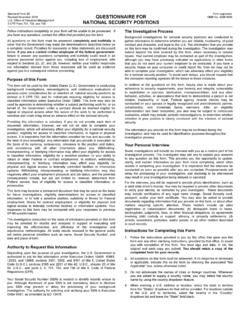
Standard Form 86 - Questionnaire for National Security
www.opm.govNATIONAL SECURITY POSITIONS. Standard Form 86 Revised November 2016 U.S. Office of Personnel Management 5 CFR Parts 731, 732, and 736 Form approved: OMB No. 3206 0005 . The U.S. Criminal Code (title 18, section 1001) provides that knowingly falsifying or concealing a material fact is a felony which may result in fines and/or up to . five (5)
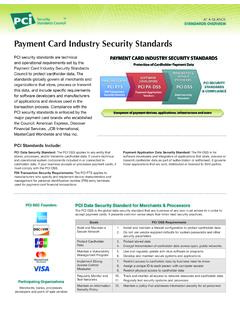
Payment Card Industry Security Standards
www.pcisecuritystandards.orgPCI Data Security Standard for Merchants & Processors The PCI DSS is the global data security standard that any business of any size must adhere to in order to accept payment cards. It presents common sense steps that mirror best security practices. Goals PCI DSS Requirements Build and Maintain a Secure Network 1.