
Self-Assessment Tools - Responsive Classroom
expectations for proficient work—level 3—with space for teachers to note ways in which a student’s work falls short of or surpasses this standard. (See page 161 for examples.) Whether you choose a multi-point or single-point format, your rubrics should provide students with important guidelines without constraining creativity.
Download Self-Assessment Tools - Responsive Classroom

Information
Domain:
Source:
Link to this page:
Documents from same domain
INTRODUCTION Knowing Fifth Graders - …
www.responsiveclassroom.orgFifth Graders C O N T I N U E D Common Characteristics School implications Language 6 the information in this chart is based on Yardsticks: Children in the Classroom Ages 4–14,3rd ed., by Chip Wood (Northeast Foundation
16 If I Were - Responsive Classroom
www.responsiveclassroom.orgcharacters, fairy tale characters Animals in the jungle, in the sea, on a farm, etc. Cities in our state States, capitals Famous people Countries, rivers, mountains Sports, sport teams Things that . . . grow, are round, are green, float, are made of . . . 3. If the student is …
INTRODUCTION Knowing Third Graders
www.responsiveclassroom.org1 S o you’re about to teach third grade? You’re in for a treat! As I talk to teachers all over the country, I keep hearing third grade teachers make statements like these:
INTRODUCTION Knowing Fifth Graders - Responsive …
www.responsiveclassroom.orgn Large muscles developing quickly. n Drawn to the outdoors and physical challenges. n handwriting may become messier than in fourth grade. n Due to growth spurts, frequently hungry and can tire easily. n Set up schedules to include sufficient time for recess (and other outdoor play), ener-gizers and other movement breaks, snacks, and lunch.
Knowing Second Graders - Responsive Classroom
www.responsiveclassroom.org6 try hard to make their work perfect. enjoy repeating tasks and reviewing learning. enjoy inquiry and hands-on tasks; often wilt under time pressure. Need frequent check-ins with the teacher. Like to classify and sort. enjoy board and computer games. expect high-quality finished products. Give open-ended assignments (write about a topic in their own words, inves-
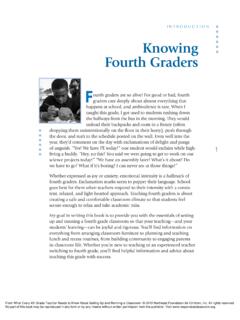
INTRODUCTION Knowing Fourth Graders
www.responsiveclassroom.orgmost fourth graders can be successful with these sorts of tasks if we set them up for success through building a safe classroom community. To learn more about child development, see the resources listed at the end of this book. 4 From What Every 4th Grade Teacher Needs to Know About Setting Up and Running a Classroom.
Sample Morning Meetings - Responsive Classroom
www.responsiveclassroom.orgResponsive Classroom ® ... literacy skills. Morning message helps children settle down after the lively activity and serves as a transition to the rest of the school day. ... for children to practice social-emotional and academic skills that carry over to the rest of the day.
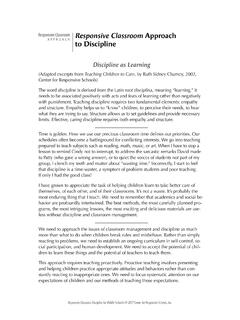
Responsive Classroom Approach
www.responsiveclassroom.orgResponsive Classroom Discipline Framework COMPONENT Laying the foundation for positive behavior GOAL To create and maintain a positive learning community and to teach self-regulation. PRACTICES • Teaching routines • Establishing rules and expectations • Investing students in rules • Setting goals
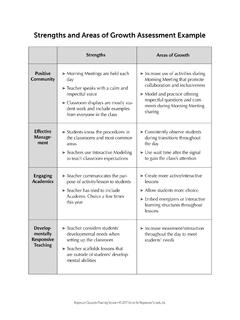
Strengths and Areas of Growth Assessment Example
www.responsiveclassroom.orgManage - ment Engaging Academics Develop-mentally Responsive Teaching Strengths and Areas of Growth Assessment Example Strengths Areas of Growth Morning Meetings are held each day Teacher speaks with a calm and respectful voice Classroom displays are mostly stu - dent work and include examples from everyone in the class
Related documents

Enhancing Students’ Participation in Classroom Group ...
www.ijsrp.orgclassroom and what teachers do to foster greater participation specifically in group discussions. Accordingly, ... Ground rules are a set of guidelines describing behaviors that may improve a group’s process. Usually the ... so that students have …
EARLY LEARNING GUIDELINES FOR CHILDREN
www.okdhs.orgguidelines are a resource with commonly held expectations and widely accepted best practices for children. At the same ... same learning space. H Provide exposure to a wide variety of information and literacy experiences, and the use of appropriate ... classroom environment. Teachers will make sure each
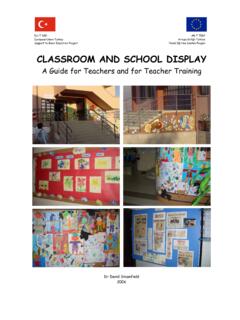
Classroom Display Handbook - School
www.schoolofeducators.comCLASSROOM AND SCHOOL DISPLAY A Guide for Teachers and for Teacher Training Dr David Smawfield 2006 - 1 - ... or a space for each student to display his or her best piece of work. ... use guidelines (or stencils if these are available and suitable). Draw guidelines faintly in
Action Research in Teacher Education: Classroom Inquiry ...
files.eric.ed.govclassroom or by working with another teacher in their school. This study used reports from action research projects completed by 18 candidates enrolled in the course during the fall 2009 semester. In the course, candidates are given guidelines (Appendix A) to fulfill their action research requirements.

Eating Space Guidance - University of Washington
www.ehs.washington.edubuilding space where you can distance at least 6 feet from others . o Although, individuals should eat and drink in appropriate or designated spaces, hydration is important and intermittently consuming water or other beverages in a shared workspace, public/common area, or classroom is allowed if you can:
PROTOCOLS - khda.gov.ae
www.khda.gov.ae49. Classrooms should have enough space for groups to maintain a physical distance of a recommended one metre per child when possible. 50. To avoid crowding, the number of students using toilet facilities at any one time should be limited. 51. Use of outside space should be encouraged: • for exercise and breaks;