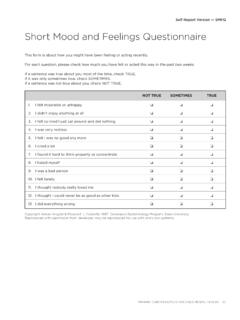
Self Report Version — SMFQ
Sensitivity of 60% and specificity of 85% for major depression at a cut off score of 8 or higher. Source is Angold A, Costello EJ, Messer SC. “Development of a short questionnaire for use in epidemiological studies of depression in children and adolescents.” International Journal of Methods in Psychiatric Research (1995), 5:237-249.
Download Self Report Version — SMFQ

Information
Domain:
Source:
Link to this page:
Documents from same domain

Seattle Children’s Wish List
www.seattlechildrens.orgSee our official wish list on Amazon. Use Amazon Smile and a percentage of your purchase will go toward Uncompensated Care. Greatest Needs Twistable Crayola Crayons (Mini Size) Crayola Crayons Fisher Price Medical Play Kits Infant Rattles, Handheld Oball, Winkle Sensory

PE1925 Low Iodine Diet - Seattle Children's
www.seattlechildrens.orgPatient and Family Education 1 of 5 Low Iodine Diet . What is a low iodine diet and why does my child need it? The purpose of a low iodine diet is to deplete the iodine stored in your child’s

IS907 Active Shooter: What You Can Do - seattlechildrens.org
www.seattlechildrens.orgVisual 30 IS-907 – Active Shooter: What You Can Do A preferred method for reporting different types of emergencies An evacuation policy and procedure
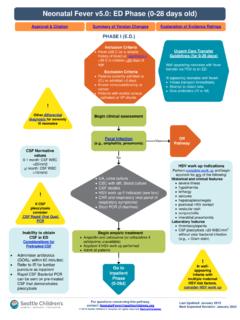
Neonatal Fever v5.0: ED Phase (0-28 days old)
www.seattlechildrens.orgNeonatal Fever v5.0: Inpatient Phase (0-28 days old) Daily re-evaluation · Treat specific condition · Narrow antibiotic agent if po s ble · If HS V+, transfer to ID

CSW Bronchiolitis Pathway - Seattle Children's
www.seattlechildrens.orgRoutine testing for viral pathogens NOT recommended unless for cohorting Medical Unit Admit Criteria (any of the following) · Sustained hypoxemia (SpO2 < 90% awake, 88% asleep) · Apnea · Dehydration/impaired oral hydration requiring ongoing IV or NG fluids
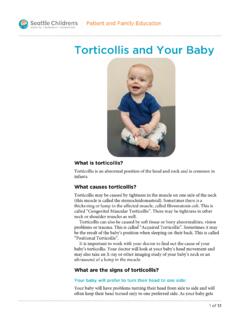
Patient and Family Education - Seattle Children's
www.seattlechildrens.orgTorticollis and Your Baby . 6 of 13. Stretching Exercises . Passive range of motion (gentle stretches) may help your baby achieve full neck motion. You can start doing these stretches right away.

A Guide to Feminizing Hormones - Seattle Children's
www.seattlechildrens.orgThe binary term “male,” “female,” “masculine,” “feminine,” “masculinizing” and “feminizing” do not accurately reflect the diversity of people’s bodies or identities. To describe how hormones work, it is helpful to know how testosterone works in non …

Authorization Release Obtain Exchange Patient Health ...
www.seattlechildrens.orgInstructions for completing the Authorization to Release/Obtain/Exchange Patient Health Information form. Purpose: To request that Seattle Children’s Hospital provides health information to a recipient outside of Children’s, requests that outside information be sent to our organization, or to exchange verbal information about your child.
Torticollis and Your Baby
www.seattlechildrens.orghelp treat my baby’s torticollis? Torticollis is treated through exercises that you do at home with your baby. A good way to work on the exercises is to do stretching and one other exercise with each diaper change. The main areas that you will work on with your baby are: 1. Positioning 2. Stretching . 3. Strengthening 4. Motor development

PE1706 Early Speech Development in Children with Cleft Palate
www.seattlechildrens.orgsounds (like “aaaaa”). Next babies begin to babble using consonant sounds in repeated strings of syllables (like “baba,” “mama” and “nana”). By about six months of age, a baby should have 2 to 5 speech sounds that they use during babbling. During these early stages, babies learn they can use sound to get attention. How is sound
Related documents

Edinburgh Postnatal Depression Scale (EPDS)
www.fresno.ucsf.eduEdinburgh Postnatal Depression Scale 1 (EPDS) Postpartum depression is the most common complication of childbearing. 2 The 10-question Edinburgh Postnatal Depression Scale (EPDS) is a valuable and effici ent way of identifying patients at risk for “perinatal” depression.

Promis Depression Scoring Manual - HealthMeasures
www.healthmeasures.netDEPRESSION A brief guide to the PROMIS ... pattern scoring is especially useful when there is missing data (i.e., a respondent skipped an item), different groups of participants responded to different items, or you have created a new questionnaire using a subset of questions from a PROMIS item bank.

TOOL 1. The Patient Health Questionnaire-2 (PHQ-2)
www.med-iq.comThe Patient Health Questionnaire-9 (PHQ-9) Instructions. Instructions: To further evaluate patients with PHQ-2 scores of 3 or more, administer or have them complete the questionnaire on the next page. USE OF THE PHQ-9 TO MAKE A TENTATIVE DEPRESSION DIAGNOSIS
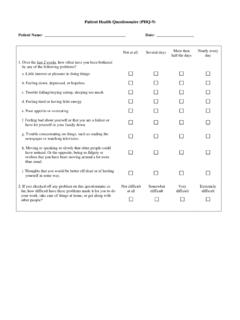
Patient Health Questionnaire (PHQ-9)
www.med.umich.eduPHQ-9* Questionnaire for Depression Scoring and Interpretation Guide For physician use only Scoring: Count the number (#) of boxes checked in a column. Multiply that number by the value indicated below, then add the subtotal to produce a total score. The possible range is 0-27. Use the table below to interpret the PHQ-9 score.

PHQ-9* Questionnaire for Depression Scoring and ...
www.med.umich.edu23 UMHS Depression Guideline, August 2011 PHQ-9* Questionnaire for Depression Scoring and Interpretation Guide For physician use only Scoring: Count the number (#) of boxes checked in a column. Multiply that number by the value indicated below, then add the subtotal to produce a total score. The possible range is 0-27.

INSTRUCTION MANUAL Instructions for Patient Health ...
www.pcpcc.orgPHQ and GAD-7 Instructions P. 4/9 Table 2. Diagnostic Algorithms for the PHQ Page 1 Somatoform Disorder if at least 3 of #1a-m bother the patient ―a lot‖ and lack an adequate biological explanation. Major Depressive Syndrome if #2a or b and five or more of #2a-i are at least ―More than half the days‖ (count #2i if present at all) .

Beck Depression Inventory II - Saint Louis University : SLU
www.slu.eduThe Beck Depression Inventory-II (BDI-II) developed in 1996, was derived from the BDI. The 21-item self-administered survey is scored on a scale of 0–3 in a list of four statements arranged in increasing severity about a particular symptom of depression. Scoring: Scoring: Each of the 21 items corresponding to a symptom of