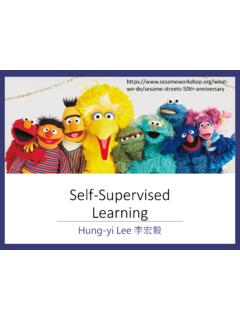
Self-supervised Learning
•Corpus of Linguistic Acceptability (CoLA) •Stanford Sentiment Treebank (SST-2) •Microsoft Research Paraphrase Corpus (MRPC) •Quora Question Pairs (QQP) ... Sentiment analysis Random initialization Init by pre-train This is the model to be learned. this is good
Download Self-supervised Learning

Information
Domain:
Source:
Link to this page:
Documents from same domain
Introduction of Reinforcement Learning - 國立臺灣大學
speech.ee.ntu.edu.twScenario of Reinforcement Learning Agent Environment Observation Action Don’t do Reward that State Change the environment

Convolutional Neural Network - 國立臺灣大學
speech.ee.ntu.edu.twFully Connected Feedforward network output. ... object detection and semantic segmentation”, CVPR, 2014. Convolution Max Pooling Convolution Max Pooling input 25 3x3 filters 50 3x3 ... “Deep Inside Convolutional Networks: Visualising Image Classification Models and Saliency Maps”, ICLR, 2014 | ...

Transformer
speech.ee.ntu.edu.twBeam Search A B A B A B A B A B A B A B 0.4 0.9 0.9 0.6 0.4 0.4 0.6 0.6 The green path is the best one. Not possible to check all the paths … Assume there are only two tokens (V=2). The red path is Greedy Decoding. →Beam Search

Machine Learning PyTorch Tutorial - 國立臺灣大學
speech.ee.ntu.edu.twPyTorch Tutorial TA:張恆瑞 (Heng-Jui Chang) 2021.03.05. Outline Prerequisites What is PyTorch? PyTorch v.s. TensorFlow Overview of the DNN Training Procedure ... C++, JavaScript, Swift Debug Easier Difficult (easier in 2.0) Application Research Production. Overview of the DNN Training Procedure Define Neural Network Loss Function Optimizer ...

Machine Learning 2020 - NTU Speech Processing Laboratory
speech.ee.ntu.edu.twText-to-Speech Synthesis Machine Translation Text (Chinese) Text (English) ... •All the assignments have sample codes based on Python. •You need to be able to read and modify the sample ... 3/12 Deep Learning Classification 3/19 Theory of ML (Prof. Pei-Yuan Wu) 3/26 Self-attention CNN / Self-attention

Convolutional Neural Network - 國立臺灣大學
speech.ee.ntu.edu.twConvolutional Neural Network (CNN) Network Architecture designed for Image 1. Image Classification Model ... Benefit of Convolutional Layer Fully Connected Layer •Some patterns are much smaller than the whole image. Receptive Field …

AUTO-ENCODER
speech.ee.ntu.edu.twVincent, Pascal, et al. "Extracting and composing robust features with denoising autoencoders." ICML, 2008. Add noises The idea sounds familiar? ☺ ...

Generation - NTU Speech Processing Laboratory
speech.ee.ntu.edu.twminimize cross entropy = class 1 class 2 Train a binary classifier . Discriminator ... Image Style Transfer Domain Domain ... Unsupervised Conditional Generation . Learning from Unpaired Data Network 70 Domain Domain ...

You can listen to the English version of this course at ...
speech.ee.ntu.edu.tw•Math: Calculus (微積分), Linear algebra (線性代數) and Probability (機率) •Programming •All the assignments have sample codes based on Python. •You need to be able to read and modify the sample codes. This course will not teach Python. •This course will not teach any Python package, except PyTorch. •Only focus on ML.

Hung-yi Lee 李宏毅 - 國立臺灣大學
speech.ee.ntu.edu.twVector Set as Input 10ms 25ms 400 sample points (16KHz) 39-dim MFCC 80-dim filter bank output frame 1s →100 frames 4
Related documents
Language Models are Unsupervised Multitask Learners
d4mucfpksywv.cloudfront.netsentiment analysis (Radford et al.,2017). In this paper, we connect these two lines of work and con-tinue the trend of more general methods of transfer. We demonstrate language models can perform down-stream tasks in a zero-shot setting – without any parameter or archi-tecture modification. We demonstrate this approach shows
Natural Language Processing - Tutorialspoint
www.tutorialspoint.comFourth Phase (Lexical & Corpus Phase) – The 1990s We can describe this as a lexical & corpus phase. The phase had a lexicalized approach to grammar that appeared in late 1980s and became an increasing influence. There was a revolution in natural language processing in this decade with the introduction of machine
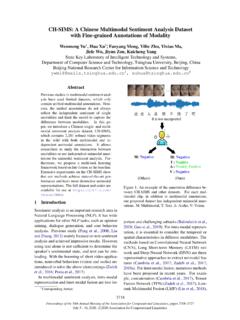
CH-SIMS: A Chinese Multimodal Sentiment Analysis Dataset ...
aclanthology.orgSentiment analysis is an important research area in Natural Language Processing (NLP). It has wide applications for other NLP tasks, such as opinion mining, dialogue generation, and user behavior analysis. Previous study (Pang et al.,2008;Liu and Zhang,2012) mainly focused on text sentiment analysis and achieved impressive results. However,
Recurrent Attention Network on Memory for Aspect …
aclanthology.orgtic analysis (Socher et al.,2010) and sentence sen-timent analysis (Socher et al.,2013). (Dong et al., 2014;Nguyen and Shirai,2015) adopted Rec-NN for aspect sentiment classication, by converting the opinion target as the tree root and propagating the sentiment of targets depending on the context and syntactic relationships between them. How-
i Data-Intensive Text Processing with MapReduce
lintool.github.ioData are called corpora (singular, corpus) by NLP researchers and collections by those from the IR community. Aspects of the representations of the data are called fea-tures, which may be \super cial" and easy to extract, such as the words and sequences ... a task known as sentiment analysis or opinion mining [118], which has been applied to ...

BERT: Pre-training of Deep Bidirectional Transformers for ...
nlp.stanford.eduImagine it’s 2013: Well-tuned 2-layer, 512-dim LSTM sentiment analysis gets 80% accuracy, training for 8 hours. Pre-train LM on same architecture for a week, get 80.5%.