
Shoulder: Rotator Cuff Home Exercise Program – Prone
Shoulder: Rotator Cuff Home Exercise Program – Prone. Begin all of the following exercises in the described position: Lie on stomach, pillow support under stomach, head positioned neutrally with towel roll under forehead and arm hanging off the table. 1. Prone Retraction (shoulder blade setting position)
Download Shoulder: Rotator Cuff Home Exercise Program – Prone

Information
Domain:
Source:
Link to this page:
Documents from same domain

Lower Extremity Strengthening Exercises in Supine
ahc.aurorahealthcare.orgLower Extremity Strengthening Exercises in Supine, Page 2 X19572bc (Rev. 04/10) ©AHC Lower Extremity The information presented is intended for general information and educational purposes.

Relaxation Exercises - Aurora Health Care
ahc.aurorahealthcare.orgX26017 (07/06) ©AHC Breathing/Relaxation Relaxation Exercises The information presented is intended for general information and educational purposes. It is not intended to replace the advice of your health care provider. Contact your health care provider if you believe you have a health problem.

Hip: Straight Leg Raise – Supine 4-Way - Aurora Health Care
ahc.aurorahealthcare.orgHip: Straight Leg Raise – Supine 4-Way Straight leg raise – flexion 1. Lie on your back. 2. Bend uninvolved knee and put foot on floor. 3. Slowly tighten the thigh muscle of the involved leg, performing a quad set. 4. Flex foot of involved leg toward nose. 5. Slowly lift entire leg 12 to 18 inches off floor.
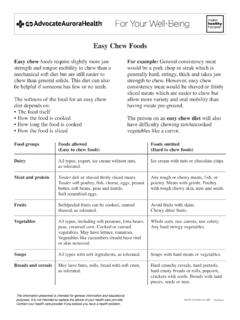
Easy Chew Foods - Aurora Health Care
ahc.aurorahealthcare.orgEasy Chew Foods. Easy chew foods require slightly more jaw strength and tongue mobility to chew than a mechanical soft diet but are still easier to chew than general solids. This diet can also be helpful if someone has few or no teeth. The softness of the food for an easy chew

“D (Rh) Type” and “D Variant” Antigen
ahc.aurorahealthcare.org“D (Rh) Type” and “D Variant” Antigen What is the D antigen? D antigen is a protein with many parts, found on the surface of red blood cells. The D antigen is also known as the “Rh factor” and it tells us your blood type. People are either D (Rh) negative or D (Rh) positive. If your blood type is D negative, your red

Vestibular Rehabilitation Exercises – Level 1
ahc.aurorahealthcare.orgVestibular Rehabilitation Exercises – Level 1, page 3 X20521 (Rev. 12/2019) ©AAHC Vertigo/Vestibular. The information presented is intended for general information and educational purposes. It is not intended to replace the advice of your health care provider. Contact your health care provider if you believe you have a health problem. 6.

Shoulder: Rotator Cuff Isometric Program – Standing
ahc.aurorahealthcare.orgX08252 (Rev. 11/2019) ©AAHC \OT Shoulder/Scapula Shoulder: Rotator Cuff Isometric Program – Standing. Isometric exercises are muscle tightening exercises performed with no joint movement. Their action is to increase circulation for healing and strengthening muscles with minimal joint irritation.
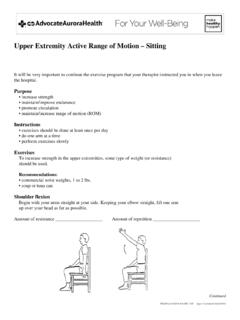
Upper Extremity Active Range of Motion – Sitting
ahc.aurorahealthcare.orgTo increase strength in the upper extremities, some type of weight (or resistance) should be used. Recommendations: • commercial wrist weights, 1 to 2 lbs. • soup or tuna can . Shoulder flexion Begin with your arms straight at your side. Keeping your elbow straight, lift one arm . up over your head as far as possible.
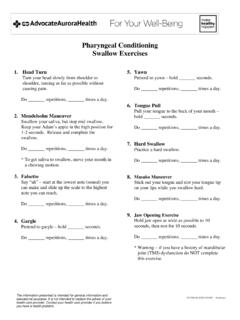
Pharyngeal Conditioning Swallow Exercises
ahc.aurorahealthcare.orgSwallow your saliva, but stop mid swallow. Keep your Adam’s apple in the high position for 1-2 seconds. Release and complete the swallow. Do _____ repetitions, _____ times a day. * To get saliva to swallow, move your mouth in a chewing motion. 3. Falsetto 8. Say “ah” – start at the lowest note (sound) you

Cervical Range of Motion and Isometrics Home Exercise …
ahc.aurorahealthcare.org3. Neck Flexion. Slowly bend your head forward, return to the starting position. Hold . Perform . seconds. Repeat times per day. times. 4. Neck Sidebending. Slowly tilt your head toward one shoulder, then slowly repeat . to the opposite side while keeping your face straight ahead. Hold . Perform . seconds. Repeat times per day. times. 5. Neck ...
Related documents

Rehabilitation Guidelines for Type I and Type II Rotator ...
www.uwhealth.orgby the rotator cuff muscles, with assistance from the ligaments, glenoid labrum and capsule of the shoulder. The rotator cuff is a group of four muscles: subscapularis, supraspinatus, infraspinatus and teres minor (Figure 1). Rotator cuff tears can occur from repeated stress or from trauma. Throwing a baseball can create up

Post-operative Rotator Cuff Repair Protocol Therapist ...
moonshoulder.comtiming of post‐ operative therapy after rotator cuff repair. This patient is to begin therapy in the first week after surgery. The patient should work with the therapist 1‐3x/week until released by the surgeon. Your patient has received a home therapy exercise guide. You should review this home exercise program with the patient.

SLAP Repair Protocol - South Shore Orthopedics
southshoreorthopedics.comwhether the procedure is open or arthroscopic all patients will likely be home on the same day as surgery. South Shore Hospital Orthopedic, Spine and Sports Therapy ... Initiate gentle peri-scapular and rotator cuff strengthening . ... strengthening program 1 -2 times a week while undergoing return to sport progression.
BOWFLEX OWER PRO - Nautilus
download.nautilus.comHand Cuff Grip Slip your hand through the cuff portion of the grip so that the foam pad rests on the back of your hand. Then grasp the remainder of the grip that is sit-ting in your palm. This method of gripping is great for exercises like front shoulder raises or any exercise where your palm is facing down. Ankle Cuff Grip: The cuff portion of ...