Signals, Systems and Inference, Chapter 9: Random Processes
a class of signals referred to as random signals (alternatively referred to as random processes or stochastic processes). Such signals play a central role in signal and ... A full probabilistic characterization of this collection of random variables would require the joint PDFs of multiple samples of the signal, taken at arbitrary times: a X(t ...
Download Signals, Systems and Inference, Chapter 9: Random Processes

Information
Domain:
Source:
Link to this page:
Documents from same domain
Wireless Communications - MIT OpenCourseWare
ocw.mit.eduWireless Communications Wireless telephony Wireless LANs Location-based services 1 The Technology: ... Cellular Phone Networks Frequency reuse
SYSTEMS ENGINEERING FUNDAMENTALS - MIT …
ocw.mit.eduSystems Engineering Fundamentals Introduction iv PREFACE This book provides a basic, conceptual-level description of engineering management disciplines that
Fundamentals of Chemical Reactions - MIT …
ocw.mit.edu10.37 Chemical and Biological Reaction Engineering, Spring 2007 Prof. William H. Green Lecture 4: Reaction Mechanisms and Rate Laws Fundamentals of Chemical Reactions

The Heart of a Vampire - MIT OpenCourseWare
ocw.mit.eduThe Heart of a Vampire ... Interview with the Vampire might not have convinced me that vampires could be sexy until I read a fantasy book on the subject, ...
Heijunka Product & Production Leveling
ocw.mit.eduHeijunka Product & Production Leveling Module 9.3 Mark Graban, LFM Class of ’99, Internal Lean Consultant, Honeywell Presentation for: Summer 2004

15.501/516 Final Examination December 18, 2002
ocw.mit.edu15.501/516 Final Examination December 18, 2002 ... accounting, used for many years ... Metro Area Inc. was in severe financial difficulty and threatened to
Sloan School of Management Massachusetts …
ocw.mit.eduSloan School of Management Massachusetts Institute of Technology ... Managerial Accounting ... Financial accounting information facilitates the

USS Vincennes Incident - MIT OpenCourseWare
ocw.mit.eduOverview • Introduction and Historical Context • Incident Description • Aegis System Description • Human Factors Analysis • Recommendations
Stochastic Processes and Brownian Motion
ocw.mit.eduChapter 1. Stochastic Processes and Brownian Motion 2 1.1 Markov Processes 1.1.1 Probability Distributions and Transitions Suppose …
Stochastic Processes I - MIT OpenCourseWare
ocw.mit.eduLecture 5 : Stochastic Processes I 1 Stochastic process A stochastic process is a collection of random variables indexed by time. An alternate view is that it is a probability distribution over a space
Related documents
Lecture 3 ELE 301: Signals and Systems - Princeton University
www.princeton.eduIII. METHODSÑDETECTOR CHARACTERIZATION A. Flood source histogram A detector module was uniformly irradiated with a68Ge point source!2.6"Ci#. The signals from the PS-PMT were treated and digitized as described above in Sec. II D. The lower energy threshold was set to approximately$ 100 keV with the aid of the threshold on the constant fraction dis-
SC505 STOCHASTIC PROCESSES Class Notes
www.mit.eduSC505 STOCHASTIC PROCESSES Class Notes c Prof. D. Castanon~ & Prof. W. Clem Karl Dept. of Electrical and Computer Engineering Boston University College of Engineering
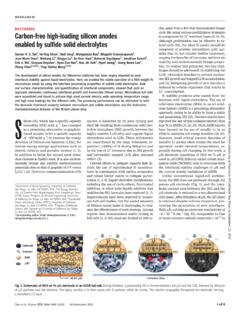
Carbon-free high-loading silicon anodes enabled by sulfide ...
smeng.ucsd.eduBATTERIES Carbon-free high-loading silicon anodes enabled by sulfide solid electrolytes Darren H. S.Tan 1,Yu-Ting Chen , Hedi Yang1,Wurigumula Bao , Bhagath Sreenarayanan , Jean-Marie Doux 1,Weikang Li , Bingyu Lu 1, So-Yeon Ham , Baharak Sayahpour , Jonathan Scharf1, Erik A.Wu 1, Grayson Deysher , Hyea Eun Han 2, Hoe Jin Hah2, Hyeri Jeong2, Jeong Beom Lee ,

Highly Stable Center Frequency • Immunity to False Signals ...
www.ti.comJunction-to-top characterization parameter 10.0 19.6 ψ. JB. Junction-to-board characterization parameter 47.0 30.1 (1) For more information about traditional and new thermal metrics, see the Semiconductor and IC Package Thermal Metrics application report, (SPRA953). LM567, LM567C. SNOSBQ4F – MAY 1999 – REVISED JANUARY 2022. www.ti.com

Problem set 5: Properties of linear, time-invariant systems
ocw.mit.eduSignals and Systems P5-4 (b) The inverse of a causal LTI system is always causal. (c) If Ih[n] 5 K for each n, where K is a given number, then the LTI system with h[n] as its impulse response is stable. (d) If a discrete-time LTI system has an impulse response h[n] of finite duration,

SINUSOIDAL SIGNALS - Åbo Akademi
users.abo.fisignal into a larger class of signals involving both a cosine and a sine component. It turns out that a convenient way to do this is to consider the complex input signal xc(t) = cos(!t)+jsin(!t) = ej!t The output then also has real and imaginary components: ... A unique characterization of ...