Simple, Compound and Complex Sentences
Simple Sentences • A simple sentence is a basic sentence that expresses a complete thought. It contains: 1. A subject 2. A verb 3. A complete thought …
Download Simple, Compound and Complex Sentences

Information
Domain:
Source:
Link to this page:
Documents from same domain

Final Project Instructions for “The Most Dangerous …
www.oxfordsd.orgFinal Project Instructions for “The Most Dangerous Game” Option #1: Rainsford’s 4th Trap Product You Produce: 2-Dimensional Poster Illustration With Written Explanation of Rainsford’s 4th Hunting Trap OR

Section 2 - Laboratory Equipment and Functions
www.oxfordsd.orgpowders (often when obtaining mass) Wash bottle Used to wash down specific pieces of equipment with water or keep materials moist. Micropipets Used to measure and dispence very small amounts of liquids. (ex. 0.5 mL) Buret Measuring specific amounts of liquids (often determining amounts of acids or bases needed) (ex.

Figurative Language - Oxford School District
www.oxfordsd.org3. The coach was as upset as a lion when his team lost the game. 4. Freddy French fired five fabulous free throws. 5. The snowmobile was a rocket in the newly fallen snow. 6. The running shoes danced as the runner neared the finish line. 7. “Bang!” went the gun as the race started. 8. Steven boxes in the light-heavyweight division.
Related documents

Overview of Sentence Structure
www.hunter.cuny.eduThe simple subject of a sentence is always a noun or pronoun used without single-word modifiers, phrases, and subordinate clauses; the complete subject includes the simple subject and any modifying words or word groups. A predicate is the part of a sentence that contains the verb and its modifiers and that

Simple Compound and Complex Sentences - CSU, Chico
www.csuchico.eduSimple Sentence A simple sentence only has one independent clause. An independent clause has a subject and a verb and expresses a complete thought. Examples: Some students like to study in the morning. The green dish broke. The llama spit. Sometimes, simple sentences have compound structures. There are four main types of compound structures:

Complex Test Simple Past, Answers - Englisch-Hilfen
www.englisch-hilfen.de5) Which question is in the Simple Past? a) When did Anne find the keys? b) When found Anne the keys? 6) In which sentence is the Simple Past used correctly? a) The hotel room were very nice. b) The hotel room was very nice. 7) In which sentence is the Simple Past used correctly? a) Steven forgetted his homework. b) Steven forgot his homework.
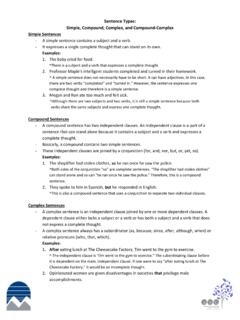
Sentence Types: Simple, Compound, Complex, and …
www.lamission.eduSentence Types: Simple, Compound, Complex, and Compound-Complex Simple Sentences - A simple sentence contains a subject and a verb. - It expresses a single complete thought that can stand on its own. Examples: 1. The baby cried for food. ^There is a subject and a verb that expresses a complete thought. 2.
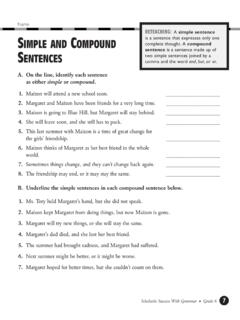
Name RETEACHING: simple sentence S COMPOUND …
www.scholastic.comRETEACHING: A simple sentence is a sentence that expresses only one complete thought. A compound sentence is a sentence made up of two simple sentences joined by a comma and the word and, but, or or. T H I N K & W R I T E On a separate piece of paper,write a paragraph about a time when a teacher

Sentence Types and Functions - San Jose State University
www.sjsu.eduSentences are divided into four categories: simple sentences, compound sentences, complex sentences, and compound-complex sentences. Simple Sentences Definition A simple sentence contains one independent clause. Examples Johnny rode his bike to school. Who is your best friend? She ate her lunch, took a walk, and went back to work.

2016 U.S. Sentencing Guidelines Manual - Sentencing Table
www.ussc.govSENTENCING TABLE (in months of imprisonment) Criminal History Category (Criminal History Points) Offense Level I (0 or 1) II (2 or 3) III (4, 5, 6)