SNIP Literacy Programme Part 3
in spelling and 12.1 months in reading. This included the pupil with the most significant need, who averaged 3.5 mths a year in spelling and 4 mths a year in reading and the most improved pupil, who averaged 14 mths a year in spelling and 19 mths a year in reading.
Download SNIP Literacy Programme Part 3

Information
Domain:
Source:
Link to this page:
Documents from same domain
SNIP Literacy Programme 1 Introduction
www.snip-newsletter.co.ukSNIP Literacy Programme 1 Introduction Phil and Carol Smart are both qualified dyslexic tutors. They were both classroom teachers for many years before specialising in addressing the barriers to learning experienced by children

Wellbeing resources - SNIP
www.snip-newsletter.co.uk1 Wellbeing resources The emotional wellbeing of pupils and of staff is of increasing importance in schools. This information aims to identify no-cost resources available to help …
SNIP Precision Teaching Pack
www.snip-newsletter.co.ukSNIP Precision teaching pack This pack is aimed at increasing the reading ages of pupils in KS3 with moderate reading difficulties. It is intended to be used with pupils from Y8 and above, with reading ages of
Sheets to promote the teaching of common words …
www.snip-newsletter.co.ukSheets to promote the teaching of common words as identified in the Literacy initiative for Y1/Y2 Page 1 Contents and instru ctions Page 2/3/4
Special Educational Needs Information Report …
www.snip-newsletter.co.uk1 Special Educational Needs Information Report Sample/Proforma www.snip-newsletter.co.uk This proforma has been provided as a starting place for schools wishing to meet the statutory reporting regulations of the SEN Information
SNIP Literacy Programme Part 2 - snip …
www.snip-newsletter.co.uk2 SNIP Literacy Programme Part 2 http://www.snip-newsletter.co.uk Introduction What is the programme? The programme is aimed at increasing reading …
Assessment book (Updated March 2015) www.snip …
www.snip-newsletter.co.uk1 Assessment book (Updated March 2015) www.snip-newsletter.co.uk Contents An overview of issues associated with testing Reading tests

Session 17 - snip-newsletter.co.uk
www.snip-newsletter.co.uk7 SNIP Literacy Programme Part 4 http://snip-newsletter.co.uk e r m o r t a m t y d l a n d s c a p e c a r a n d l c e r

SNIP KS2 Social and Emotional Skills
www.snip-newsletter.co.ukRationale for planning of SNIP KS2 Social and Emotional Skills Programme This planning was originally completed for a group o f mixed aged KS2 children who
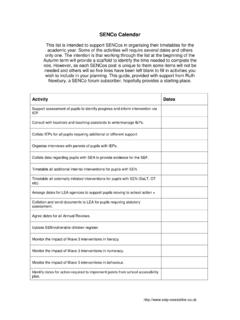
SENCo Calendar - snip-newsletter.co.uk
www.snip-newsletter.co.ukhttp://www.snip-newsletter.co.uk SENCo Calendar This list is intended to support SENCos in organising their timetables for the academic year. Some of the activities ...
Related documents
bl Blend Activities - to Carl
www.carlscorner.us.comCherry Carl, 2017 blank block Special Spelling o Illustrate your spelling words. o Write five of the words in sentences. o Build your spelling words with magnetic letters. o Write your spelling words in ABC order. o Make a word search using your spelling words. o Write each word and circle the beginning blends. o Write each word and then write two words that rhyme.

English Appendix 1: Spelling - GOV.UK
assets.publishing.service.gov.ukEnglish – Appendix 1: Spelling 1 English Appendix 1: Spelling . Most people read words more accurately than they spell them. The younger pupils are, the truer this is. By the end of year 1, pupils should be able to read a large number of different words containing the GPCs that they have learnt, whether or not they have seen these words before.
Phonics and Spelling - Building RTI
buildingrti.utexas.org2TRA: Phonics and Spelling Handout 5 (2 of 3) Blending Activities Say It Slowly Using letters, demonstrate how to say a CVC word slowly by blending the sounds together in units: Letters: s, a, t Say: /s/, /sa/, /sat/ Have children practice blending CVC words using this method.

Spelling word list for Year 3 and Year 4 - Oxford Owl
cdn.oxfordowl.co.ukSpelling word list for Year 3 and Year 4 100 words that children in England are expected to be able to spell by the end of Year 4 (age 9). How many can you spell? Created Date:

Teaching Elementary School Students to Be Effective Writers
ies.ed.govTeach students to become fluent with handwriting, spelling, sentence construction, typing, and word processing. 1. Teach very young writers how to hold a pencil correctly and form letters fluently and efficiently. 2. Teach students to spell words correctly. 3. Teach students to construct sentences for fluency, meaning, and style. 4.
2022 Rules for Local Spelling Bees
spellingbee.com3. Word list: Local spelling bee officials are responsible for selecting the word lists for use in their spelling bees and are encouraged to select word lists generated by the SNSB that are dated 2022. These word lists include many words that appear in the current edition of two study resources — the School Spelling Bee Study List and Words of the Champions.

Spelling Bee Grade 5 Word List - AFPCS
www.afpcs.orgSpelling Bee Grade 5 Word List 1 absorb transitive verb \əb-ˈs rb, -ˈz rb\ : to take in and make part of an existent whole The walls are made of a material that absorbs sound. 2 accelerate verb \ak-sel-uh-reyt\ : to cause faster or greater activity, development, progress, advancement, etc., in: The car started to accelerate after the stop sign.

SCOPE AND SEQUENCE Spelling
www.qcaa.qld.edu.auSpelling knowledge relates to word knowledge in reading. In both word recognition and spelling, students use the same orthographic information to make meaning. However, they use it differently, e.g. encoding and decoding. Students will need to be explicitly taught four kinds of knowledge in order to become independent spellers. These