Solving One-Step Equations 1 - McNabbs
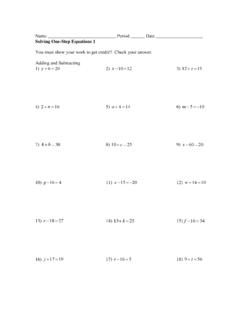
Solving One-Step Equations 1 You must show your work to get credit!! Check your answer. Adding and Subtracting 1) y 6 20 2) x 10 12 3) 12 z 15 14 22 3 4) 2 n 16 5) a 4 14 6) m 5 10 14 10 -5 7) 4 b 1030 8) c 25 9) x 60 20 26 15 80 10) g 16 4 11) x 15 20 12) w 14 10
Download Solving One-Step Equations 1 - McNabbs

Information
Domain:
Source:
Link to this page:
Documents from same domain
CHAPTER 9 PRACTICE TEST Perimeter, Area, …
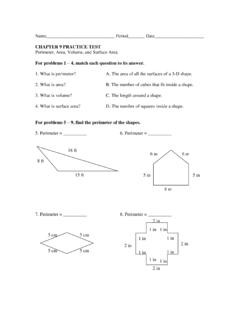
karen.mcnabbs.orgName_____ Period_____ Date_____ CHAPTER 9 PRACTICE TEST Perimeter, Area, Volume, and Surface Area For problems 1 – 4, match each question to its answer.
Solving Two-Step Equations 1 - The McNabbs
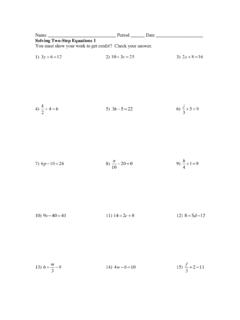
karen.mcnabbs.orgName _____ Period _____ Date _____ Solving Two-Step Equations 1 You must show your work to get credit!!

Volume and Surface Area of Rectangular Prisms …
karen.mcnabbs.orgName _____ Period_____ Date_____ Volume and Surface Area of Rectangular Prisms and Cylinders Remember, the volume of a …
6, add the two negative numbers. - McNabbs
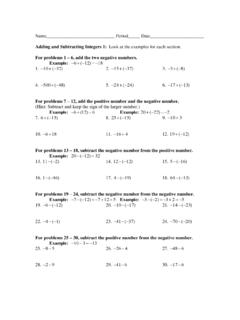
karen.mcnabbs.orgName_____ Period_____ Date_____ Adding and Subtracting Integers 1: Look at the examples for each section. For problems 1 – 6, add the two negative numbers.

Name Period Date - McNabbs
karen.mcnabbs.orgName_____ANSWER KEY_____ Period_____ Date_____ Add and Subtract Integers 2 Solve. 1. 5 9 2. 7 ( 12) 3. 23 ( 1) 4 -19 -24
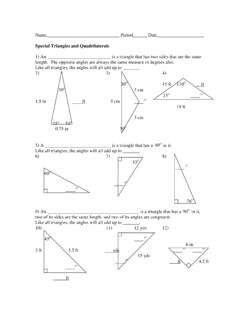
Special Triangles and Quadrilaterals - McNabbs
karen.mcnabbs.org13) A _____ is a quadrilateral (has ___ sides) that has two sides that are parallel. Like all convex quadrilaterals, the angles will all add up
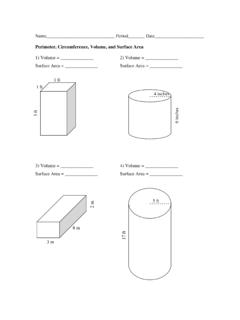
Perimeter, Circumference, Volume, and Surface Area
karen.mcnabbs.orgName __ANSWER KEY_____ Period_____ Date_____ Perimeter, Circumference, Volume, and Surface Area 1) Volume = _3 cubic ft._____ 2) …

Missing Measures: Complimentary and …
karen.mcnabbs.orgFor problems 9 – 16, the angles are supplementary. Find the measure of the missing angle. 9) 10) A 105O X 21O 11) 12) 47O B H 73O 13) 14)
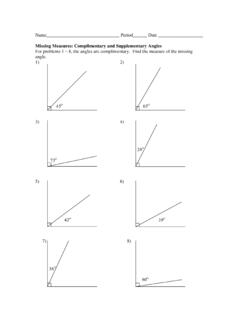
Missing Measures: Complimentary and Supplementary Angles
karen.mcnabbs.orgFor problems 9 – 16, the angles are supplementary. Find the measure of the missing angle. 9) 10) 130O 165O 11) 12) 175 O 124

Tables and Linear Graphs 1 - The McNabbs
karen.mcnabbs.orgName_____ANSWER KEY_____ Period_____ Date_____ Tables and Linear Graphs 1 . 5. x -2 0 2 4 y = 3 - x 5 3 1 -1 7 . x -2 0 2 4 y = -1 + x -3 -1 1 3 6. x -2 0 2 4
Related documents
Solving Linear Equations - Age Problems
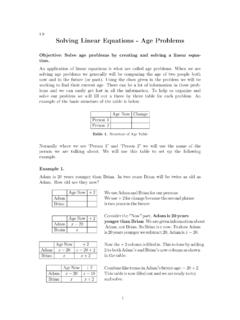
www.wallace.ccfaculty.orgSolving Linear Equations - Age Problems Objective: Solve age problems by creating and solving a linear equa-tion. An application of linear equations is what are called age problems. When we are solving age problems we generally will be comparing the age of two people both now and in the future (or past). Using the clues given in the problem we ...
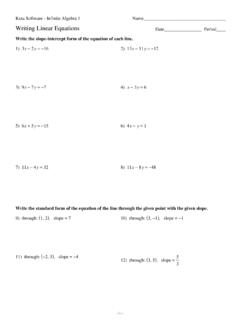
Writing Linear Equations - cdn.kutasoftware.com
cdn.kutasoftware.comWriting Linear Equations Date_____ Period____ Write the slope-intercept form of the equation of each line. 1) 3 x − 2y = −16 y = 3 2 x + 8 2) 13 x − 11 y = −12 y = 13 11 x + 12 11 3) 9x − 7y = −7 y = 9 7 x + 1 4) x − 3y = 6 y = 1 3 x − 2 5) 6x + 5y = −15 y = − 6 5 x − 3 6) 4x − y = 1 y = 4x − 1 7) 11 x − 4y = 32 y ...

Linear Equations in Three Variables - University of Utah
www.math.utah.eduLinear equations and planes The set of solutions in R2 to a linear equation in two variables is a 1-dimensional line. The set of solutions in R3 to a linear equation in three variables is a 2-dimensional plane. Solutions to systems of linear equations As in the previous chapter, we can have a system of linear equations, and
Second Order Linear Partial Differential Equations Part I
www.personal.psu.eduinto a simultaneous system of 2 ordinary differential equations. They are a second order homogeneous linear equation in terms of x, and a first order linear equation (it is also a separable equation) in terms of t. Both of them can be solved easily using what we have already learned in this class.

Solving Linear Inequalities- Worksheet 1
www.somerset.k12.ky.usSolving Linear Inequalities- Worksheet 1 Solve following linear inequalities 1. 5x + 4 < 3 – 3x 2. 5y - 6 < 2y - 7 3. 8x > x + 2 . 4. 6x > 4 + 2x . 5. 5x - 2 > 4 + 3x . 6. 2x - 2 < 8x + 4 . Solve and graph the solution set of following : 7. 2y < -4 . 8. 7y < 2x + 8 . 9. 2y > y - 9 . 10. 9y < -3 .
Lesson 24: Two-Variable Linear Equations - Literacy …
www.literacymn.orgLESSON 24: Two-Variable Linear Equations part 1 Lesson Summary: For the warm-up, students will solve a problem about a gym membership. In Activity 1, they will write equations with one variable. In Activity 2, they will solve equations by the substitution method. In Activity 3, they will solve equations by the combination method.

Review for Grade 9 Math Exam - Unit 6 - Linear Equations ...
blogs.vsb.bc.caReview for Grade 9 Math Exam - Unit 6 - Linear Equations and Inequalities Answer Section MULTIPLE CHOICE 1. ANS: D PTS: 1 DIF: Easy REF: 6.1 Solving Equations by Using Inverse Operations LOC: 9.PR3 TOP: Patterns and Relations (Variables and Equations) KEY: Procedural Knowledge 2.ANS: B PTS: 1 DIF: Easy

PAIR OF LINEAR EQUATION IN TWO VARIABLES
vaga.study22. Assertion : Pair of linear equations : 9 3 12 0xy++= , 8 6xy++24 0= have infinitely many solutions. Reason : Pair of linear equations ax by c 11 1++ =00andax by c 22 2++= have infinitely many solu-tions, if a a b b c c 2 1 2 == (a) Both assertion (A) and reason (R) are true and reason (R) is the correct explanation of assertion (A).