
Solving Polynomial Equations
Elementary Algebra Skill Solving Polynomial Equations Solve each equation. 1) 2 n3 − n2 − 136n = 0 2) 5x3 + 4x2 − 57x = 0 3) 6n4 + 9n3 + 3n2 = 0 4) 2n3 + 24n2 − 56n = 0 5) x3 − x = 0 6) 2r5 − 6r4 − 56r3 = 0 7) 12b3 − 2b2 − 30b = 0 8) 4r4 − 64r2 = 0 9) 12b3 + 6b2 = 18b 10) 6v3 − 42v = −4v2 11) 2n4 − 27n2 = −3n3 12) 5y3 − 126y = 9y2
Download Solving Polynomial Equations

Information
Domain:
Source:
Link to this page:
Documents from same domain

Solving Quadratic Equations: Completing the Square
lavc.eduElementary Algebra Skill Solving Quadratic Equations: Completing the Square Solve each equation by completing the square. 1) x2 + 2x − 24 = 0 2) p2 + 12p − 54 = 0 3) x2 − 8x + 15 = 0 4) r2 + 18r + 56 = 0 5) m2 − 6m − 55 = 0 6) m2 − 4m − 91 = 0 7) m2 + 16m − 32 = −7 8) r2 − 8r = −8 9) n2 = −14n − 37 10) n2 − 2n = 15 11) x2 + 15x + 15 = 2 + x 12) −3n2 + 4n − 59 ...

Adding and Subtracting Integers
lavc.eduAnswers to Adding and Subtracting Integers 1) −4 2) 2 3) 3 4) 2 5) 4 6) −5 7) −5 8) −17 9) −13 10) 2 11) −1 12) 0

Dividing Complex Numbers - Los Angeles Valley College
lavc.eduIntermediate Algebra Skill Dividing Complex Numbers Simplify. 1) 5 −5i 2) 1 −2i 3) − 2 i 4) 7 4i 5) 4 + i 8i 6) −5 − i −10i 7) 9 + i −7i
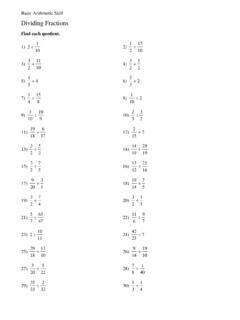
Dividing Fractions - Los Angeles Valley College
lavc.eduAnswers to Dividing Fractions 1) 20 2) 5 17 3) 15 11 4) 3 5) 1 20 6) 5 6 7) Title: fractD Author: Sutclitv Created Date: 20090102213823

Simplifying Complex Fractions
lavc.eduSimplifying Complex Fractions Simplify each complex fraction. 1) x 25 4 x2 2) 4 u2 4 u 3) y2 4 y x + 4 4) n − 4 m2 m n − 4 5) x − 5 2x − 5 x − 5 2x − 5 − x + 2 x − 5 6) x − 1 x − 1 9 + 9 x − 1 7) a2 b + 3 + 2 a a2 8) u2 2v v2 u2 + v 2 9) x2 9 − 25 4 4 x − x 5 10) 4 3x + 2 x2 x x + 1 − 4 x + 1. Answers to Simplifying ...

Dividing Polynomials
lavc.eduElementary Algebra Skill Dividing Polynomials Divide. 1) (18r5 + 36r4 + 27r3) ÷9r 2) 9x5 + 9x4 + 45x3 9x2 3) (2n3 + 20n2 + n) ÷10n2 4) 3v3 + v2 + 2v 9v3 5) (45v4 + 18v3 + 4v2) ÷9v3 6) 9n3 + n2 + 3n 9n2 7) (30r3 + 2r2 + 30r) ÷10r2 8) 9k3m2n + 3k2mn2 + 54km3n 6kmn 9) (6p3 + 150p2 + 5p) ÷15p 10) 12m3y4 + 12m2y3 + 3my2 6m2y2 11) (m2 + 14m + 31) ÷(m + 10) 12) (x2 + 2x − 36) …

Multiplying and Dividing Using Scientific Notation
lavc.eduAnswers to Multiplying and Dividing Using Scientific Notation 1) 9.407 × 10⁻¹¹ 2) 1.16 × 10⁻¹ 3) 1.024 × 10¹⁰ 4) 9.006 × 10⁻⁹ 5) 3.8 × 101 6) 3.68 × 10³ 7) 9.75 × 10² 8) 6.928 × 10⁻³ 9) 9.182 × 10⁴ 10) 1.407 × 10⁶ 11) 1.038 × 10⁻³ 12) 1.02 × 101 13) 4.209 × 100 14) 1.458 × 10¹⁶ 15) 9.766 × 10⁻⁹ 16) 9.064 × 10⁻²⁷

Finding the Area of a Circle - Los Angeles Valley College
lavc.edu-3-Answers to Finding the Area of a Circle 1) 452.4 mi² 2) 84.9 km² 3) 128.7 mi² 4) 28.3 yd² 5) 78.5 ft² 6) 232.4 in² 7) 333.3 km² 8) 201.1 cm²
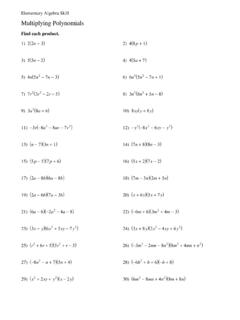
Multiplying Polynomials - Los Angeles Valley College
lavc.eduElementary Algebra Skill Multiplying Polynomials Find each product. 1) 2(2 n + 3) 2) 4(8p + 1) 3) 5(5n − 2) 4) 4(5a + 7) 5) 4n(5n2 − 7n − 3) 6) 6n5(5n2 − 7n + 1) 7) 7r2(3r2 − 2r − 5) 8) 3n2(8n2 + 5n − 8) 9) 3a3(8a + b) 10) 8xy(x + 8y) 11) −3v(−8u2 − 8uv − 7v2) 12) −y2(−8x2 − 6xy − y2) 13) (n − 7)(3n + 1) 14) (7n + 8)(8n − 3)
Related documents

3.2 The Factor Theorem and The Remainder Theorem
www.shsu.eduTheorem 3.4.Polynomial Division: Suppose d(x) and p(x) are nonzero polynomials where the degree of pis greater than or equal to the degree of d. There exist two unique polynomials, q(x) and r(x), such that p(x) = d(x)q(x) + r(x); where either r(x) = 0 or the degree of ris strictly less than the degree of d.

Approximating functions by Taylor Polynomials.
www.math.smith.eduPolynomials. 4.1 Linear Approximations We have already seen how to approximate a function using its tangent line. This was the key idea in Euler’s method. If we know the function value at some point (say f (a)) and the value of the derivative at the same
Zernike Polynomials - University of Arizona
wp.optics.arizona.eduZernike polynomials are the best polynomials for fitting test data. Sometimes Zernike polynomials give a poor representation of the wavefront data. For example, Zernikes have little value when air turbulence is present. Likewise, fabrication errors in the single point diamond turning process cannot be represented using a

Solving Cubic Polynomials - SHSU
www.shsu.eduSolving Cubic Polynomials 1.1 The general solution to the quadratic equation There are four steps to nding the zeroes of a quadratic polynomial. 1.First divide by the leading term, making the polynomial monic. 2.Then, given x2 + a 1x+ a 0, substitute x= y a 1 2 to obtain an equation without the linear term. (This is the \depressed" equation.)

Dividing Polynomials Date Period - kutasoftware.com
www.kutasoftware.comDividing Polynomials Date_____ Period____ Divide. 1) (m2 − 7m − 11) ÷ (m − 8) m + 1 − 3 m − 8 2) (n2 − n − 29) ÷ (n − 6) n + 5 + 1 n − 6 3) (n2 + 10 n + 18) ÷ (n + 5) n + 5 − 7 n + 5 4) (k2 − 7k + 10) ÷ (k − 1) k − 6 + 4 k − 1 5) (n2 − 3n − 21) ÷ (n − 7) n + 4 + 7 n − 7 6) (a2 − 28) ÷ (a − 5) a + 5 ...

Factoring By Grouping
cdn.kutasoftware.com©G Y210 a192 J RK7uetjac yS Xo ZfHthw Fa UreL aL bL wCt. L m pAMlSl4 MrMiFg sh9t8sC 3r 8ens jeyrdvJe AdN.m m 0MzaHd2eG ywFivtsh0 4Itn tf ri AnJi 7t 2eH mAolmgsexbfr gar Z1e.t Worksheet by Kuta Software LLC

NCERT Solution For Class 10 Maths Chapter 2- Polynomials
cdn1.byjus.comNCERT Solution For Class 10 Maths Chapter 2- Polynomials Exercise 2.3 Page: 36 1. Divide the polynomial p(x) by the polynomial g(x) and find the quotient and remainder in each of the

LEGENDRE POLYNOMIALS AND APPLICATIONS Legendre …
faculty.fiu.eduLEGENDRE POLYNOMIALS AND APPLICATIONS 3 If λ = n(n+1), then cn+2 = (n+1)n−λ(n+2)(n+1)cn = 0. By repeating the argument, we get cn+4 = 0 and in general cn+2k = 0 for k ≥ 1. This means • if n = 2p (even), the series for y1 terminates at c2p and y1 is a polynomial of degree 2p.The series for y2 is infinite and has radius of convergence equal to 1 and y2 is …
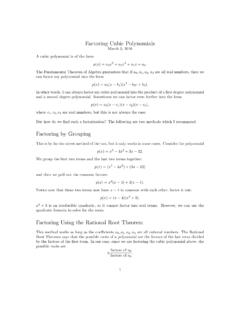
Factoring Cubic Polynomials - UC Santa Barbara
web.math.ucsb.eduFactoring Cubic Polynomials March 3, 2016 A cubic polynomial is of the form p(x) = a 3x3 + a 2x2 + a 1x+ a 0: The Fundamental Theorem of Algebra guarantees that if a 0;a 1;a 2;a 3 are all real numbers, then we can factor my polynomial into the form

ASYMPTOTES OF RATIONAL FUNCTIONS
www.austincc.eduUse long division of polynomials or, in case of D(x) being of the form: (x c), you can use synthetic division. T he equation of the asymptote is y = mx + b which is the quotient of the polynomial division (ignore remainder) _____ Examples 2 18 6 1 ( ) 2 3 x x f x deg N(x) = 3 , deg D(x) = 2. Perform long division D(x) N(x ...