Specific Language Impairment - NIDCD
impairment (SLI)? Specific language impairment (SLI) is a communication disorder that interferes with the development of language . skills in children who have no hearing loss or intellectual disabilities. SLI can affect a child’s speaking, listening, reading, and writing. SLI is also called developmental language
Download Specific Language Impairment - NIDCD

Information
Domain:
Source:
Link to this page:
Documents from same domain

Sound Advice on Hearing Protection for Young Ears
www.nidcd.nih.govDifferent hearing protectors offer different levels of protection, as shown by their Noise Reduction Rating, or NRR. The higher the NRR, the greater the protection
Speech and Language Developmental Milestones
www.nidcd.nih.govDevelopmental Milestones . The irst 3 years of life, when the brain is developing and maturing, is the most intensive period for acquiring speech and language skills. These skills develop best in a world that is rich with sounds, sights, and consistent …
Communication Problems in Children with Autism Spectrum ...
www.nidcd.nih.govCenters for Disease Control and Prevention (CDC) estimates that about 1 out of every 88 children will be identified with ASD. How does ASD affect communication? The word “autism” has its origin in the Greek word “autos,” which means “self.” Children with ASD often are self-absorbed and seem to exist in a private world

Ménière’s Disease - NIDCD
www.nidcd.nih.govMénière’s disease, but no definite answers are available. Some researchers think that Ménière’s disease is the result of constrictions in blood vessels similar to those that cause migraine headaches. Others think Ménière’s disease could be a consequence of viral infections, allergies, or autoimmune reactions.
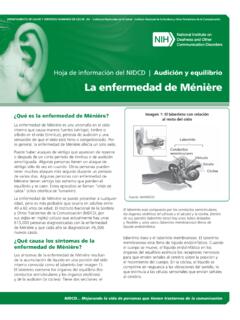
La enfermedad de Ménière - NIDCD
www.nidcd.nih.govTitle: La enfermedad de Ménière Author: Instituto Nacional de la Sordera y otros Trastornos de la Comunicación Subject: Una hoja de información que describe qué es la enfermedad de Ménière, sus síntomas, cómo se diagnostica y se trata, y qué …
Presbycusis - NIDCD
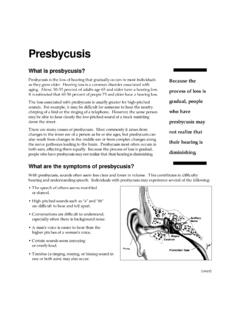
www.nidcd.nih.gova sensorineural hearing disorder. It is most commonly caused by gradual changes in the inner ear. The cumulative effects of repeated exposure to daily traffic sounds or construction work, noisy offices, equip-ment that produces noise, and loud music can cause sensorineural hearing loss. Sensorineural hearing
Autism Spectrum Disorder: Communication Problems ... - …
www.nidcd.nih.govusing eye contact, gestures, body movements, imitation, and babbling and other vocalizations to help them communicate. Children who lack these skills may be evaluated and treated by a speech-language pathologist to prevent further developmental delays. For slightly older children with ASD, communication
Apraxia of Speech - NIDCD
www.nidcd.nih.govthe presence of several of a group of symptoms, including those described earlier. Ruling out other conditions, such as muscle weakness or language production problems (e.g., aphasia), can help with the diagnostic process. People with either form of AOS may have a
Aphasia - NIDCD
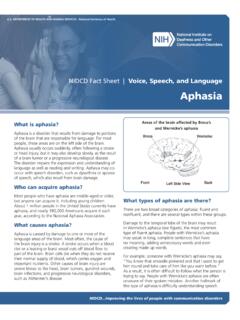
www.nidcd.nih.govThe use of speech-generating applications on mobile . 3 ... retrieval, grammar, prosody (tone), and other aspects of speech. Some of these new methods involve improving cognitive ... understand the parts of the brain that played a role in language and recovery after a stroke. Recently, scientists ...

Etapas del desarrollo del habla y el lenguaje
www.nidcd.nih.govintensivo en la adquisición de las habilidades del habla y el lenguaje. Estas habilidades se desarrollan mejor cuando el niño está expuesto consistentemente a un mundo lleno de imágenes, sonidos y al habla y el lenguaje de los demás. Existen períodos clave en el desarrollo del habla y el lenguaje de los bebés y los niños pequeños. En ...
Related documents
Doctor's Report C-4.3 of MMI/Permanent Partial Impairment
www.wcb.ny.govimpairment, see Chapter 1.5 and 1.6 of the 2018 Guidelines and Chapter 9.2 of the 2012 Guidelines. List all the body parts and/or conditions that the patient was treated for with regards to the workers' compensation claims identified in Section A of the form (Question 2).

Work Productivity and Activity Impairment Questionnaire
oml.eular.orgWork Productivity and Activity Impairment Questionnaire: General Health V2.0 (WPAI:GH) The following questions ask about the effect of your health problems on your ability to work and perform regular activities. By health problems we mean any physical or emotional problem or symptom. Please fill in the blanks or circle a number, as indicated. 1.
Impairment of Assets - Australian Accounting Standards Board
www.aasb.gov.auan impairment loss. The Standard also specifies when an entity should reverse an impairment loss and prescribes disclosures. Application Aus1.1 This Standard applies to: (a) each entity that is required to prepare financial reports in accordance with Part 2M.3 of the Corporations Act and that is a reporting entity;

Review of the Tables for the Assessment of Work-related ...
www.dss.gov.auimpairment. is defined in section 3 to mean a loss of functional capacity affecting a person’s ability to work that results from the person’s condition. Scaling system and descriptors (3) In the Tables: (a) subject to section 11, where a descriptor applies in relation to an impairment, an impairment rating can be
ISNCSCI / ASIA Examination & Cases - UNC School of Medicine
www.med.unc.eduASIA Impairment Scale—1992 FIM incorporated, PP/LT tested separately, motor level defined as 3/5 with 5/5 above. Revisions—1996 ASIA C vs. D clarified; motor level determined by sensory level in areas unable to be tested (C2-4, T2-L1) Revisions—2000 ASIA C/D required to have either voluntary anal contraction OR

NSW workers compensation guidelines for the evaluation of ...
www.sira.nsw.gov.aupermanent impairment and making deductions for pre-existing injuries/conditions. c. In calculating the final level of impairment, the assessor needs to clarify the degree of impairment that results from the compensable injury/condition. Any deductions for pre-existing injuries/conditions are to be clearly identified in the report and calculated.