Standard Test Methods for Determining Average Grain Size1
oriented surface for a non-equiaxed grain structure., 0 = base intercept length of 32.00 mm for defining the relationship between G and , (and N L) for macroscopically or micro-scopically determined grain size by the intercept method. L = length of a test line. M = magnification used. …
Download Standard Test Methods for Determining Average Grain Size1

Information
Domain:
Source:
Link to this page:
Documents from same domain

Standard Specification for Steel Bar, Carbon and Alloy ...
www.fushunspecialsteel.com6.1 Feedstock—Cold-finished steel bar shall be produced from hot-wrought carbon or alloy steel bar (Specification A 29/A 29M), or from hot-wrought rod designated for cold-finished bar (Specification A 510). 6.2 Condition—The product shall be furnished in one of the following conditions as specified by the purchaser. 6.2.1 Rounds:

Standard Specification for Steel Bars, Carbon and Alloy ...
www.fushunspecialsteel.comelement to a standard steel, the percentage of lead is reported as 0.15 to 0.35 incl, which is the range commonly specified for this element. 4 Copies of military specifications, military standards, and federal standards required by contractors in connection with specific procurement functions should be

Standard Practice for Ultrasonic Examination of Heavy ...
www.fushunspecialsteel.comFor Annual Book of ASTM Standards volume information, refer to the standard’s Document Summary page on the ASTM website. 4 Available from American National Standards Institute (ANSI), 25 W. 43rd St., 4th Floor, New York, NY 10036. 5 Available from the American Society for Nondestructive Testing, 1711 Arlin-
Standard Specification Steel Bars Carbon and Alloy Hot ...
www.fushunspecialsteel.comHot-Rolled Alloy Steel Bars: Steel Bars, Alloy, Standard Grades A 322 Carbon and Alloy Steel Bars Subject to End-Quench Hardenability Requirements A 304 Steel Bars, Alloy, Hot-Wrought or Cold-Finished, Quenched and Tempered A 434 Steel Bars, Alloy, Hot-Wrought, for …

Specification for Wrought Steels for Mechanical and Allied ...
www.fushunspecialsteel.comforging steels and low alloy steels: maximum permissible defect depths 9 Table 10 — Flats equal to or less than 105 mm wide in free-cutting, semi-free-cutting and carbon steels: maximum ... rapid cooling by means of a suitable quenching medium and subsequent reheating to a temperature below the lower critical temperature (Seenoteto2.1.4.) 2.1.8
Related documents

Farmers’ Training Manual
ecdpm.orgcheap rice from Pakistan require policy oriented interventions. The Need to Address the Smallholder Problem Following the identification of various capacity development needs to smallholder farmers, several recommendations were made; 1. Comprehensive training and mentoring in structured grain trading be offered to the farmer
Grain-Oriented Electrical Steel
www.spacematdb.comATI Allegheny Ludlum Grain-Oriented Electrical Steel (GOES) is processed under carefully controlled conditions to develop optimum magnetic characteristics in the rolling direction. GOES develops low core losses at high inductions when used as core material in designs with the flux path parallel to the rolling direction.
SELECTION OF ELECTRICAL STEELS FOR Magnetic Cores
www.brown.edu2. Grain-Oriented. This term is used to designate elec-trical steels that possess magnetic properties which are strongly oriented with respect to the direction of rolling. By a process of rolling and annealing, alloys of suitable composition can be produced with a metallic crystal structure in which the grains are aligned so that mag-
Lecture 2: Grain Size Distributions and Soil Particle ...
user.engineering.uiowa.eduLecture 2: Grain Size Distributions and Soil Particle Characteristics A. Motivation: In soil mechanics, it is virtually always useful to quantify the size of the grains in a type of soil. Since a given soil will often be made up of grains of many different sizes, sizes are measured in terms of grain size distributions.

Standard Test Methods for Determining Average Grain Size1
tubingchina.comN Aα = number of α grains per mm 2 at 1X in a two phase (constituent) microstructure. N AE = number of grains per inch 2 at 100X. N Aℓ = N A on a longitudinally oriented surface for a non-equiaxed grain structure. N At = N A on a transversely oriented surface for a non-equiaxed grain structure. N Ap = N A on a planar oriented surface for a non- equiaxed grain structure. N I = …
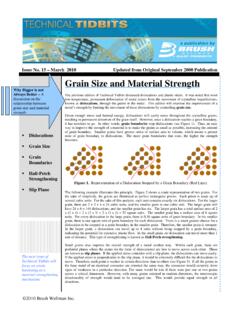
Issue No 15 - Grain Size and Material Strength
materion.comgrain, there are 2 x 3 x 4 = 24 cubic units, and the smaller grain is one cubic unit. The larger grain will ... the base metal of an electrical connector are oriented the same way, the connector would certainly show signs of weakness in a particular direction. The same would be true if there were just one or two grains

Chapter 4 THE STRUCTURE AND ENERGY OF GRAIN …
users.encs.concordia.caof misorientation angles predicted for a randomly oriented grain assembly in which only the axes closest to <110> are considered. The curve now shows two peaks, and as demonstrated by Hutchinson et al. (1996), experimental observation of such peaks may The Structure and Energy of Grain Boundaries 93

Chapter ITC HS Codes Description Unit of Measurement
www.mca.gov.in72 72261100 flt ‐rld prdcts of silicon electrical stl grain oriented kgs 72 722619 flt ‐rold prdcts of silicon electrical stl othr thn grain oriented 72 72261910 flt‐rld prdcts of silicon elctrcl steel othr tan grain oriented: hot rolled kgs 72 72261920 flt‐rld prdcts of silicon elctrcl steel othr tan grain oriented: cold rolled kgs

CHAPTER 7 DISLOCATIONS AND STRENGTHENING …
www3.nd.eduGrain boundaries are barriers to slip: Owing to misalignment of the slip planes in adjacent grains, a dislocation passing the grain boundary have to change its direction and thus lose its energy. A single grain may be favorably oriented for slip, but cannot deform until the adjacent grains (less favorable) are also capable to slip;