
Standing Waves - Physics Department
Standing Waves 3 In this equation, v is the (phase) velocity of the waves on the string, ‚ is the wavelength of the standing wave, and f is the resonant frequency for the standing wave. For waves on a string the velocity of the waves is given by the following equation:
Download Standing Waves - Physics Department

Information
Domain:
Source:
Link to this page:
Documents from same domain
Series and Parallel Resistive Circuits - Mercer …
physics.mercer.eduSeries and Parallel Resistive Circuits Physics Lab VIII Objective In the set of experiments, the theoretical expressions used to calculate the total resistance

Re ection and Refraction Objective Equipment List ...
physics.mercer.eduRe ection and Refraction 3 In this equation, n i is the index of refraction of the incident medium, n r is the index of refraction of the refraction medium, and critical is the critical angle for total internal re ection. You will test these relationships in this set of experiments using a laser pointer as the source of

Physics Lab Report Guidelines
physics.mercer.eduPhysics Lab Report Guidelines Summary The following is an outline of the requirements for a physics lab report. A. Experimental Description 1. Provide a statement of the physical theory or principle observed during the exper-

Conservation of Energy - Physics Department
physics.mercer.eduTheoretical Background The conservation principles are the most powerful concepts to have been developed in physics. In this lab exercise one of these conservation principles, the conservation of energy, will be explored. This experiment explores properties of two types of mechanical energy, kinetic and potential energy.

Projectile Motion - College of Liberal Arts and Sciences
physics.mercer.eduProjectile Motion: Initial Velocity Measurement Caution: You must wear your safety goggles at all times during this experiment. Failure to do so will find you expelled from the lab room. It is necessary to first determine the initial velocity of the ball when launched from the …

Moment of Inertia & Rotational Energy
physics.mercer.edudetermine the specific range of data that you want to fit. Find the slope of the rising part in the "Velocity" plot for each run. The slope is the angular acceleration, α, produced by the hanging weight. 2. Calculate the value,rm. H (g. −. r. α) for each hanging mass, m. H. 3. Calculate the . I. exp1. with Equation (4) for each hanging mass ...
Newton’s Second Law
physics.mercer.eduof an object to motion. This relationship was first postulated by Isaac Newton in his Second Law of Motion, Σ F = ma. (1) In this equation, Σ F is the sum …
Related documents
PHYSICS XI (Code No. 042) COURSE STRUCTURE Class XI ...
cbseacademic.nic.inPHYSICS XI (Code No. 042) COURSE STRUCTURE Class XI (Theory) Term 1 ... Wave motion: Transverse and longitudinal waves, speed of travelling wave, displacement relation for a progressive wave, principle of superposition of waves, reflection of waves, standing waves in
Lecture Notes on Condensed Matter Physics (A Work in …
courses.physics.ucsd.eduD. Feng and G. Jin, Introduction to Condensed Matter Physics (I) (World Scienti c, Singapore, 2005) New and with a distinctly modern avor and set of topics. Looks good. N, Ashcroft and N. D. Mermin, Solid State Physics (Saunders College Press, Philadelphia, 1976) Beautifully written, this classic text is still one of the best comprehensive guides.

Waves Oscillations - Harvard University
scholar.harvard.eduDavid Morin, morin@physics.harvard.edu A wave is a correlated collection of oscillations. For example, in a transverse wave traveling along a string, each point in the string oscillates back and forth in the transverse direc-tion (not along the direction of the string). In sound waves, each air molecule oscillates

Finding the Mass of an Exoplanet - Physics & Astronomy
astro.gsu.edu(i.e. radio waves ) [0.01-1] L is the length of time such a civilization is detectable [50-1,000,000 years] While the equation itself is simple enough, the trick comes in determining the values of all the terms in it. The study of exoplanets allows us to …

4. Energy Levels - MIT OpenCourseWare
ocw.mit.eduThen we expect waves inside the well and an imaginary momentum (yielding exponentially decaying probability of finding the particle) in the outside regions. More precisely, in the 3 regions we find: Region I Region II Region III . k′ = iκ, k = 2m(V H +E 2) I. I. 1. 1. 1. 2 = 2. 1
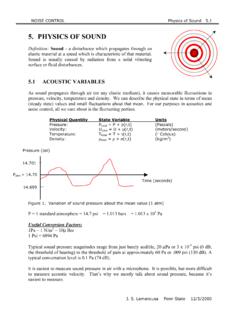
5. PHYSICS OF SOUND - Pennsylvania State University
www.mne.psu.edutorsional waves. Bending waves (in a beam or plate), and water waves are a mixture of shear and longitudinal waves. 5.3 SPEED OF SOUND For a longitudinal wave in an unbounded medium, sound travels at a speed of c: E = Young’s modulus for a solid material, or the bulk modulus for a fluid ρ= density of the material Volume / Bulk Modulus = ∂ ∂

Waves Exam Style Questions 57 Marks - Physics Tutor Online
www.physicstutoronline.co.ukSound waves cross a boundary between two media X and Y. The frequency of the waves in X is 400 Hz. The speed of the waves in X is 330 m s–1 and the speed of the waves in Y is 1320 m s– 1. What are the correct frequency and wavelength in Y? Frequency / Hz Wavelength / m A 100 0.82 B 400 0.82 C 400 3.3 D 1600 3.3
Combination of Waves - Physics Main | Physics
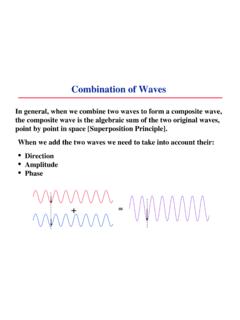
physics.ucf.eduCombination of Waves In general, when we combine two waves to form a composite wave, the composite wave is the algebraic sum of the two original waves, point by point in space [Superposition Principle]. When we add the two waves we need to take into account their: • Direction • Amplitude • Phase + =

Mechanical waves - Department of Physics
webhome.phy.duke.eduPhysics 142 Mechanical Waves Page 3! ! This gives us the formula for the intensity of the intensity of the resultant wave in terms of that of one wave alone: 1 Iav=4Iavcos2(δ/2)=2I 1 av(1+cosδ). If δ is an integer multiple of 2π, we have 1 Iav=4Iav; this is constructive interference. If δ