
Substance Abuse Subtle Screening Inventory (SASSI)
Abuse Subtle Screening Inventory-3 (SASSI-3) in identifying substance dependence disorders in clinical settings. Journal of Personality Assessment, 71(1), 114-128. Horrigan, T.J., Piazza, N.J. & Weinstein, L. (1996). The Substance Abuse Subtle Screening Inventory (SASSI) is more cost effective and has better selectivity than
Download Substance Abuse Subtle Screening Inventory (SASSI)

Information
Domain:
Source:
Link to this page:
Documents from same domain
Alcohol and your health - National Institutes of …
pubs.niaaa.nih.gov“It emphasized that drinking is not bad in and of itself—it’s how much you’re doing it and how it’s affecting your life.”
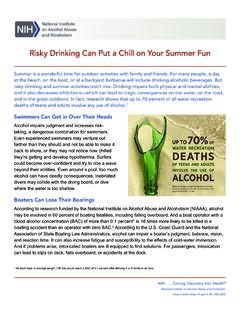
Risky Drinking Can Put a Chill on Your Summer Fun
pubs.niaaa.nih.govSummer is a wonderful time for outdoor activities with family and friends. For many people, a day at the beach, on the boat, or at a backyard barbecue will include drinking alcoholic beverages.
The Role of Nurses in Care - National Institutes of …
pubs.niaaa.nih.govThe Role of Nurses in Primary Care Managing AlcoholAbusing Patients E LEANOR J. S ULLIVAN, P H ... Information on the patient’s combined characteristics forms the basis of ... ing client education, screening, and refer ral if needed (Shenk in press).
The Neurobiology of Addiction
pubs.niaaa.nih.govneurobiology. The Neurobiology of Addiction An Overview AMANDA J. ROBERTS, PH.D., AND GEORGE F. KOOB, PH.D. Addiction can be defined in part as a compulsion to use alcohol or other drugs and the occurrence of withdrawal symptoms when long-term consumption ceases. In
Neurobiology of Alcohol Dependence
pubs.niaaa.nih.govNeurobiology of Alcohol Dependence greater than 0.08 percent within a 2 hour period, may be associated with dependence (NIAAA 2004 b). Models
Stages of Change Readiness and Treatment Eagerness …
pubs.niaaa.nih.govEagerness Scale (SOCRATES) BRIEF DESCRIPTION The SOCRATES is a 19-item, self-administered instrument designed to assess client motivation to change drinking-related behavior.
Alcohol Alert Number 86 - National Institutes of Health
pubs.niaaa.nih.govAlcohol Alert Number 86 ch e human genetic makeup (the genome) decoded and genetic testing ... The altered epigenetics caused by alcohol may play a role in alcohol-induced fatty liver and the progression of liver cancer, and may contribute to widespreadchanges in other organs.
Focus on: Epigenetics and Fetal Alcohol Syndrome
pubs.niaaa.nih.govFOCUS ON: EPIGENETICS AND FETAL ALCOHOL SPECTRUM DISORDERS homocysteine cycle, methionine is activated to SAM, ultimately resulting in the formation of homocysteine.
Cognitive-Behavioral Coping-Skills Therapy for Alcohol ...
pubs.niaaa.nih.govCognitive-Behavioral Coping-Skills Therapy for Alcohol Dependence Current Status and Future Directions Richard Longabaugh, Ed.D., and Jon Morgenstern, Ph.D. Cognitive-behavioral coping-skills training (CBST) is an alcoholism treatment approach aimed

Semi-Structured Assessment for the Genetics of Alcoholism ...
pubs.niaaa.nih.govSemi-Structured Assessment for the Genetics of Alcoholism (SSAGA-II) BRIEF DESCRIPTION TARGET POPULATION The SSAGA-II was designed to assess the physical, psychological, and social manifestations of alcohol abuse or dependence and other psychiatric disorders. It is is a polydiagnostic instrument that assesses somatization
Related documents
Drug Abuse Screening Test, DAST-10 - Boston University
www.bu.eduDrug Abuse Screening Test, DAST-10 The following questions concern information about your possible involvement with drugs not including alcoholic beverages during the past 12 months. "Drug abuse" refers to (1) the use of prescribed or over‐the‐counter drugs in excess of the directions,

COGNITIVE- BEHAVIORAL COPING SKILLS THERAPY MANUAL …
pubs.niaaa.nih.govA major focus of the efforts of the National Institute on Alcohol Abuse . and Alcoholism (NIAAA) in treatment research is to rigorously test the patient-treatment matching approach to the clinical management of alcoholism. This commitment is particularly reflected in its multi-site clinical trial, Project MATCH.

Drug Screening Questionnaire (DAST)
www.sbirtoregon.org2. Do you abuse more than one drug at a time? No Yes 3. Are you always able to stop using drugs when you want to? No Yes 4. Have you ever had blackouts or flashbacks as a result of drug use? No Yes 5. Do you ever feel bad or guilty about your drug use? No Yes 6. Does your spouse (or parents) ever complain about your involvement with drugs? No ...

Drug Abuse Screening Test - Addictions, Drug & Alcohol ...
adai.uw.eduIn the statements "drug abuse" refers to (1) the use of prescribed or over the counter drugs in excess of the directions and (2) any non-medical use of drugs. The various classes of drugs may include: cannabis (e.g. marijuana, hash), solvents, tranquilizers (e.g. Valium), barbiturates, cocaine, stimulants (e.g. speed), hallucinogens (e.g. LSD) or
May 2016 Screening & Assessment of Cannabis Use Disorders
adai.uw.eduhomework or study for a test”, “Missed out on other things because you spent too much money on marijuana.” The 27-item Cannabis Problems Questionnaire, CPQ (Copeland et al., 2005) measures acute and physical consequences, psychological consequences, and social consequences of cannabis use. While the CPQ is geared

College Drinking Fact Sheet
www.collegedrinkingprevention.govNational Institute on Alcohol Abuse and Alcoholism . w w w.niaaa.nih.gov • 301.443.3860 . Academic Problems . About 1 in 4 college students report academic consequences from drinking, including missing class, falling behind in class, doing poorly on exams or papers, and receiving lower grades overall. 5 . In a national survey of