
Surgical Pathology
Surgical Pathology Any UNLISTED specimen should be assigned to the CPT code which most closely reflects the work involved when compared to other specimens assigned to that code. The unit of service for CPT codes 88300 - 88309 is the SPECIMEN.A specimen …
Download Surgical Pathology

Information
Domain:
Source:
Link to this page:
Documents from same domain

Complete Blood Count Normal Pediatric Values
a1.mayomedicallaboratories.comComplete Blood Count Normal Pediatric Values Complete Blood Count Normal Pediatric Values Age Red Blood Cells (x 106/µL) Hemoglobin (g/dL) …
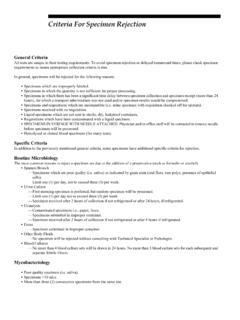
Criteria For Specimen Rejection - Mayo Medical Laboratories
a1.mayomedicallaboratories.comCytology • Fixative not added. • Unsatisfactory (acellular). Histology • Unresolved mislabeled or unlabeled specimen. Policy For Handling Rejected Specimens All specimens will be order entered into the computer. They may then be cancelled or logged off with an explanation of why they
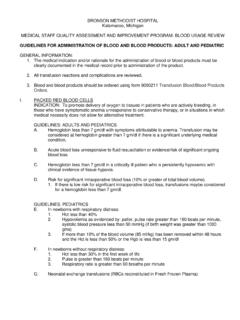
GUIDELINES FOR ADMINISTRATION OF BLOOD AND …
a1.mayomedicallaboratories.comGUIDELINES FOR ADMINISTRATION OF BLOOD AND BLOOD PRODUCTS: ADULT AND PEDIATRIC GENERAL INFORMATION: 1. The medical indication and/or rationale for the administration of blood or blood products must be clearly documented in the medical record prior to administration of the product. 2. All transfusion reactions and complications are reviewed. 3.

Specimen Collection, Preparation, and Transport
a1.mayomedicallaboratories.com• On-site chain-of-custody collection is available by special request, scheduled in advance. Training for on-site collection is also available by contacting NetworkReferenceLab. Microbiology Specimen Collection Please see specific test in “Alphebetical Test Listings” for detailed specimen requirement, handling, and transport information.
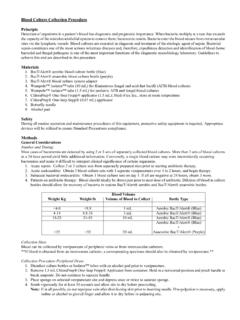
Blood Culture Collection Procedure
a1.mayomedicallaboratories.comBlood Culture Collection Procedure Principle Detection of organisms in a patient’s blood has diagnostic and progn ostic importance. When bacteria multiply at a rate that exc eeds the capacity of the reticuloendothelial system to remove them; b acteremia results. Bacteria enter the blood stream from extrava scular sites via the lymphatic vessels.
Related documents

ACUTE MYELOGENOUS LEUKEMIA (Including Acute …
www.who.int• Bone marrow aspirates are part of the routine evaluation of AML. In scenario’s where there is a “dry tap” or absence of material in the aspirate, a bone marrow biopsy will also be required. Otherwise a biopsy is not required for standard evaluation and care. Smears (touch preps) of the biopsy should also be evaluated. • This ...

Bone Marrow Transplantation in Mice - New York University
dental.nyu.eduOnce the marrows are flushed, a sterile Pasteur pipette or plastic transfer pipette is used to aspirate the cell suspension. A minimum of 35 aspirations will insure adequate dispersal of the cells. This can be verified visually with hemocytometer. The bone marrow disperses quite readily. An aliquot of the
THE LUGANO CLASSIFICATION
oncologypro.esmo.orgBONE MARROW EVALUATION • HL If PET-CT is performed, bone marrow biopsy no longer indicated for HL • DLBCL Biopsy if the PET is negative and identifying a discordant histology is important for patient management • Other subtypes ~2.5 cm unilateral bone marrow biopsy is recommended, along with immunohistochemistry and flow cytometry at
Multiple Myeloma
www.albertahealthservices.ca• Bone marrow aspirate and biopsy • Skeletal survey The following tests should be obtained . yearly. thereafter: • CBC • Serum creatinine • Calcium, • Serum, and 24-hour urine protein electrophoresis • Quantitative immunoglobulins • Free light chains • Skeletal survey . Page 7 of 62

Hodgkin Lymphoma Early Detection, Diagnosis, and Staging
www.cancer.orgMar 28, 2017 · A bone marrow biopsy is usually done just after the aspiration. A small piece or core of bone and marrow is removed with a slightly larger needle that's pushed into the bone. The biopsy may also cause some brief pain. Most children having a bone marrow aspiration and biopsy are either given medicine to
Multiple Myeloma Early Detection, Diagnosis, and Staging
www.cancer.orgFeb 28, 2018 · The bone marrow tissue is examined in the lab to see the appearance, size, and shape of the cells, how the cells are arranged and to determine if there are myeloma cells in the bone marrow and, if so, how many. The aspirate (the liquid part of the bone marrow) may also be sent for other tests, including immunohistochemistry and flow cytometry,

Minimal Residual Disease (MRD)
www.lls.orgThese tests use samples of bone marrow cells (taken by aspiration) and/or peripheral blood cells (taken through a vein). Flow Cytometry. Flow cytometry is a technique that evaluates individual cells by checking for the presence or the absence of certain protein markers on the cell surface. A fresh bone marrow aspirate sample is required

UNDERSTANDING MULTIPLE MYELOMA AND LABORATORY …
www.lls.orgSmall fragments of bone marrow cells can be withdrawn with an aspirate needle, and a small core of bone and marrow is often removed at the same time with a different type of needle. Both tests are done to determine how much of the normal bone marrow is replaced by myeloma cells. Additional, specialized testing (cytogenetics and FISH)

NCCN Guidelines for Patients: Acute Myeloid Leukemia
www.nccn.orgDec 02, 2021 · Bone marrow is the sponge-like tissue in the center of most bones. Inside your bone marrow are early blood-forming cells called blood stem cells (hematopoietic stem cells). All types of blood cells start as blood stem cells. At any given time, bone marrow will have cells in various stages of development, from very immature to almost fully mature.