
Task Analysis (TA) ---Step-by-Step Guide---
When forward chaining is used, an adult begins by teaching the first step in the chain. As each step is mastered, the next step in the task analysis is then taught. Follow the steps outlined below: Prompt the learner to perform the first step identified in the task analysis. Use the selected
Download Task Analysis (TA) ---Step-by-Step Guide---

Information
Domain:
Source:
Link to this page:
Documents from same domain

---Step-by-Step Guide--- - afirm.fpg.unc.edu
afirm.fpg.unc.eduThe planning step how to conduct a reinforcer sampling and prepare materials for PECS. 1.1 Receive PECS training from a certified PECS Training This module is not intended to take the place of training provided by Pyramid Educational Consultants, Inc.
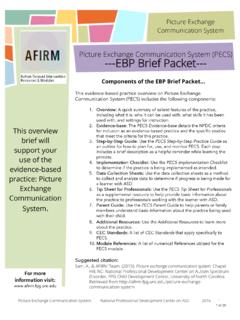
Picture Exchange Communication System (PECS) - AFIRM
afirm.fpg.unc.eduPicture Exchange Communication System (PECS) is used to teach learners with ASD with limited functional communication skills to initiate communicative exchanges and interactions within a …
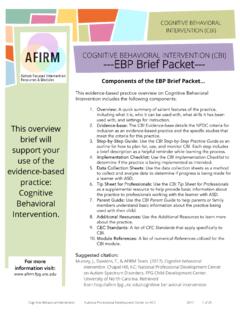
COGNITIVE BEHAVIORAL INTERVENTION (CBI) ---EBP Brief …
afirm.fpg.unc.eduFeb 15, 2017 · conditions (e.g., anxiety, depression, anger). In addition, once some of these foundational skills are addressed, effects may also be seen on adaptive behavior skills. Evidence-base Cognitive behavioral intervention meets the evidence-based practice criteria set by NPDC with 1 single case design study and 3 group design studies.

Visual Support (VS) ---EBP Brief Packet---
afirm.fpg.unc.eduBased upon the recent review, visual supports meets the evidence-based practice criteria set by NPDC with 18 single case design studies. The practice has been effective for preschoolers (3-5 years) to high school-age learners (15-22) with ASD. …

---CEC Professional Standards---
afirm.fpg.unc.eduThe CEC Standards that apply to a specific evidence-based practice can be found on our website at . https://afirm.fpg.unc.edu/. Initial Practice-Based Standards for Early Interventionists/Early Childhood ( 0-5 years; CEC, 2020) Standard Description Standard 1: Child Development and Early Learning 1.1

What are Visual Cues? - AFIRM
afirm.fpg.unc.eduturning on the water). TIP: See . Home Companion Guide for Prompting. for more information about least-to-most prompting. Type of Prompt Example Gestural Point to the picture or directions Model Show child how to follow the visual cue to do task …

Supporting Online Learning for Students with Autism
afirm.fpg.unc.educhallenges faced by students with autism when transitioning to online learning during the COVID -19 pandemic. The logistical and social nuances of online learning may be particularly challenging for students with autism. This guide is intended to provide support to families and their children and offer tools that can
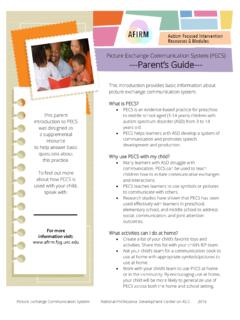
---Parent’s Guide--- - AFIRM
afirm.fpg.unc.edupicture exchange communication system. What is PECS? PECS is an evidence-based practice for preschool to middle school aged (3-14 years) children with autism spectrum disorder (ASD) from 3 to 14 years old. PECS helps learners with ASD develop a system of communication and promotes speech development and production. Why use PECS with my child?
Related documents
VALUE CHAIN: A CONCEPTUAL FRAMEWORK
accioneduca.org“A Value chain Analysis is an alliance of enterprises ... the value chain influences the dynamics of firm behavior and this dynamic persuade how well the value chain performs. Value chain structure includes the five elements like end market, Business and …
SHAPING AND CHAINING - Knapp Center
knappcenter.orgTask analysis is taught in reverse order (last step first) until all steps are completed independently. All of the behaviors identified in the task analysis are completed by the teacher, except for the final behavior in the chain. Allows a student to be reinforced immediately after the task is complete; as student sees the result, he/she is
The Value Chain From Competitive Advantage , by Michael …
people.tamu.eduAn analysis of the value chain rather than value added is the appropriate way to examine competitive advantage. Value added (selling price less the cost of purchased raw materials) has sometimes been used as the focal point for cost analysis because it was viewed as the area in which a firm can control costs.
supply chain roadmap: The method
www.supplychainroadmap.comSupply Chain Roadmap: The Method by Hernan David Perez is licensed under a Creative Commons Attribution-NoDerivs 3.0 Unported License. 10 Third step: Gap analysis Gap analysis stage pretends to find dominant behavior of supply chain, factors that are out of the

INSTRUCTIONS FOR CHAIN ANALYSIS WORKSHEET
blogs.uw.edubehavior). C. Describe the intensity of the behavior and other characteristics of the behavior that are important. D. Describe problem behavior in enough detail that an actor in a play or movie could recreate the behavior exactly. 2. Describe the specific PROMPTING EVENTthat started the whole chain of behavior.

Behavior Chain Analysis Information - UNC School of Social ...
cls.unc.eduChain Analysis of Problem Behavior Date Filled Out: Possible Types of Links Actions Body sensations Cognitions Events Feelings List actual, specific behaviors and then list new, more skillful behaviors to replace ineffective behaviors. 10th 11th 12th 1 3th 14th

TREATMENT OF AGGRESSIVE BEHAVIOR
www.chp.edufunction the behavior plays in the sequence of the episode. [Braden 1997] Most behaviors serve a purpose. The aggressive behavior may provide an escape from something that is frightening or threatening. The individual with FXS quickly learns that aggressive behavior is a powerful way to signal a desire to be left alone, moved away, or timed out.