Technical DaTa SheeT Polycarbonate - Laminated Plastics
Technical DaTa SheeT Polycarbonate (PC) Polycarbonate is best known for its impact resistance but has additional properties like: Optical transparency, excellent creep resistance, wide temperature range, high dimensional stability, good electrical characteristics and self-extinguishing behavior.
Download Technical DaTa SheeT Polycarbonate - Laminated Plastics

Information
Domain:
Source:
Link to this page:
Documents from same domain

Technical DaTa SheeT Polypropylene - Laminated Plastics
laminatedplastics.comTYPICAL PROPERTIES of POLYPROPYLENE ASTM or UL test Property Homopolymer Co-Polymer Flame Retardant PHYSICAL D792 Density (lb/in³) (g/cm³) 0.033 0.905 0.033 0.897 0.035 0.988 D570 Water Absorption, 24 hrs (%) <0.01 0.01 0.02 MECHANICAL D638 Tensile Strength (psi) 4,800 4,800 4,300 D638 Tensile Modulus (psi) 195,000 - -

Technical DaTa SheeT Polyethylene - Laminated Plastics
laminatedplastics.comPOlYeThYlene GRaDeS high Density Polyethylene (hDPe) Representing the largest portion of the polyethylene applications, HDPE offers excellent impact resistance, light weight, low moisture absorption, and high tensile strength. HDPE is also non-toxic and non-staining and meets FDA and USDA certifica-tion for food processing. Benefits Abrasion ...
Technical DaTa SheeT high Density Polyethylene
laminatedplastics.comhigh Density Polyethylene (HDPE) Representing the largest portion of the polyethylene applications, HDPE offers excellent impact resistance, light weight, low moisture absorption, and high tensile strength. HDPE is also non-toxic and non-staining and meets FDA and USDA certifica-tion for food processing. Benefits Abrasion Resistant

Technical DaTa SheeT Teflon (PTFe) - Laminated Plastics
laminatedplastics.com(260 C). It is the most chemically resistant plastic available and only a few chemicals react with it. PTFE mechanical properties are low compared to other engineering plastics, but its integrity is maintained over a wide temperature range - from -400 to 500°F (-240 to 260°C).

Technical DaTa SheeT lexan (Pc) Polycarbonate
laminatedplastics.comnTe Te inoration containe erein are typical ales intene or reerence an coparison prposes only Tey sol nT be se as a basis or esin specifications or ality control contact s or anactrers’ coplete aterial property ataseets.

Technical DaTa SheeT Plexiglass (PMMa)
laminatedplastics.comTYPICAL PROPERTIES of ACRYLIC PMMA ASTM or UL test Property Acrylic PHYSICAL D792 Density (lb/in³) (g/cm³) 0.043 1.18 D570 Water Absorption, 24 hrs (%) 0.3 MECHANICAL D638 Tensile Strength (psi) 8,000 - 11,000 D638 Tensile Modulus (psi) 350,000 - 500,000 D638 Tensile Elongation at Break (%) 2 D790 Flexural Strength (psi) 12,000 - 17,000

Technical DaTa SheeT nylon - Laminated Plastics
laminatedplastics.comse as a asis o esin specifications o ality contol contact s o anactes’ coplete ateial popety ataseets. all ales at F c nless oteise note. Technical DaTa SheeT nylon (Polyamide) The exceptional bearing and wear properties of Nylon make it one of the …

TECHNICAL DATA SHEET Mylar® - Laminated Plastics
laminatedplastics.comMylar® (Polyester Film) Mylar® exhibits superior strength, heat resistance, and excellent insulating properties. The unique qualities of Mylar® are found in many consumer, high tech, and electronic markets. Mylar® Polyester Film is ideally suited for a wide range of uses such as
Technical DaTa SheeT acetal (POM) - Laminated Plastics
laminatedplastics.comCopolymer Acetal has superior performance in continuous high heat and hot water environments. Copolymer Acetal also tends to have less porosity than Homopolymer Acetal. Grades of Acetal aceTal cOPOlYMeR (unfilled) The copolymer grade offers excellent performance at a slightly lower cost than Delrin®. Certain grades are FDA, USDA, NSF,
Technical DaTa SheeT PVc - Laminated Plastics
laminatedplastics.comDielectric Strength (V/mil) short time, 1/8" thick 544 1250 D150 Dielectric Constant at 60 Hz 3.2 3.7 D150 Dissipation Factor at 60 Hz .0096 - D257 15Volume Resistivity (ohm-cm)at 50% RH 5.4 x 10 3.4 x 10¹⁵ S available
Related documents
PEL
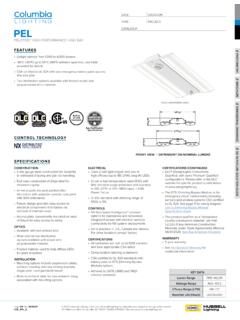
hubbellcdn.comPolycarbonate Blank No Lens W Wide Distribution N Narrow Distribution Blank Lambertian Distribution Blank No uplight U1 1000 Lumens +7.5W U2 2000 Lumens +18.7W U3 3000 Lumens +27.1W U4 4000 Lumens +40.4W – Driver Voltage Options Control Options E Fixed Output ED 0–10V Dimming U 120–277V 347 347V5 480 480V5,12
THERMOFORMING DESIGN GUIDELINES
multifabmanufacturing.comGenerally speaking amorphous materials like polystyrene, ABS, polycarbonate, PVC, and PVC/Acrylic blends are easier to vacuum form as they do not have such a critical forming temperature. When heat is applied amorphous materials become soft and plia- ... Twin sheet forming has a lower tooling cost than blow molding and still produces a hol-
4007ES Fire Detection and Control with Addressable ...
simplex-fire.comFor more detailed information on ES Net, refer to data sheet S4100-0076, and talk to your local Simplex product supplier. Operator interface Convenient status information With the locking door closed, the glass window allows viewing of the display status LEDs. The user interface is a 4.3 in. (109 mm) diagonal
DA10D and DA30D Data Sheet - Red Lion
www.redlion.netConstruction: Polycarbonate enclosure with IP40 rating for indoor use Weight: DA10D – 6.8 oz (192.78 g) DA30D – 6.9 oz (195.61 g) Specifications are subject to change. Visit www.redlion.net for more information. DA10D and DA30D Specifications MODEL NUMBER* DESCRIPTION SERIAL/ ETHERNET PORTS USB HOST DATA LOGGING & WEB SERVER EXPANSION …
A Guide to Chemical Resistance of Polycarbonate Sheet
www.theplasticshop.co.ukLexan polycarbonate sheet has a good chemical resistance, at room temperature, to a variety of dilute organic and inorganic acids. Water, vegetable oils, solutions of neutral salts, aliphatic hydrocarbons and alcohols are also included in this category. When polycarbonate sheet is attacked by a chemical it usually takes one of three forms.