
Test3 ch17b Buffer-Titration-Equilibrium Practice Problems
5 Buffer Calculations 20. Calculate the pH of a solution that is 0.30 M in ammonia (NH 3) and 0.20 M in ammonium chloride (NH 4Cl, K a = 5.62 × 10 –10). 21. Calculate the pH of a solution containing 0.40 mol fluoride anion and 0.30 mol of hydrogen fluoride (HF).
Download Test3 ch17b Buffer-Titration-Equilibrium Practice Problems

Information
Domain:
Source:
Link to this page:
Documents from same domain
Chapter 4: Energy from Combustion The primary …
web.mnstate.eduChapter 4: Energy from Combustion The primary means of generating energy for human endeavors is the combustion of fuels. Fuels: Coal -burned in power plants Gasoline -burned in automobiles
Mass Spectroscopy
web.mnstate.edu1 Mass Spectroscopy Mass Spectroscopy is a technique causing the formation of the gaseous ions with or without fragmentation; the gas phase ions are then

African Environmental Issues - Minnesota State …
web.mnstate.eduAfrican Environmental Issues . Environment in Africa: continuity & change. •Important to consider geological age of Africa & its tropical location. •Both affect
Reactions of Amines - Minnesota State University …
web.mnstate.eduChem 360 Jasperse Ch. 19 Notes + Answers. Amines 1 Reactions of Amines 1. Reaction as a proton base (Section 19-5 and 19-6) RN H H N H R H H X …
Standardization of a Hydrochloric Acid Solution
web.mnstate.eduPage 1 Spring 2011 Standardization of a Hydrochloric Acid Solution The purpose of this experiment is to test your lab technique and examine potential sources of error in

Some Arrow-Pushing Guidelines (Section 1.14)
web.mnstate.eduOrganic Chemistry I Review: Highlights of Key Reactions, Mechanisms, and Principles 1 Some Arrow-Pushing Guidelines (Section 1.14) 1. Arrows follow electron movement.

Recrystallization I 9 Chem 355 Jasperse RECRYSTALLIZATION
web.mnstate.eduRecrystallization I 9 Chem 355 Jasperse RECRYSTALLIZATION Background: Impurities often contaminate organic compounds, whether they have been synthesized in

1. Given the relation R (1 1) (1 3) (1 4) (2 2) (3 1) (3 4 ...
web.mnstate.edu9. For each of the following collections of subsets of A= {1,2,3,4,5}, determine whether of not the collection is a partition. If it is, list the ordered pairs in the equivalence relation determined by the partition.
Gas Chromatograph Gas Chromatography
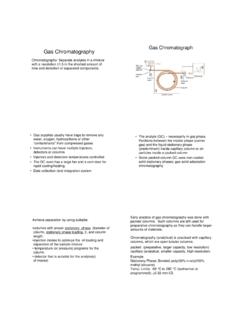
web.mnstate.eduColumn selection GC: Select a stationary phase that would retain (‘dissolve’) the analytes of interest. Stationary phase polarity ~ analyte polarity; (like dissolves like). Selectivity to individual analytes determines the quality of separation (ability to discern the

Acute Stress Response Spectrum Adaptationist Perspectives ...
web.mnstate.edurecent literature, freeze, flight, fight, fright, faint provides a more complete description of the human acute stress response sequence than current descriptions.
Related documents
phosphate buffer - University of Nebraska–Lincoln
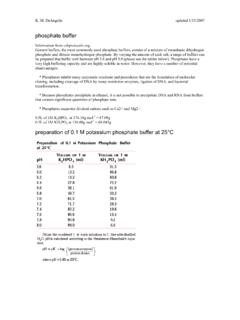
www.unl.eduphosphate buffer Information from cshprotocols.org: Gomori buffers, the most commonly used phosphate buffers, consist of a mixture of monobasic dihydrogen phosphate and dibasic monohydrogen phosphate. By varying the amount of each salt, a range of buffers can be prepared that buffer well between pH 5.8 and pH 8.0 (please see the tables below).
pH Measurements and Buffer Laboratory Introduction
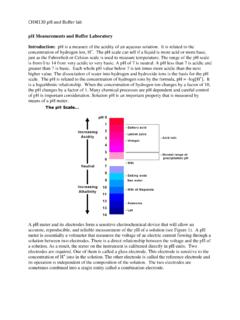
classes.kvcc.eduCHM130 pH and Buffer lab pH Measurements and Buffer Laboratory Introduction: pH is a measure of the acidity of an aqueous solution.It is related to the concentration of hydrogen ion, H+.The pH scale can tell if a liquid is more acid or more base,

Experiment 7: Preparation of a Buffer
jupiter.plymouth.eduSecond, you will make 100 mL of a buffer also with pH = 5, but with a higher buffering capacity, using 5 mL of a 0.5 M acetic acid solution. Although a buffer will resist a change in pH, eventually enough acid or base can be added to destroy it. The amount of acid or base needed to change the pH of a buffer is known as the "buffering capacity."

The Preparation of Buffers and Other Solutions: A Chemist ...
sun-lab.med.nyu.edua = 6.7) to buffer a solution at pH 4, or to use acetic acid (pK a = 4.7) to buffer near neutral pH. What Are the Criteria to Consider When Selecting a Buffer? Target pH Of primary concern is the target pH of the solution. This narrows the possible choices to those buffers with pK a values within 1 pH unit of the target pH. pH pK CH COO CH COOH ...
Protocol: Protein electrophoresis and western blot recipes
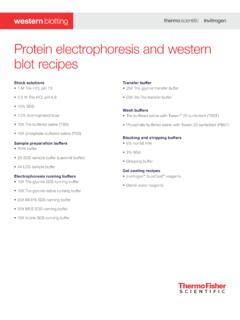
assets.thermofisher.comadjust pH. Bis-Tris transfer buffer: 25 mM bicine, 25 mM Bis-Tris (free base), 1 mM EDTA, pH 7.2 Recipe for 20X buffer stock: Bicine 10.2 g Bis-Tris (free base) 13.1 g EDTA 0.75 g Deionized water to 125 mL The buffer is stable for 6 months when stored at 4°C. Do not use acid or base to adjust pH. Tris-glycine transfer buffer: 12 mM Tris base,

Direct ELISA protocol - Abcam
www.abcam.comBicarbonate/carbonate coating buffer (100 mM) Antigen or antibody should be diluted in coating buffer to immobilize them to the wells: 3.03 g Na 2CO 3, 6.0 g NaHCO 3 1000 ml distilled water pH 9.6, PBS 1.16 g Na 2HPO 4, 0.1 g KCl, 0.1 g K 3PO 4, 4.0 g NaCl (500 ml distilled water) pH 7.4. Blocking solution Commonly used blocking agents are 1% ...

pH and Fermentation - Agriculture with Mrs. Skien
agriculturewithmrsskien.weebly.comThe pH Scale The pH scale is a measurement of the total acidity or alkalinity of a substance. Every substance has a pH that can be measured with a variety of methods. The pH scale measures from 0 to 14.0, with 7.0 being neu-tral. Any substance that has a pH of less than 7.0 (meaning 0 to 6.9) is considered acidic and will display ...
pH buffers. Buffer capacity and buffering range
pg.edu.pl- buffer solution, pH = 4.01 - buffer solution, pH = 7.00 Mount the combined glass electrode in the holder. Thoroughly rinse the electrode with distilled water and gently dry with a piece of paper towel. Place the vial with buffer solution (pH 4.01) on the magnetic stirrer. Immerse the glass electrode in the buffer solution (the

Buffer pKa and pH Range Values - Animal Science
animalscience.unl.eduBuffer pKa and pH Range Values For preparation of . Buffers in the pH . Buffers pKa range . Hydrochloric Acid - HCl 0-2 . Nitric Acid - HNO. 3 . Perchloric Acid – HClO. 4. Potassium Chloride – KCl 1.1-1.8 . Oxalic Acid – C. 2. H. 2. O. 4
Acid Rain Experiments - Cornell University
ei.cornell.eduAcid precipitation is defined to have a pH lower than 5.6. In New York, the average pH of rainfall is 4.0-4.5 and individual storms as low as 3.0 are not unusual. Freshwater lakes commonly are slightly basic. pH's in the range of 6.5 to 8.2 are optimal for most organisms, and below 5.0 is lethal to many fish species.