
The 4 Basic Tissue Types in the Human Body
The 4 Basic Tissue Types in the Human Body www.exploringnature.org Tissues are groups of cells with a common structure (form) and function (job). There are four main tissues in the body – epithelium, muscle, connective tissue and nervous tissue. I. EPITHELIUM Functions (jobs): 1) It protects us from the outside world – skin.
Download The 4 Basic Tissue Types in the Human Body

Information
Domain:
Source:
Link to this page:
Documents from same domain

Cellular Respiration - Exploring Nature Science …
www.exploringnature.org1) photosynthesis creates glucose molecules (instead of eating) → 2) this fuels cellular respiration in the plant cells → 3) creates ATP → 4) fuels plant growth and reproduction → 5) provides carbohydrates to animals for
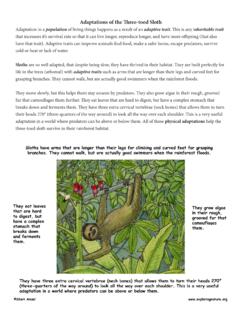
Adaptations of the Three-toed Sloth - The Exploring Nature ...
www.exploringnature.orgAdaptations of the Three-toed Sloth Adaptation in a population of living things happens as a result of an adaptive trait.This is any inheritable trait that increases it’s survival rate so that it can live longer, reproduce longer, and have more offspring (that also
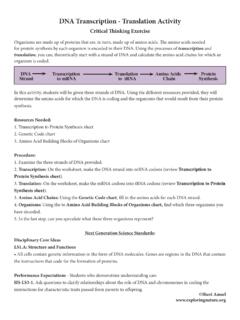
DNA Transcription - Translation Activity
www.exploringnature.orgGenes are regions in the DNA that contain the instructions that code for the formation of proteins. Performance Expectations - Students who demonstrate understanding can: HS-LS3-1. Ask questions to clarify relationships about the role of DNA and chromosomes in coding the
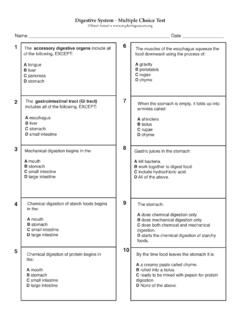
Digestive System - Multiple Choice Test - Exploring Nature
www.exploringnature.orgThe accessory digestive organs include all of the following, EXCEPT: A tongue B liver C pancreas D stomach The gastrointestinal tract (GI tract) includes all of the following, EXCEPT: A esophagus B liver C stomach D small intestine Mechanical digestion begins in the: A mouth B stomach C small intestine D large intestine
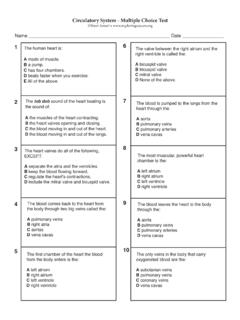
Circulatory System - Multiple Choice Test
www.exploringnature.orgB the heart valves opening and closing. C the blood moving in and out of the heart. D the blood moving in and out of the lungs. The heart valves do all of the following, EXCEPT: A separate the atria and the ventricles. B keep the blood flowing forward. C regulate the heart’s contractions. D include the mitral valve and bicuspid valve.
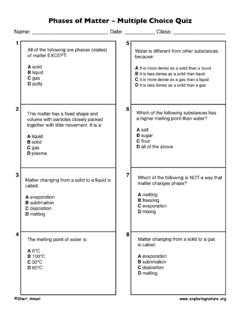
Matter Assessment and NGSS - Exploring Nature
www.exploringnature.orgScience and Engineering Practices: Developing and Using Models Modeling in 6–8 builds on K–5 and progresses to developing, using and revising models to describe, test, and predict more abstract phenomena and design systems. • Develop a model to predict and/or describe phenomena. (MS-PS1-1),(MS-PS1-4)
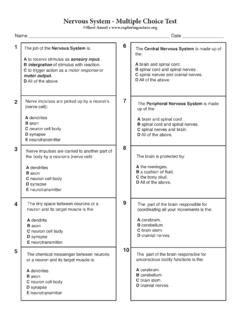
Nervous System - Multiple Choice Test - Exploring Nature
www.exploringnature.orgThe Central Nervous System is made up of the: brain and spinal cord. B spinal cord and spinal nerves. C spinal nerves and cranial nerves. D All of the above. The Peripheral Nervous System is made up of the: A brain and spinal cord. B spinal cord and spinal nerves. C spinal nerves and brain. D All of the above. The part of the brain responsible for
Bones and Features of the Skull - Cranium and Face
www.exploringnature.orgBones and Features of the Skull - Cranium and Face ©Sheri Amsel • www.exploringnature.org Bones of the Cranium The cranium is made up of 8 bones: 2 (paired) parietal bones • 2 (paired) temporal bones • frontal bone • occipital bone • sphenoid bone • ethmoid bone The frontal bone is located on the anterior cranium and includes the following features:

Phases of the Moon - Exploring Nature
www.exploringnature.org2. The moon takes the same amount of time to rotate once around on its axis as it does to revolve around the Earth - so the same side of the moon always faces the Earth. The moon looks different during its revolution around the Earth, because at each position its is getting a different amount of sunlight on its surface.
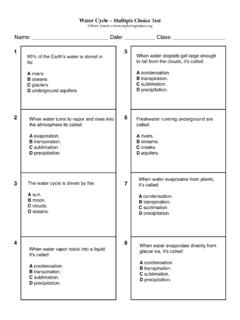
Water Cycle – Multiple Choice Test - Exploring Nature
www.exploringnature.orgC creeks. D aquifers. The water cycle is driven by the: A sun. B moon. C clouds. D oceans. When water turns to vapor and rises into the atmosphere its called: A evaporation. B transpiration. C sublimation. D precipitation. When water evaporates directly from glacial ice, it’s called: A condensation. B transpiration. C sublimation. D ...
Related documents

Basic Concepts of Human Genetics
pages.mtu.edu1 Basic Concepts of Human Genetics • The genetic information of an individual is contained in 23 pairs of chromosomes. Every human cell contains the 23 pair of chromosomes. • One pair is called sex chromosomes Male: XY Female: XX • Other 22 pairs of homologous chromosomes are called autosomes. • The autosome chromosome pairs are called homologous pair.

ELECTROMAGNETIC FIELD INTERACTIONS WITH THE …
ntrs.nasa.govParts of the Human Body 75. 26. Calculated Current Densities in a Grounded Man in Re-sponse to a 60-Hertz, 10,000 Volt/Meter Electric Field 76. 27. Dielectric Properties of Human Brains in the Microwave S-Band, at 37 Degrees Centigrade 79. 28. Frequency Dependence of Muscle Tissue Dielectric Con-stant 80. 29.

Physiology I: Human Physiology
lpc1.clpccd.cc.ca.usStructure – function maps 2. Process maps or Flow charts Follow process in sequence Fig 1-5b . Key Themes in Physiology: 1. Homeostasis (Chapter 6) Body systems work together (Integration of function) Internal vs. external failure of homeostasis 2. Communication and movement across ... Sometime human experimentation necessary.
Structure and Function of Neurons
assets.cambridge.orggeneral structure of the neuron another general structure of the neuron cell body (soma) A B FIGURE 1-1A and B Generic structure of neuron. This is an artist’sconception of the generic structure of a neuron. All neurons have a cell body known as the soma, which is the command center of the nerve and contains the nucleus of the cell.

A Guide for Business How to develop a Human rights Policy
www.ohchr.orgbranch of the United Nations human rights structure. The High Commissioner is respon- ... intergovernmental body on human rights, the Human Rights Council. OHCHR has supported the human rights component of the United Nations Global Compact since it was launched in 2000.
CHAPTER 1: INTRODUCTION TO THE HUMAN BODY
nursingnsn.weebly.com1.2. HUMAN BODY ORGANIZATION Human beings are arguably (questionably, perhaps) the most complex organisms on this planet. Imagine billions of microscopic parts, each with its own identity, working together in an organized manner for the benefit of the total being. The human body is a single structure but it is

KS2 Scheme of Work the Human Body - STEM
www.stem.org.ukKS2 The human body Part 1 The skeleton-muscular system Introduction: This series of activities is designed to run over several lessons and to involve pupils in a range of learning activities relating to the human body. Some of these activities make use of the Siemens Education resource ‘Inside the Human Body’ interactive tool.

Structure and Function of the Musculoskeletal System
www.ergo.human.cornell.eduHuman Muscles Î Muscular system is 50% of total human body weight. Î >600 skeletal muscles, which enables the human body to move and stand erect. Î Skeletal muscles are arranged in overlapping intricate layers: z Superficial muscles z Deep muscles Skeletal muscle Î Skeletal muscle is striated (striped), and excludes cardiac and smooth muscle.

The Human Skeleton - Institute for Emerging Issues
kenanfellows.orgthe postcranial body has been studied extensively for evidence of age at time of death, estimate of stature and bodily proportions, and presence of injury and disease. Although we will focus on the human skeleton, the same bones, with some modification in shape, are found in non-human primates and other mammals, for example, the dog.