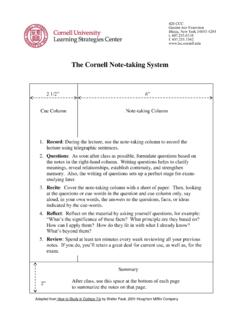
The Cornell Note-taking System
How can I apply them? How do they fit in with what I already know? What’s beyond them? 5. Review: Spend at least ten minutes every week reviewing all your previous notes. If you do, you’ll retain a great deal for current use, as well as, for the exam. 420 CCC Garden Ave Extension Ithaca, New York 14853-4203 t. 607.255.6310 f. 607.255.1562
Download The Cornell Note-taking System

Information
Domain:
Source:
Link to this page:
Documents from same domain

Topic #2: Why Study Statistics - Cornell University
lsc.cornell.eduTopic #2: Why Study Statistics? Hopefully, the discussion above has helped you to understand a little better what the terms measurement and statistics mean.

Topic #1: Introduction to measurement and statistics
lsc.cornell.eduTopic #1: Introduction to measurement and statistics "Statistics can be fun or at least they don't need to be feared." Many folks have trouble believing this premise.
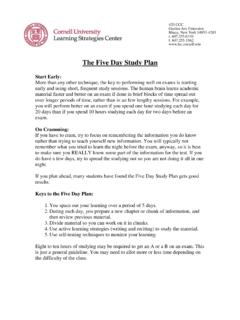
The Five Day Study Plan - Cornell University
lsc.cornell.eduto make sure you REALLY know some part of the information for the test. If you do have a few days, try to spread the studying out so you are not doing it all in one night. If you plan ahead, many students have found the Five Day Study Plan gets good results. Keys to the Five Day Plan: 1. You space out your learning over a period of 5 days. 2.
Topic #1: Introduction to measurement and statistics
lsc.cornell.edumeasurement is an interval scale. The Fahrenheit scale is a clear example of the interval scale of measurement. Thus, 60 degree Fahrenheit or -10 degrees Fahrenheit are interval data. Measurement of Sea Level is another example of an interval scale. With each of these scales there is direct, measurable quantity with equality of units.

The Cornell Note-taking System
lsc.cornell.eduNote-taking Column Cue Column Summary After class, use this space at the bottom of each page to summarize the notes on that page. 1. Record: During the lecture, use the note-taking column to record the lecture using telegraphic sentences. 2. Questions: As soon after class as possible, formulate questions based on
Topic #2: Why Study Statistics - Cornell University
lsc.cornell.eduTopic #2: Why Study Statistics? Hopefully, the discussion above has helped you to understand a little better what the terms measurement and statistics mean. However, you may still be wondering "Why do I need to learn statistics?" or "What future benefit can I get from a statistics class?". Well, since you asked -

Understanding Academic Anxiety - Cornell University
lsc.cornell.eduanxiety, however, most of us would lack the motivation to study for exams, write papers, or do daily homework (especially in classes we find boring). A moderate amount of anxiety actually helps academic performance by creating motivation. The graph below illustrates the relationship between anxiety and performance. Low High Level of Anxiety
Related documents
Internal Audit and SOX Best Practices
www.dallasiia.orgRisk Assessment and Audit Plan Establish Annual Audit Plan: - Done by the CAE and senior management. - Risk-based approach based on auditable items in the company. - External and internal risks are considered: Environmental, regulations, turnover, segregation of duties. - Best use of audit teams time is considered.

Flyer Know Your Investments (formerly Hall of Shame)
timothyplan.comMar 31, 2021 · Know Your Investments The list we’ve compiled in this “Know Your Investments” piece is a very small sampling of companies who are actively involved in or profiting from immoral practices such as abortion, pornography, and ... Ask your financial consultant for a moral audit on your investments.
Compliance Audit Handbook
www.environment.nsw.gov.auCollecting audit evidence through gathering information, observations and interviews, and sampling see 2.3.2 Conducting a closing meeting see 2.3.3 Post-site visit activities Evaluating audit evidence see 2.4.1 Compiling a compliance audit report see 2.4.2 Developing a follow-up action program see 2.4.3

Audit Interview Questions And Answers Guide.
www.globalguideline.comHaving been an auditee, I know it helps to hear audit findings firsthand, the positive as well as the negative. Involving people creates a feeling that everyone is a vital contributor to the goal of the company - compliance. ... Compliance procedures can be …

Research Process Flowchart - ShoulderDoc
www.shoulderdoc.co.ukSampling What method of sampling will give you the most useful data for the project you are working on? Sampling methods from the National Audit Office Sampling Guide Discussion on the distinction between Probability and Nonprobability sampling methods Statistical Issues Are you familiar with the statistics you may need to use?
Pub 131:10/19 Your Rights and Obligations Under the Tax ...
www.tax.ny.govWe use several different audit methods to conduct audits. We may conduct: • a detailed audit, • an audit involving a test period method, or • an audit involving a statistical sampling method. The method an auditor chooses will depend on several variables, such as the type of tax, the accuracy and availability