Think Stats: Probability and Statistics for Programmers
populations. Most statistical analysis is based on probability, which is why these pieces are usually presented together. Computation is a tool that is well-suited to quantitative analysis, and computers are commonly used to process statistics. Also, computa-tional experiments are useful for exploring concepts in probability and statistics.
Download Think Stats: Probability and Statistics for Programmers

Information
Domain:
Source:
Link to this page:
Documents from same domain
Think Stats - Green Tea Press
greenteapress.comvi Chapter 0. Preface This book takes a computational approach, which has several advantages over mathematical approaches: I present most ideas using Python code, rather than mathematical

Think Python - Green Tea Press
greenteapress.comThink Python How to Think Like a Computer Scientist 2nd Edition, Version 2.2.23 Allen Downey Green Tea Press Needham, Massachusetts

Think DSP - Green Tea Press
greenteapress.comThink DSP Digital Signal Processing in Python Version 1.0.9 Allen B. Downey Green Tea Press Needham, Massachusetts
Modeling and Simulation in Python - Green Tea Press
greenteapress.comModeling and Simulation in Python Version 2.2.4 Allen B. Downey Green Tea Press Needham, Massachusetts

Think Complexity - Green Tea Press – Free books …
greenteapress.comPreface 0.1 Why I wrote this book This book is inspired by boredom and fascination: boredom with the usual presentation of data structures and algorithms, and fascination with complex systems.

TheLittleBookofSemaphores - Green Tea Press
greenteapress.comWellesley College. I used the first edition of The Little Book of Semaphores along with one of the standard textbooks, and I taught Synchronization as a concurrent thread for the duration of the course. Each week I gave the students a few pages from the book, ending with a …

Mapping of Computer Science A to Think Java - Green Tea …
greenteapress.comMapping of Computer Science A to Think Java This document is an extended version of the Topic Outline from the AP Computer Science A ... Following is an outline of the major topics considered for the AP Computer Science A Exam. This outline is intended to define the …

Think Perl 6 - Green Tea Press
greenteapress.comPerl 6, and more about learning how to write programs for computers. This book is intended for beginners and does not require any prior programming knowl- edge, but it is my hope that even those of you with programming experience will benefit

Think Java: How to Think Like a Computer Scientist
greenteapress.comThink Java How to Think Like a Computer Scientist Version 6.1.3 Allen B. Downey and Chris May eld Green Tea Press Needham, Massachusetts

main
greenteapress.comto the AP questions. On the other hand, if you understand the concepts in this book, along with the details of programming in C++, you will have all the tools you need to do well on the exam. 1.1 What is a programming language? The programming language you will be learning is C++, because that is the language the AP exam is based on, as of 1998.
Related documents
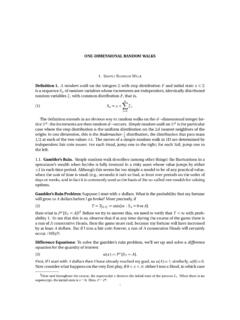
ONE-DIMENSIONAL RANDOM WALKS - University of Chicago
galton.uchicago.eduTo get at the distribution of the first passage time ˝we’ll look at its probability generating function (12) F(z):=Ez˝= X1 n=1 znPf˝=ng. This is defined for all real values of z less than 1 in absolute value. By elementary rules governing independence and generating functions, the probability generating function of ˝(m) is F(z)m, (1 ˝1 ...
A Probability and Statistics Cheatsheet
ucla.jamesyxu.comThis cheat sheet integrates a variety of topics in probability the-ory and statistics. It is based on literature [1,6,3] and in-class material from courses of the statistics department at the Univer-sity of California in Berkeley but also in uenced by other sources [4,5]. If you nd errors or have suggestions for further topics, I
Notes on Probability - Queen Mary University of London
www.maths.qmul.ac.ukSet books The notes cover only material in the Probability I course. The text-books listed below will be useful for other courses on probability and statistics. You need at most one of the three textbooks listed below, but you will need the statistical tables. • Probability and Statistics for Engineering and the Sciences by Jay L. De-

Job Shop Scheduling
courses.washington.edu1. R (Random) – Pick any Job in Queue with equal probability. This rule is often used as benchmark for other rules 2. FCFS (First Come First Serve) – Jobs are processed in the order in which they arrived at the work center (also called earliest release date) 3. SPT (Shortest Processing Time) –This rule tends to reduce both work-in-process
Problems on general probability rules, independence ...
faculty.math.illinois.eduMath 370, Actuarial Problemsolving Problems on General Probability Rules (b) Find P(D). Solution: Drawing a Venn diagram, we see that D consists of the union of A and B minus the overlap. Thus, P(D) = P(A ∪ B \ A ∩ B) = P(A ∪ B) − ...

dni.gov
www.dni.govfactors that enhance the probability of detection before actual penetration to the SCIF occurs by the existence of a layer or layers of security that offer mitigations for risks. b. To qualify for SID, at least one layer identified in the IC Tech Spec shall be applied.