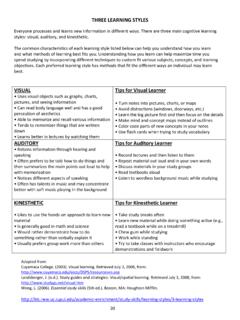
THREE LEARNING STYLES
THREE LEARNING STYLES Everyone processes and learns new information in different ways. There are three main cognitive learning styles: visual, auditory, and kinesthetic. The common characteristics of each learning style listed below can help you understand how you learn and what methods of learning best fits you.
Download THREE LEARNING STYLES

Information
Domain:
Source:
Link to this page:
Documents from same domain
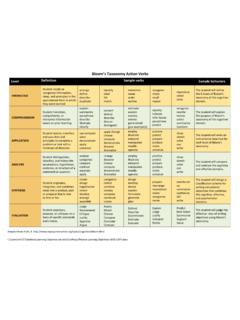
Bloom’s Taxonomy Action Verbs - Missouri State …
www.missouristate.eduC:\Users\rm727\Desktop\Learning Objective Job Aids\Crafting Effective Learning Objectives WEB COPY.docx Bloom’s Taxonomy Action Verbs

Creating a Personal Financial Plan - Missouri State …
www.missouristate.eduStep #3: Identify Alternative Courses of Action So far in the planning process you have evaluated your current financial situation and established some

SOAR - Missouri State University
www.missouristate.eduSOAR. SOAR. #CitizenBear COMMUNITY ENGAGEMENT Learn to recognize the needs in your community and use your knowledge and skills to help. CULTURAL COMPETENCE Recognize and respect multiple perspectives and cultures #CitizenBear. ETHICAL LEADERSHIP Strive for excellence and integrity as you develop

2018-2019 CALENDAR for Faculty Evaluation, Tenure ...
www.missouristate.edu1 2018-2019 CALENDAR for Faculty Evaluation, Tenure & Promotion, and Reappointment Annual Evaluation Calendar: All Full-Time Faculty This calendar is for years when funding for the raise pool is …

MARKETING PLAN PRESENTED BY CRANFORD JOHNSON …
www.missouristate.eduNov 07, 2013 · number of students due to the declining size of high school graduating classes. Universities are also ... • Junior and senior high schools students • Parents of prospective high school students ... • Developing a five-to-seven-question survey for representatives from each
Related documents

Understanding the Results of Your Vark ... - Learning Center
learningcenter.unt.eduThe kinesthetic learner enjoys learning through doing. This active learning style is useful for assembling and making things. You may find it easy to demonstrate how to do something. You are likely to enjoy the actual experience of learning. You prefer classes with labs and lecturers who give real-life examples.
Learning styles and teaching styles determine students ...
files.eric.ed.govYemen. According to the results, it showed that kinesthetic learning mode preference was reported as the major learning style among the students while visual and auditory learning style were as the minor learning styles demonstrated by them. Thus, the findings revealed that there is a mismatch between the learning style and teaching styles [16].
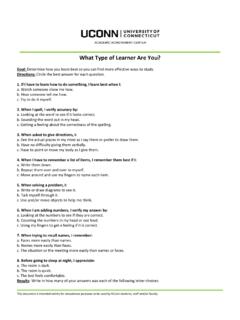
What Type of Learner Are You? - University of Connecticut
achieve.uconn.eduSTUDY TIPS FOR THE KINESTHETIC LEARNER High kinesthetic learners acquire knowledge best through manipulation – doing, touching, hands on, and writing techniques. Primary kinesthetic learners would benefit from finding their secondary learning mode and using directions for either visual or auditory in conjunction with the following hints. 1.
Learning Disabilities: Characteristics and Instructional ...
www.arcjournals.orgAbstract: A learning disability is a neurological disorder. In simple terms, a learning disability results from a difference in the way a person's brain is "wired." Children with learning disabilities are smart as or smarter than their peers. But they may have difficulty reading, writing, spelling, reasoning and organizing information if
Teaching and learning process to enhance teaching ...
files.eric.ed.govclassroom learning session is the kinesthetic learner. Learners in this category are more comfortable in learning through hands-on approach rather than visual or auditory learning. Thus, they learn best when teachers give them instructions through physical activities.

David Kolb’s Cycle of Experiential Learning - Creative Agni
creativeagni.comLearning begins in the Concrete Experience stage, where the learner goes through a new learning experience. At this stage, the learner experiences learning through visual, audio, or kinesthetic means. In the ADDIE cycle, you’d find this stage of Kolb’s cycle present in the Implementation Phase. For a learner, this learning experience may be:

Learning Styles Tips and Strategies - Florida State University
ace.fsu.eduKnowing your learning style enables you to use your strengths as you study for courses. One of many instruments for determining learning style is the VARK questionnaire, developed by Neil Fleming. The VARK system categorizes learners into four styles: Visual, Aural, Reading/Writing, and Kinesthetic.

Educational Psychology and Learning Theories in Music
www.apsu.eduEducational Psychology and Learning Theories in Music Theorist Theory Principal Features Links for Extended Learning Stage and Phase Theories

Learning Style Assessment - University of Missouri–St. Louis
www.umsl.eduTOUCH: Hints for the Tactile/Kinesthetic Learner 1. Keep your desk clear of distracting objects. 2. Cover the page you’re not reading. 3. If you are distracted by noise, turn off the radio; wear earplugs or wear an earphone in the learning center to block out noise. If you want sound, listen to soft music. 4. Divide your work into short study ...