
Topic #2: Why Study Statistics - Cornell University
analytic skills. The study of statistics will serve to enhance and further develop these skills. To do well in statistics one must develop and use formal logical thinking abilities that are both high level and creative. The fourth reason to study statistics is to be an informed consumer. Like any other tool, statistics can be used or misused.
Download Topic #2: Why Study Statistics - Cornell University

Information
Domain:
Source:
Link to this page:
Documents from same domain
Topic #2: Why Study Statistics - Cornell University
lsc.cornell.eduTopic #2: Why Study Statistics? Hopefully, the discussion above has helped you to understand a little better what the terms measurement and statistics mean.

Topic #1: Introduction to measurement and statistics
lsc.cornell.eduTopic #1: Introduction to measurement and statistics "Statistics can be fun or at least they don't need to be feared." Many folks have trouble believing this premise.
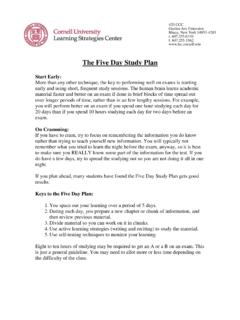
The Five Day Study Plan - Cornell University
lsc.cornell.eduto make sure you REALLY know some part of the information for the test. If you do have a few days, try to spread the studying out so you are not doing it all in one night. If you plan ahead, many students have found the Five Day Study Plan gets good results. Keys to the Five Day Plan: 1. You space out your learning over a period of 5 days. 2.
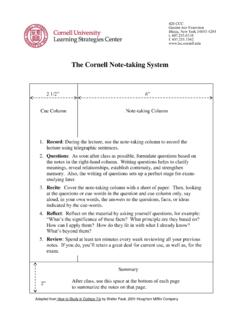
The Cornell Note-taking System
lsc.cornell.eduAdapted from How to Study in College 7/e by Walter Pauk, 2001 Houghton Mifflin Company The Cornell Note-taking System 2 1/2” 6” 2” Note-taking Column
Topic #1: Introduction to measurement and statistics
lsc.cornell.edumeasurement is an interval scale. The Fahrenheit scale is a clear example of the interval scale of measurement. Thus, 60 degree Fahrenheit or -10 degrees Fahrenheit are interval data. Measurement of Sea Level is another example of an interval scale. With each of these scales there is direct, measurable quantity with equality of units.

The Cornell Note-taking System
lsc.cornell.eduNote-taking Column Cue Column Summary After class, use this space at the bottom of each page to summarize the notes on that page. 1. Record: During the lecture, use the note-taking column to record the lecture using telegraphic sentences. 2. Questions: As soon after class as possible, formulate questions based on

Understanding Academic Anxiety - Cornell University
lsc.cornell.eduanxiety, however, most of us would lack the motivation to study for exams, write papers, or do daily homework (especially in classes we find boring). A moderate amount of anxiety actually helps academic performance by creating motivation. The graph below illustrates the relationship between anxiety and performance. Low High Level of Anxiety
Related documents

PROBABILITY AND STATISTICS - ERNET
math.iisc.ernet.inas the probability of error, and deduce thresholds based on it. This brings us to the question of computing probabilities in various situations. Probability: Probability theory is a branch of pure mathematics, and forms the theoretical basis of statistics. In itself, probability theory has some basic objects and their relations (like real num-
Statistical Decision Theory: Concepts, Methods and ...
probability.caThe basic ideas of decision theory and of decision theoretic methods lend themselves to a variety of applications and computational and analytic advances. This initial part of the report introduces the basic elements in (statistical) decision theory and reviews some of the basic concepts of both frequentist statistics and Bayesian analysis.
Review of Probability Theory - Stanford University
cs229.stanford.eduThe mathematical theory of probability is very sophisticated, and delves into a branch of analysis known as measure theory. In these notes, we provide a basic treatment of probability that does not address these finer details. 1 Elements of probability In order to define a probability on a set we need a few basic elements, Sample space

Chapter 4 Exploratory Data Analysis - CMU Statistics
stat.cmu.eduwith low density (or probability). The de nition of \outlier" for standard boxplots is described below (see4.3.3). Another common de nition of \outlier" consider any point more than a xed number of standard deviations from the mean to be an \outlier", but these and other de nitions are arbitrary and vary from situation to situation.
Grinstead and Snell’s Introduction to Probability
math.dartmouth.edu1 Discrete Probability Distributions 1 ... voted to providing materials for beginning courses in probability and statistics. The ... computer and more theoretical exercises to improve the understanding of basic con-cepts. More di cult exercises …

Single Maths B Probability & Statistics: Exercises & Solutions
www.maths.dur.ac.ukthe sequences: The probability of a red on an individual roll is 2 6 = 1 3 and the probability of a green is 2 3. Hence, since successive rolls are independent, the probability of the first sequence is 1 3 × 2 3 × 1 3 × 1 3 × 1 3 = 2 243 = 0.0082. Similarly the probabilities of the other two sequences are 1 3 × 2 3 × 1 3 × 1 3 × 1 3 × ...
Repeated Measures ANOVA - Discovering Statistics
www.discoveringstatistics.comDescriptive statistics and other Diagnostics Output 1 Output 1 shows two tables. The first lists the variables that represent each level of the independent variable, which is useful to check that the variables were entered in the correct order. The second table …

Monte Carlo Method: Probability - People
people.sc.fsu.eduThe Monte Carlo Method is based on principles of probability and statistics. To begin our discussion, we will look at some basic ideas of probability; in particular, the idea of how the behavior of a system can be described by a curve called the probability density function, and how the properties of that curve can help us to understand a
Bayesian Statistics (a very brief introduction)
faculty.washington.eduright) had wrongly interpreted the small probability of two cot deaths as a small probability of Clark’s innocence After a long campaign, including refutation of Meadow’s statistics, Clark was released and cleared in 2003 After being freed, she developed alcoholism anddied in 2007 5