
TREE IDENTIFICATION KEY - Exploring Nature
Tree has broad leaves .....use DECIDUOUS TREE KEY CONIFEROUS TREE KEY 1. Needles in bundles or groups (2) 1. Needles single or flattened and scaly (3) 2. Needles in clusters of more than 5 needles..... Tamarack (Larix laricina) 2. Needles 2 to 5 …
Download TREE IDENTIFICATION KEY - Exploring Nature

Information
Domain:
Source:
Link to this page:
Documents from same domain

Cellular Respiration - Exploring Nature Science …
www.exploringnature.org1) photosynthesis creates glucose molecules (instead of eating) → 2) this fuels cellular respiration in the plant cells → 3) creates ATP → 4) fuels plant growth and reproduction → 5) provides carbohydrates to animals for
Adaptations of the Three-toed Sloth - The Exploring Nature ...
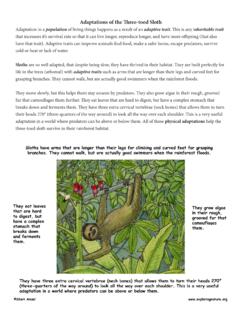
www.exploringnature.orgAdaptations of the Three-toed Sloth Adaptation in a population of living things happens as a result of an adaptive trait.This is any inheritable trait that increases it’s survival rate so that it can live longer, reproduce longer, and have more offspring (that also
DNA Transcription - Translation Activity
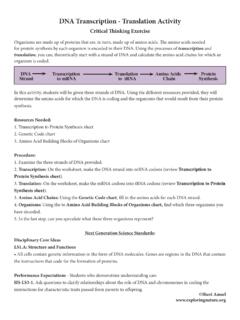
www.exploringnature.orgGenes are regions in the DNA that contain the instructions that code for the formation of proteins. Performance Expectations - Students who demonstrate understanding can: HS-LS3-1. Ask questions to clarify relationships about the role of DNA and chromosomes in coding the
Digestive System - Multiple Choice Test - Exploring Nature
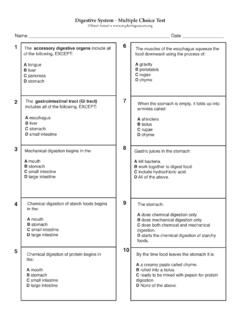
www.exploringnature.orgThe accessory digestive organs include all of the following, EXCEPT: A tongue B liver C pancreas D stomach The gastrointestinal tract (GI tract) includes all of the following, EXCEPT: A esophagus B liver C stomach D small intestine Mechanical digestion begins in the: A mouth B stomach C small intestine D large intestine
Circulatory System - Multiple Choice Test
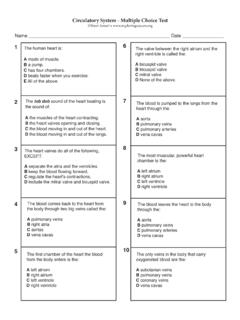
www.exploringnature.orgB the heart valves opening and closing. C the blood moving in and out of the heart. D the blood moving in and out of the lungs. The heart valves do all of the following, EXCEPT: A separate the atria and the ventricles. B keep the blood flowing forward. C regulate the heart’s contractions. D include the mitral valve and bicuspid valve.
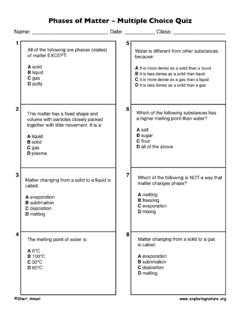
Matter Assessment and NGSS - Exploring Nature
www.exploringnature.orgScience and Engineering Practices: Developing and Using Models Modeling in 6–8 builds on K–5 and progresses to developing, using and revising models to describe, test, and predict more abstract phenomena and design systems. • Develop a model to predict and/or describe phenomena. (MS-PS1-1),(MS-PS1-4)
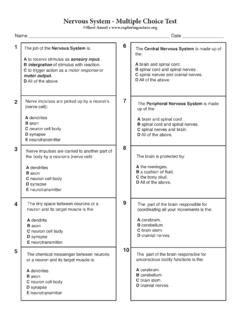
Nervous System - Multiple Choice Test - Exploring Nature
www.exploringnature.orgThe Central Nervous System is made up of the: brain and spinal cord. B spinal cord and spinal nerves. C spinal nerves and cranial nerves. D All of the above. The Peripheral Nervous System is made up of the: A brain and spinal cord. B spinal cord and spinal nerves. C spinal nerves and brain. D All of the above. The part of the brain responsible for
Bones and Features of the Skull - Cranium and Face
www.exploringnature.orgBones and Features of the Skull - Cranium and Face ©Sheri Amsel • www.exploringnature.org Bones of the Cranium The cranium is made up of 8 bones: 2 (paired) parietal bones • 2 (paired) temporal bones • frontal bone • occipital bone • sphenoid bone • ethmoid bone The frontal bone is located on the anterior cranium and includes the following features:

Phases of the Moon - Exploring Nature
www.exploringnature.org2. The moon takes the same amount of time to rotate once around on its axis as it does to revolve around the Earth - so the same side of the moon always faces the Earth. The moon looks different during its revolution around the Earth, because at each position its is getting a different amount of sunlight on its surface.
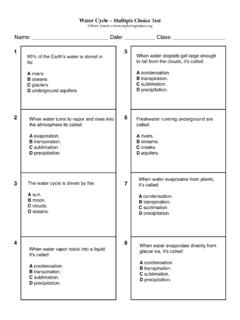
Water Cycle – Multiple Choice Test - Exploring Nature
www.exploringnature.orgC creeks. D aquifers. The water cycle is driven by the: A sun. B moon. C clouds. D oceans. When water turns to vapor and rises into the atmosphere its called: A evaporation. B transpiration. C sublimation. D precipitation. When water evaporates directly from glacial ice, it’s called: A condensation. B transpiration. C sublimation. D ...
Related documents

TAXONOMY: THE STUDY OF IDENTIFICATION, …
nativeplants.orgkey to family and then consulting books on genera, if available. ... but dichotomous keys for making a determination • The inexact part of this aspect of i.d. is because keys contain many inconsistencies and sometimes just plain mistakes • The other inexact part is that plants vary a lot in the wild, and ... Many classification systems ...

PLANT REPRODUCTION
www.xtec.catplant kingdom classification (fig 3). At the end you can test your answers looking at slide 11 on the power point. Plants are the key to life on Earth. Without them many other living organisms would soon disappear. This is because higher life forms depend on plants, either directly or indirectly, for their food. Most

Unit 1 Characteristics and classification of living organisms
assets.cambridge.orgE Simple dichotomous key When you have studied this unit, you should be able to: • list and descr ibe the character istics of organ isms • define the terms nutr ition,excretion,respiration,sensitivity,reproduction, growth and movement • outline the use of a h ierarchical class ification system for l iving organ isms

Characteristics and Classification of Living Organisms
cdn.savemyexams.co.ukUse the key to identify each species. Write the letter of each species (A to G) in the correct box beside the key. One has been done for you. Key 1 (a) long, narrow body, with or without legs go to 2 (b) body not long and narrow, back legs are larger than the front legs go to 5 2 (a) body without legs Gymnopis multiplicata B
Classification of Microorganisms
instruction2.mtsac.eduViral classification • Viral species – Population of viruses with similar characteristics occupying a particular ecological niche •Wd t y sheelrheuho ... Dichotomous Key UN 10.2. Cladogram Figure 10.19, steps 1–2. Title: Microsoft PowerPoint - micro class of microorganism (4)
Unit 2: Taxonomy and Classification
www.chicagoagr.orgOct 10, 2013 · Dichotomous keys are often used to determine the exact species and genus of an organism Use visible characteristics to determine an organism’s identity Characteristics are presented in pairs (i.e. Blue vs. Not Blue) Progressively reduces the number of potential species Can be presented with text or a flow chart.

TACIT VS. EXPLICIT KNOWLEDGE – THE CURRENT …
www.irbnet.deKey words : Human Resource Management, Knowledge Management, Tacit, Explicit, Knowledge 1. INTRODUCTION ... approaches are based on the dichotomous view of knowledge as either tacit or explicit. ... little agreement on a universal classification of the types of knowledge but wide consensus abound that they are multiple and consequential ...

12 Orders of Soil Taxonomy - Home - Soil | Soil Science ...
www.soils.org• soil classification (soil taxonomy, land capability classification, engineering uses) ... dichotomous key- A key used to classify an item in which each stage presents two options, with a direction to another stage in the key, until the lowest level is reached.