
TREE IDENTIFICATION KEY - Exploring Nature
DECIDUOUS TREE KEY 1. Opposite branching (2) 1. Alternate branching (4) 2. Compound leaves (3) 2. Simple leaves: Maple species (see a-c below) a. Leaf margins smooth, 5 lobes .....
Download TREE IDENTIFICATION KEY - Exploring Nature

Information
Domain:
Source:
Link to this page:
Documents from same domain

Cellular Respiration - Exploring Nature Science …
www.exploringnature.org1) photosynthesis creates glucose molecules (instead of eating) → 2) this fuels cellular respiration in the plant cells → 3) creates ATP → 4) fuels plant growth and reproduction → 5) provides carbohydrates to animals for
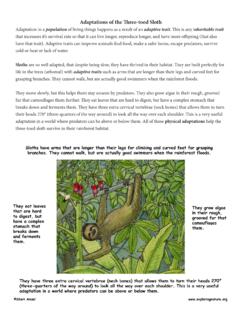
Adaptations of the Three-toed Sloth - The Exploring Nature ...
www.exploringnature.orgAdaptations of the Three-toed Sloth Adaptation in a population of living things happens as a result of an adaptive trait.This is any inheritable trait that increases it’s survival rate so that it can live longer, reproduce longer, and have more offspring (that also
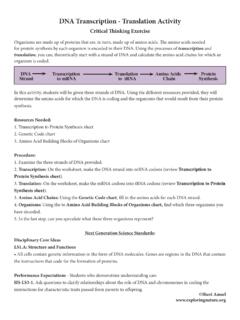
DNA Transcription - Translation Activity
www.exploringnature.orgGenes are regions in the DNA that contain the instructions that code for the formation of proteins. Performance Expectations - Students who demonstrate understanding can: HS-LS3-1. Ask questions to clarify relationships about the role of DNA and chromosomes in coding the
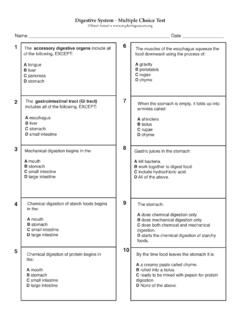
Digestive System - Multiple Choice Test - Exploring Nature
www.exploringnature.orgThe accessory digestive organs include all of the following, EXCEPT: A tongue B liver C pancreas D stomach The gastrointestinal tract (GI tract) includes all of the following, EXCEPT: A esophagus B liver C stomach D small intestine Mechanical digestion begins in the: A mouth B stomach C small intestine D large intestine
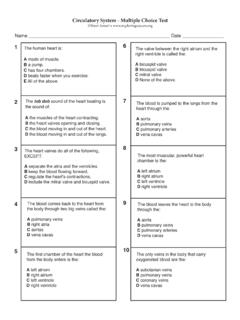
Circulatory System - Multiple Choice Test
www.exploringnature.orgB the heart valves opening and closing. C the blood moving in and out of the heart. D the blood moving in and out of the lungs. The heart valves do all of the following, EXCEPT: A separate the atria and the ventricles. B keep the blood flowing forward. C regulate the heart’s contractions. D include the mitral valve and bicuspid valve.
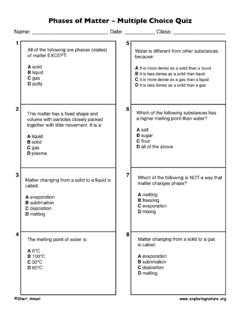
Matter Assessment and NGSS - Exploring Nature
www.exploringnature.orgScience and Engineering Practices: Developing and Using Models Modeling in 6–8 builds on K–5 and progresses to developing, using and revising models to describe, test, and predict more abstract phenomena and design systems. • Develop a model to predict and/or describe phenomena. (MS-PS1-1),(MS-PS1-4)
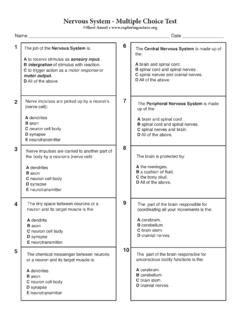
Nervous System - Multiple Choice Test - Exploring Nature
www.exploringnature.orgThe Central Nervous System is made up of the: brain and spinal cord. B spinal cord and spinal nerves. C spinal nerves and cranial nerves. D All of the above. The Peripheral Nervous System is made up of the: A brain and spinal cord. B spinal cord and spinal nerves. C spinal nerves and brain. D All of the above. The part of the brain responsible for
Bones and Features of the Skull - Cranium and Face
www.exploringnature.orgBones and Features of the Skull - Cranium and Face ©Sheri Amsel • www.exploringnature.org Bones of the Cranium The cranium is made up of 8 bones: 2 (paired) parietal bones • 2 (paired) temporal bones • frontal bone • occipital bone • sphenoid bone • ethmoid bone The frontal bone is located on the anterior cranium and includes the following features:

Phases of the Moon - Exploring Nature
www.exploringnature.org2. The moon takes the same amount of time to rotate once around on its axis as it does to revolve around the Earth - so the same side of the moon always faces the Earth. The moon looks different during its revolution around the Earth, because at each position its is getting a different amount of sunlight on its surface.
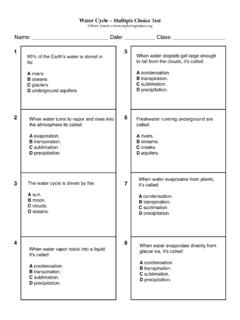
Water Cycle – Multiple Choice Test - Exploring Nature
www.exploringnature.orgC creeks. D aquifers. The water cycle is driven by the: A sun. B moon. C clouds. D oceans. When water turns to vapor and rises into the atmosphere its called: A evaporation. B transpiration. C sublimation. D precipitation. When water evaporates directly from glacial ice, it’s called: A condensation. B transpiration. C sublimation. D ...
Related documents
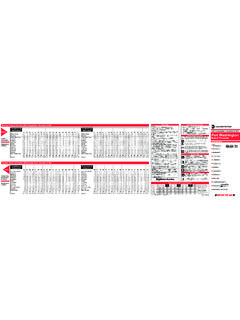
Port Washington - Home | MTA
web.mta.infoOne Way Good for one ride for 60 days including date of sale. Sold for: Peak - Weekday trains marked Peak AM or Peak PM herein. Off Peak All other trains including all day weekends & holidays.

The Science of Masking to Control COVID-19
www.cdc.govinfections come from people likely unaware they are infectious to others (red and orange in the figure, left)* Moghadas et al. 2020, Proc Natl Acad Sci USA;117(30):17513-17515. Johansson et al. 2020, CDC unpublished data; submitted. * Figure assumes peak infectiousness occurs 5 days after infection and that 24% of infections are asymptomatic.
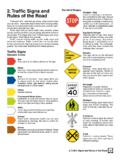
2. Traffic Signs and Rules of the Road Come to a full stop ...
www.iowadot.govCome to a full stop at an intersection controlled by this sign. Stop at the marked stop line or before entering the crosswalk or before your vehicle enters the intersection. Let other vehi cles or pedes trians pass if they are in your path. Equilateral triangle Yield the right of way. Slow down and let vehicles crossing your path go by.
Lazard’s Levelized Cost of Storage Analysis—Version 4
www.lazard.comAs costs continue to come down, particularly for shorter duration lithium-ion applications, returns have incrementally improved year -over year; however, in most geographies, project economics depend heavily on subsidized revenues or related incentives