
Trichoderma: Mass production, formulation, quality control ...
exploited in industries as sources of enzymes. A large number of research groups are working on various aspects of Trichoderma viz., diversity, ecology and their applications. In India, about 110 groups representing various universities and research institutes are working with about 15 different species and have published about 460 research papers.
Download Trichoderma: Mass production, formulation, quality control ...

Information
Domain:
Source:
Link to this page:
Documents from same domain

Strengths, weaknesses, opportunities and threats (SWOT ...
www.academicjournals.orgbusiness. External factor evaluation (EFE) matrix is a strategic-management tool often used for assessment of the current business conditions. It is a good tool used to visualize and prioritize the opportunities and threats that a business is facing. Riston (2008) pointed out that the benefits of external analysis include:
Trichoderma: Mass production, formulation, quality control ...
www.academicjournals.orgdeveloped at Tamil Nadu Agricultural University, Coimbatore for seed treatment of pulse crops and rice (Jeyarajan et al., 1994). Trichoderma is grown in the liquid medium is mixed with talc powder in the ratio of 1:2 and dried to 8% moisture under shade. The talc formulations of Trichoderma has shelf life of 3 to 4 months.
Oliveira and Ferreira - Academic Journals
www.academicjournals.orgmodel" appeared in a business journal (peer-reviewed and non-peer reviewed) follows a pattern that resembles the shape of the NASDAQ market index… [suggesting] that the topic of business models probably has a relationship with technology” (Osterwalder et al., 2005, p.7). 1 I nth es c od- lap rg f “A iB uW – S m ” .

NATIONAL DEVELOPMENT IN NIGERIA
www.academicjournals.orgNational development in Nigeria: Issues, challenges and prospects Tolu Lawal1 and Abe Oluwatoyin2* 1Department of General Studies, Rufus Giwa Polytechnic, Owo, Ondo State, Nigeria. 2Department of Political Science, University of Ado Ekiti, Ado Ekiti, Ekiti State, Nigeria. Accepted 8 April, 2011

Entrepreneurship and entrepreneur: A review of literature ...
www.academicjournals.orgThe one who literally invented the term entrepreneur, around the year 1800, was the French economist, Jean Baptiste Say; he considered the entrepreneur as a person who transfers resources from one person with a lower productivity to another with higher productivity and increased profit, thus creating value (Vlasceanu, 2010).
Strengths, weaknesses, opportunities and threats (SWOT ...
www.academicjournals.orgStrengths, weaknesses, opportunities and threats (SWOT) analysis indicates a framework for helping the researchers or planners to identify and prioritize the business goals, and to further identify the strategies of achieving them. SWOT analysis is a technique used to analyze the strengths, weaknesses, opportunities and threats of businesses.
Business Model Generation: A handbook for visionaries ...
www.academicjournals.orgvisionaries, game changers and challengers Publisher: John Wiley and Sons, Inc., Hoboken, New Jersey (2010) Authors: Alexander Osterwalder and Yves Pigneur Reviewed by: Manuel Au-Yong Oliveira1,2* and João José Pinto Ferreira1 1INESC Porto, Faculdade de Engenharia, Universidade do Porto, Rua Dr. Roberto Frias, 4200-465 Porto, Portugal.
Entrepreneurship and entrepreneur: A review of literature ...
www.academicjournals.orgThe entrepreneurship is an activity dedicated to initiation, maintenance and development of a profit oriented business. Drucker (1985) The entrepreneurship is an innovation act who presupposes the endowment of the existing resources with the capacity of producing wealth. Gartner (1985) The entrepreneurship is the creation of new organizations.

ENVIROMENTAL ETHICS IN THE HINDU VEDAS AND
www.academicjournals.orgas a companion for mutual survival. “The God who exists in the universe, lives in air, water, in fire and also in trees and herbs, men should have reverence for them”. Brhadaranyaka Upanishad (3.9.28) equate trees with human beings as follows: Just like a tree, the prince of the forest, so the man is, in truth (Trivedi, 2004). In the
Related documents

Chapter 8 Microbiological Control - Biomanufacturing
biomanufacturing.orgConcerning the former, certain bacteria and molds secrete proteolytic enzymes into the growth medium, potentially degrading the therapeutic protein. Regarding the latter, Gram-negative bacteria release a component of their cell wall termed endotoxin that can be highly toxic if introduced into patients. It is one example of a pyrogen. Pyrogens ...

Microbiological Spoilage of Fruits and Vegetables
seward.co.ukcellular lytic enzymes that degrade these polymers to release water and the plant’s other intracellular constituents for use as nutrients for their growth. Fungi in partic-ular produce an abundance of extracellular pectinases and hemicellulases that are important factors for fungal spoilage (Miedes & Lorences, 2004). Some spoilage

DR. Shah Ali-UL-Qader PERSONAL INFORMATION
www.pjps.pk28. Enhanced production of cellulose degrading CMCase by newly isolated strain of Aspergillus versicolor Carbohydrate Polymers (2014) 104,199-203 (IF: 4.219) Sofia Qaisar, Rashida Rahmat Zohra, Afsheen Aman, Shah Ali Ul Qader 29. Immobilization of pectin degrading enzyme from Bacillus Licheniformis KIBGE IB-21

Noor Almomani Alaa Bany Amer Diala Abu Hassan
doctor2020.jumedicine.comtwo enzymes (ALT & AST), because they have medical significance. The reaction of ALT goes in both directions, ... In this situation we are producing pyruvate by degrading amino acids, and we are degrading them because we're in the starvation situation to produce energy and provide gluconeogenesis with its own intermediates (e.g., oxaloacetate ...
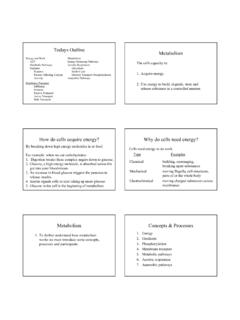
How do cells acquire energy? Why do cells need energy?
ib.berkeley.eduEnzymes Lower Activation Energy activation energy without enzyme activation energy with enzyme energy released by the reaction products starting substance direction of reaction Figure 5.8 from page 78 of your text Features of Enzymes (Cont.) 3. Enzymes are not used up or permanently altered. 4. Enzymes are substrate specific.

98 THE QUARTERLY REVIEW OF BIOLOGY 91 - IU
microbes.sitehost.iu.eduobligate parasite, such as polysaccharide-degrading enzymes, enzymes for anaerobic respiration, and those for utilization of inorganic nitrogen and sul-fates. The author suggested that there is a tradeoff for large genome size in powdery mildews: “the cost of large genomes full of active retrotransposons is

Cellular Injury, Necrosis, Apoptosis
www.life.illinois.edudegrading, but basement membranes intact • Nuclei largely intact, slightly narrowed, pyknotic. ... When enzymes have digested the cytoplasmic organelles, the cytoplasm becomes vacuolated and appears moth- eaten. Dead cells may be replaced by large, whorled phospholipid masses

Exam #3 Review
www.uwyo.eduThis pathway is an alternate glucose degrading pathway. It is used when biosynthesis is the primary focus of the cell! Its purpose is twofold. The purpose of the oxidative stage is to produce NADPH. The purpose of the non-oxidative stage is to produce ribose 5-phosphate (used in nucleotide synthesis). Sometimes