
UNDERSTANDING BY DESIGN FRAMEWORK BY JAY …
The Understanding by Design® framework (UbD™ framework) offers a plan-ning process and structure to guide curriculum, assessment, and instruction. Its two key ideas are contained in the title: 1) focus on teaching and assessing for understanding and learning transfer, and 2) design curriculum “backward” from those ends.
Download UNDERSTANDING BY DESIGN FRAMEWORK BY JAY …

Information
Domain:
Source:
Link to this page:
Documents from same domain
Intevruthif’ the Curriculum Ten Ways to Integrate ... - ASCD
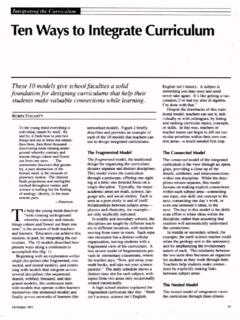
ascd.orgframework for related concepts. Teachers can arrange topics so that similar units coincide. In the self-con tained classroom, for example, Char lotte’s Web can accompany the unit on spiders. Johnny Tremain can parallel the study of the Revolutionary War. The graphing unit can coincide with data collection in the weather unit. In

DIFFERENTIATE INSTRUCTION - ASCD
ascd.orgA goal of this book is to provide a reliable source of guidance for teachers seeking to create learning environments that address the variety typical of academically diverse classrooms. It aims to help these teachers determine what differentiated instruction is, why it is essential for all learners, how to

QUALITIES OF EFFECTIVE TEACHERS - ASCD
ascd.orgOrganization of the Book Qualities of Effective Teachers, 3rd edition, is designed to serve as a resource and reference tool for educators. It identifies elements of effec-tive teaching within broad categories and aims to cover all areas of teacher effectiveness as represented in the empirical research literature. The book
STRATEGIES FOR TEACHING WRITING - ASCD
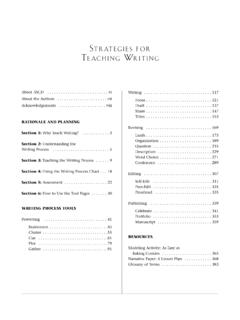
ascd.orgdents and teachers share an emotional commonality that leads to building relationships. With a strong teacher-student connection, students welcome the opportunity to express their thoughts, feelings, and reasoning in writing. Writing is a devel-opmental process that each student can suc-cessfully experience at different levels when it’s ...

Assessment and Student Success in a - ASCD
ascd.orgclassroom elements: learning environment, curriculum, assessment, instruction, and classroom leadership/management. It also calls on teachers to understand the interdependence of those elements in supporting success for each student. Weakness in any of these elements diminishes the effectiveness of all of the others.

Synthesis of Research on Homework - ASCD
ascd.orgSynthesis of Research on Homework Grade level has a dramatic influence on homework’s effectiveness. In the 1950 edition of the Kncyclo- pedia of Educational Research, H J Oito wrote, "compulsory homework does not result in suffi ciently improved academic accom plishments to justify retention" (Otto

What Is the Purpose of Education? - ASCD
ascd.org—John Dewey, “Individual Psychology and Education,” The Philosopher, 12, 1934 1934 1948 —The ASCD Committee on Platform of Beliefs, Educational Leadership, January 1957 1957 “[The purpose of education] has changed from that of producing a literate society to that of producing a learning society.”

ON DEFINING CURRICULUM - ASCD
ascd.orgIt identifies Curriculum with a course of studies (which lists content, subjects, or subject matter). Curriculum is what students should be taught. The content is generally identified with certain subject matters-the "cumulative tradition of organized knowledge." This view Is propounded in the work of theorists

FACTORS THAT INFLUENCE CURRICULUM CHANGE
ascd.orgCURRICULUM CHANGE GAIL M. INLOW Professor of Education Northwestern University, Evanston, Illinois THE purposes of education relate directly to the factors that facilitate or hinder curriculum change. These purposes are threefold: cultural transmis sion, environmental adaptation, and total personality development. The three
Related documents

A Model for Effective Online Instructional Design
infonomics-society.orgInstructional design (ID) also called instructional systematic design (ISD) is “the practice of creating instructional experiences which make the acquisition of knowledge and skill more efficient, effective, and appealing" [10]. An effective ISD model benefits both instructors and learners. An instructional design
Chapter 1. What Is Backward Design? - Educational Technology
educationaltechnology.netprimary clients, given that the effectiveness of curriculum, assessment, and instructional designs is ultimately determined by their achievement of desired learnings. As with other design professions, standards inform and shape our work. The architect, for example, is guided by building codes, customer budget, and aesthetics.
Universal Design for Learning: Guiding Principles to ...
files.eric.ed.govUniversal Design for Learning (UDL), a framework for designing instruction to address the wide range of learner variation in today’s inclusive classrooms, can be ... the UDL principles in the context of their instructional environment and of the objectives, methods, materials, and assessments that are pertinent to this environment.

School Design Standards - Albuquerque Public Schools
www.aps.eduThe A/E shall consider and employ the principles of Universal Design. ... Meet specific educational, instructional, and functional needs of specified activities. 10. Provide a pleasant environment for students, teachers, and staff and be a positive addition to the community.
eLearning Theories Models - ITMA Instructional Technology ...
www.itma.vt.edutrying to devise a universal solution for eLearning design, since there are many factors that approach one takes, including the subject content, project budgets, schedules and the purpose of the course. They recommend concentrating on the specific problem that must be solved or content to be presented to guide design efforts.

WRITING INSTRUCTIONAL OBJECTIVES
www.sc.eduWRITING INSTRUCTIONAL OBJECTIVES Kathy V. Waller, PhD, CLS(NCA) NAACLS Board of Directors Educators have used instructional, or behavioral, objectives for at least four decades. Robert Mager’s little text, Preparing Instructional Objectives, first printed in 1962, assisted many instructors in formulating and writing objectives.