
UNDERSTANDING STROKE RISK
HIGH BLOOD PRESSURE (HBP) HBP is the No. 1 cause of stroke and the most important controllable risk factor for stroke. People who are overweight or obese, over
Download UNDERSTANDING STROKE RISK

Information
Domain:
Source:
Link to this page:
Documents from same domain

2017 STROKE FACT SHEET - Stroke Association
www.strokeassociation.org• The American Stroke Association is devoted to saving people from stroke — the No. 2 cause of death in the world and a leading cause of serious disability.

let’s talk about Feeling Tired After Stroke
www.strokeassociation.orgecoey (continued) let’s talk about Feeling Tired After Stroke After a stroke, almost all stroke survivors feel tired or some type of fatigue at some point.
Playing Around - Stroke Association
www.strokeassociation.orgSeptember/October 2006 EVERYDAY Connecting You to Helpful Ideas ard games, board games and puzzles may seem like child’s play, but they are valuable tools in …

AHA/ASA Guideline 2015 AHA/ASA ... - Stroke …
www.strokeassociation.orgAHA/ASA Guideline 2015 AHA/ASA Focused Update of the 2013 Guidelines for the Early Management of Patients With Acute Ischemic Stroke …
let’s talk about Stroke Diagnosis - Stroke Association
www.strokeassociation.orgecoey (continued) let’s talk about Stroke Diagnosis It’s critical to diagnose a stroke in progress because the treatment for stroke depends on
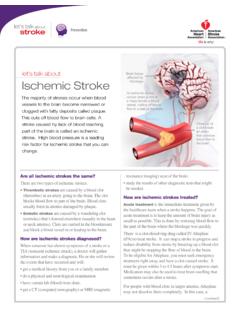
let’s talk about Ischemic Stroke - Stroke Association
www.strokeassociation.orgeention (continued) let’s talk about Ischemic Stroke The majority of strokes occur when blood vessels to the brain become narrowed or clogged with fatty deposits called plaque.
TheStrokeCollaborative Tissue Plasminogen …
www.strokeassociation.orgWhat type of stroke is IV tPA used for? It was approved by the FDA in 1996 to treat ischemic type strokes. About 8 out of 10 brain attacks/strokes

DILATED CARDIOMYOPATHY - Stroke Association
www.strokeassociation.orgDILATED CARDIOMYOPATHY Dilated or congestive cardiomyopathy (DCM) is diagnosed when the heart is enlarged (dilated) and the pumping chambers contract poorly (usually left side worse than right).

TIME LOST IS BRAIN LOST. - American Stroke …
www.strokeassociation.org©2010, American Heart Association TARGET: STROKE CAMPAIGN MANUAL TIME LOST IS BRAIN LOST.™

What is Stroke? - Stroke Association
www.strokeassociation.orgWhat is Stroke? Stroke is a disease that affects the arteries leading to and within the brain. It is the No. 5 cause of death and a leading cause of disability in the United States.
Related documents
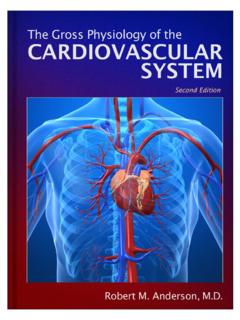
The Gross Physiology of the Cardiovascular System
cardiac-output.info2 │ Introduction After heart transplantation, without nerve supply to the heart or artificial pacing, the cardiac output and pulmonary/systemic blood volume balance remain normal. In the absence of heart failure, an increase in arterial resistance does not reduce cardiac output. An overall concept of cardiovascular physiology should accommodate these
![Heart Failure Pathophysiology.ppt [Read-Only]](/cache/preview/5/6/a/8/a/5/4/1/thumb-56a8a5411198557184679ccfbe445eec.jpg)
Heart Failure Pathophysiology.ppt [Read-Only]
www.columbia.edu5 Pathophysiology of Heart Failure Four Basic Mechanisms 1. Increased Blood Volume (Excessive Preload) 2. Increased Resistant to Blood Flow (Excessive
A Guide to Reading and Understanding the EKG
www.columbia.edu5 Step 4 Precordial Leads Understanding the precordial leads and how they align with the heart is critical to understanding the EKG. First let's remember how the heart is located in the chest.

137 Physical principles of intra-arterial blood pressure ...
www.frca.co.ukSign up to receive ATOTW weekly – email worldanaesthesia@mac.com ATOTW 137.Physical principles of intra-arterial blood pressure measurement, 08/06/2009 Page 1 of 8

BIOMETRIC SCREENING Understanding Your Results
www.mprisk.orgBlood Pressure Blood pressure is the pressure of the blood on the walls of the arterial blood vessels (blood vessels that carry blood from the heart to other parts of the body).
EXERCISE PHYSIOLOGY - Owasco Velo Club
www.owascoveloclub.comCycling Articles: Physiology 6 1. Heart Facts and Trivia from the lungs (the right and left side of the heart are thus connected) to the entire body. That means moving blood through an incredible maze of blood
Congestive Heart Failure: Diagnosis, Pathophysiology ...
www.rcjournal.comCongestive Heart Failure: Diagnosis, Pathophysiology, Therapy, and Implications for Respiratory Care Michael S Figueroa MD and Jay I Peters MD FAARC
Lower Blood Pressure Without Drugs
www.youngagain.org5 About This Book This book is the most researched, comprehensive, factual and effective book in print on lowering blood pressure in print. Here you
Related search queries
Gross Physiology of the Cardiovascular System, Heart, Blood, Heart Failure Pathophysiology, Pathophysiology, Heart Failure, Guide to Reading and Understanding the EKG, Understanding, Physical principles of intra-arterial blood pressure, Understanding Your Results, Blood Pressure Blood pressure, Pressure, EXERCISE PHYSIOLOGY, Lower Blood Pressure Without Drugs, Blood pressure