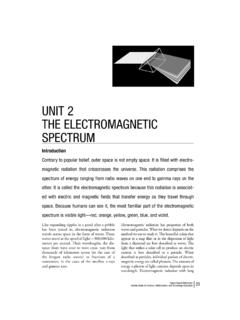
UNIT 2 THE ELECTROMAGNETIC SPECTRUM
ited so far. Instead of visiting stars and planets, astronomers collect electromagnetic radiation from them using a variety of tools. Radio dishes capture radio signals from space. Big telescopes on Earth gather visible and infrared light. Interplanetary spacecraft have traveled to all the planets in our solar system except Pluto and have ...
Download UNIT 2 THE ELECTROMAGNETIC SPECTRUM

Information
Domain:
Source:
Link to this page:
Documents from same domain
Q: What do you do on the International Space …
www.nasa.govQ: What do you do on the International Space Station (ISS)? A: Astronauts and cosmonauts on the space station stay busy.There’s lots of work to operate the many science experiments on board.
NEPA RECORD OF ENVIRONMENTAL …
www.nasa.govDec 13, 2012 · JSC Form 1119 (Revised January 25, 2011)(MS Word October 2010) NEPA RECORD OF ENVIRONMENTAL CONSIDERATION (REC) Complete this form if you answered “yes” or “unknown” on any JF 1138 entries and if
Use of XSLT to transform the output of multiple …
www.nasa.govNASA IV&V International Workshop 2014 1 Use of XSLT to transform the output of multiple Static Code Analysis tools into a consistent analysis spreadsheet format
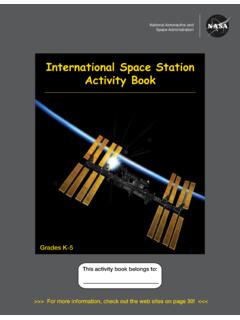
International Space Station Activity Book
www.nasa.govNational Aeronautics and Space Administration . Grades K-5 . This activity book belongs to: International Space Station Activity Book >>> For more information, check out the web sites on page 30!
Gravity, Who Needs It
www.nasa.govGravity, Who Needs It? ... six months on the space station versus three years on a Mars mission? No. ... human, being more isolated ...
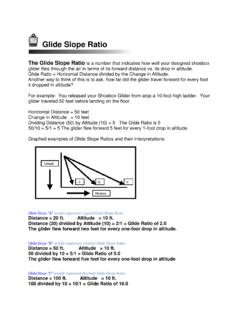
Glide Slope Ratio
www.nasa.govGlide Slope Ratio The Glide Slope Ratio is a number that indicates how well your designed shoebox glider flies through the air in terms of its forward distance vs. its drop in altitude. Glide Ratio = Horizontal Distance divided by the Change in Altitude.
Modeling, SiMulation, inforMation technology & …
www.nasa.govTA11-1 exeCuTive Summary Figure 1 is an initial draft strategic roadmap for the Modeling, Simulation, Information Technol-ogy and Processing Technology Area.
NASA Technology Roadmaps
www.nasa.gov2015 NASA Technology Roadmaps TA 11: Modeling, Simulation, Information Technology, and Processing TA 11- 2 July 2015 Foreword NASA is leading the way with a balanced program of space exploration, aeronautics, and science research.
A Journey to Inspire, Innovate, and Discover
www.nasa.govReport of the President’s Commission on 2 Implementation of United States Space Exploration Policy Transmittal Letter June 4, 2004 The Honorable George W. Bush
National Aeronautics and Space Administration Headquarters
www.nasa.govGEMS is a Category 3 project (less than $250M) in Phase B, and was requesting transition from Formulation to Implementation (Phase C) where the official Agency baseline is established and external commitments are made
Related documents
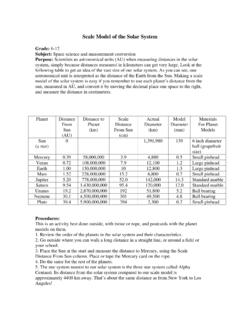
Scale Model of the Solar System
meteorite.unm.eduouter planets are spaced farther apart than the inner planets. Modifications: For students that have difficulty measuring, they can pace out the distance using a different conversion: Mercury 6 meters = 12 very small steps or 6 large steps from Sun

The Lithosphere--contains all of the cold, hard solid land ...
gml.noaa.govmagnesium. Below that is a liquid outer core of nickel and iron. At the center of Earth is a solid inner core of nickel and iron. The Hydrosphere-- contains all the solid, liquid, and gaseous water of the planet. It ranges from 10 to 20 kilometers in thickness. The …

Immersive 3D encrypted collection game NFTs+DeFi+Games
dragonmainland.s3.ap-southeast-1.amazonaws.cominvasion of outer space creatures, the dragons can't beer the planet be harassed by other foreign invaders. They began to find other planets suitable for living and breeding. By chance, they came to the planet inhabited by human beings, which triggered a war between human beings and the dragons. Finally, human tamed the dragons, and led them to
Communication with Extraterrestrial Intelligence
www.nsa.govplanets of the right chemistry, dimensions, and temperature to support organic evolution. If we consider that our own galaxy, the Milky Way, is but one of at least a billion other galaxies similar to ours in the observable universe, the number of stars that could support some form of life is, to reach for a word, astronomical.

OUR SOLAR SYSTEM
www.stem.org.ukThe planets can be placed into two distinct groups. The four planets closest to the Sun are small and rocky and are often referred to as the inner, or terrestrial, planets (Figure 1). The outer four planets are much larger and very cold. These are the giant planets (Figure 2). Jupiter and Saturn are known as the gas giants.