
Using Automatic Exposure Control in Digital Radiography
Exposure Control in Digital Radiography A. Kyle Jones, Ph.D. U.T. M. D. Anderson Cancer Center Department of Imaging Physics 2008 AAPM Meeting, Houston, TX Automatic Exposure Control The purpose of AEC is to deliver consistent, reproducible exposures across a wide range of anatomical thicknesses, tube potentials, and users
Download Using Automatic Exposure Control in Digital Radiography

Information
Domain:
Source:
Link to this page:
Documents from same domain
Acceptance Testing and Quality Control of …
www.aapm.orgAAPM REPORT NO. 93 Acceptance Testing and Quality Control of Photostimulable Storage Phosphor Imaging Systems Report of …
Dose Calculation for Photon-Emitting …
www.aapm.orgDose Calculation for Photon-Emitting Brachytherapy Sources with Average Energy Higher than 50 keV: Full Report of the AAPM and ESTRO Report of the

Digital Image Processing in Radiography
www.aapm.orgDigital Image Processing in Radiography Michael Flynn Dept. of Radiology mikef@rad.hfh.edu RADIOLOGY RESEARCH Health System Henry Ford Henry Ford Henry Ford M. Flynn 2007 1
Acceptance Testing and Quality Control of Dental …
www.aapm.orgAAPM REPORT NO. 175 Acceptance Testing and Quality Control of Dental Imaging Equipment The Report of AAPM Task Group 175 September 2016 DISCLAIMER: This publication is based on sources
AcceptanceTesting andQualityAssuranceProcedures ...
www.aapm.org3 II. Acceptance Test Procedures Prior to MR System Installation A. VibrationMeasurements MostMRsystemvendorsspecifyacceptabletransientandsteady-statevibrationlevels,asa

Failure Mode and Effects Analysis (FMEA)
www.aapm.orgFailure Mode and Effects Analysis (FMEA) Frank Rath University of Wisconsin and The Center for the Assessment of Radiological Sciences. Disclosures • I am the Secretary Treasurer of the non‐profit Center for the Assessment of Radiological Sciences, an ... Severity of the effect when a failure mode occurs

CT Image Reconstruction
www.aapm.org8 x-ray source Object being imaged Imaged plane Direction of rotation Film plane (Single spot) Aperture to form laminar beam “Image” of object What if we change the geometry of …
QUALITY CONTROL IN DIAGNOSTIC RADIOLOGY
www.aapm.orgthe various test instruments that may be used in performance evaluation. The diag-nostic medical physicist acts as a local expert on Joint Commission on Accreditation of Healthcare Organizations (JCAHO), state, and federal requirements concern-ing quality control, equipment performance, and radiation safety. As such, the

PET/CT Acceptance Testing and Quality Assurance
www.aapm.orgtance testing or follow-up measurements can be validated against established benchmarks. This document provides guidance on acceptance testing and quality control (QC) of the PET sub-system of any commercial PET/CT scanner and can be used to enable direct comparisons among vari-ous scanner models and manufacturers. Table 1: Periodic tests

TG-263: Standardizing Nomenclatures in Radiation Oncology
www.aapm.orgDepartment of Radiation Oncology (MAASTRO), GROW School for Oncology and Developmental Biology, Maastricht University Medical Centre+, Maastricht, The Netherlands Theodore Hong Massachusetts General Hospital, Boston, Massachusetts Rishabh Kapoor Virginia Commonwealth University, Richmond, Virginia Beth Lansing Elekta Corporation, St. …
Related documents

Protect Your Employees with an Exposure Control Plan
www.cdc.govExposure Control Plan. These plans are required by the Occupational Safety and Health Administration (OSHA) bloodborne pathogens standard. In addition, local regulations, employer policy, or collective bargaining agreements may call for such a program. What is an Exposure Control Plan? by . Why is an Exposure Control Plan Important?
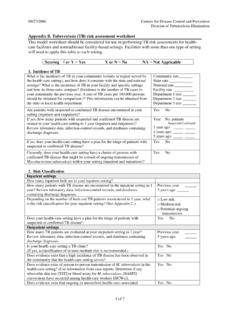
Appendix B. Tuberculosis (TB) risk assessment worksheet
www.cdc.gov09/27/2006 Centers for Disease Control and Prevention Division of Tuberculosis Elimination Appendix B. Tuberculosis (TB) risk assessment worksheet This model worksheet should be considered for use in performing TB risk assessments for health-care facilities and nontraditional facility-based settings. Facilities with more than one type of setting

Bloodborne Pathogens Exposure Control Plan
dsps.wi.govThe objective of this Bloodborne Pathogens Exposure Control Plan is to comply with the Occupational Safety and Health Administration’s Bloodborne Pathogens Standard, 29 CFR 1910.1030, and to eliminate or minimize employee occupational exposure to blood, certain other bodily fluids or other potentially infectious materials.

Bloodborne Pathogens Exposure Control Plan
ehs.weill.cornell.eduThis Exposure Control Plan (ECP) has been developed to minimize or eliminate employee occupational exposure. Occupational exposure is any "reasonably anticipated skin, eye, mucous membrane or parenteral contact with blood or other potentially infectious

How to Reduce Your Exposure to Chemicals at Home, Work ...
www.atsdr.cdc.govReducing Your Exposure to Chemicals at Play . If your hobby involves the use of chemicals, you can reduce your chances of exposure in several ways. • Read the instructions for how to use the chemical properly. • Keep the work area well ventilated. • Wear gloves, masks, or other protective devices to reduce contact with the chemicals.
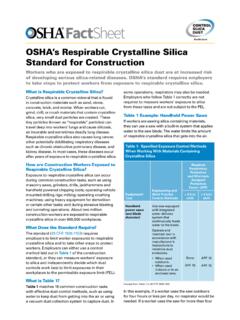
OSHA’s Respirable Crystalline Silica Standard for Construction
www.osha.govAlternative Exposure Control Methods Employers who do not fully implement the control methods on Table 1 must: • Determine the amount of silica that workers are exposed to if it is, or may reasonably be expected to be, at or above the action level of 25 μg/m3 (micrograms of silica per cubic meter of air), averaged over an 8-hour day;

www.osha
www.osha.govModel Exposure Control Plan POLICY The (Your facility name)is committed to providing a safe and healthful work environment for our entire staff. In pursuit of this goal, the following exposure control plan (ECP) is provided to eliminate or minimize occupational exposure to bloodborne pathogens in accordance with OSHA standard 29 CFR 1910.1030,

Exposure Control Plan for Bloodborne Pathogens
www.dir.ca.govOur exposure control plan is made available upon request, for examination and copying, to our employees, the Chief of Cal/OSHA, and NIOSH (or their respective designees) in accord with 8 CCR 3204, “Access to Employee Expo-sure and Medical Records.” Our organization’s written exposure control plan contains at least the following elements: